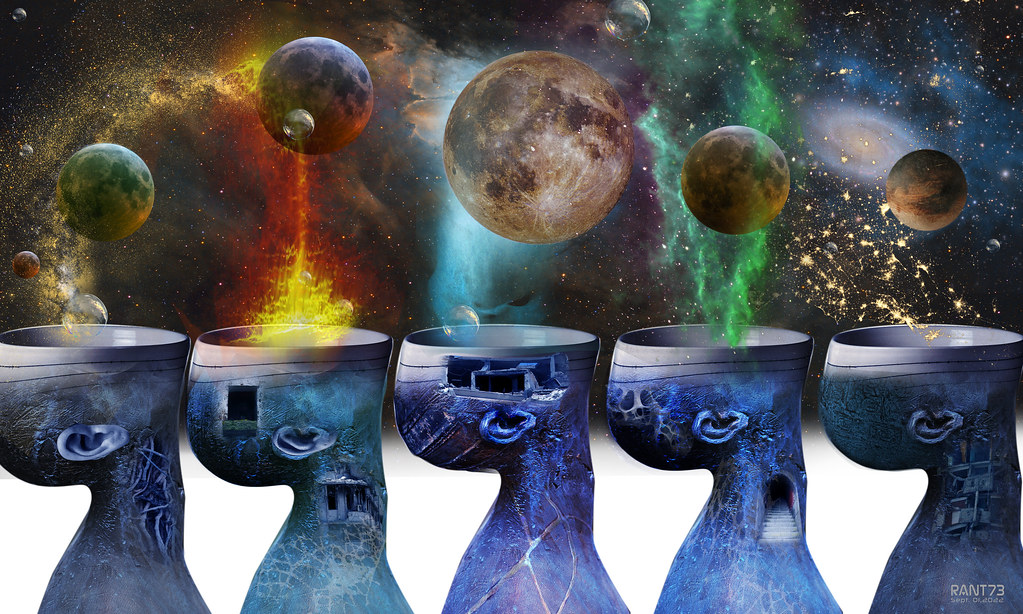

Imagine if every thought you’ve ever had, every feeling you’ve ever felt, and every choice you didn’t make still existed somewhere, like books on a shelf in a library outside of time. That’s the idea behind the Akashic Records, a concept that sounds like science fiction but has been taken seriously in spiritual and esoteric traditions for more than a century. Some people describe it as a field of information woven into the fabric of the universe itself, a kind of invisible archive where nothing is truly lost.
I remember the first time I heard about the Akashic Records, it honestly felt both thrilling and unsettling. The thrilling part was the notion that meaning and pattern might exist behind the chaos of life; the unsettling part was the thought that nothing is ever really “private” on a cosmic level. Whether you see it as a metaphor, a mystical reality, or an intriguing psychological tool, the idea of a cosmic library raises big questions about memory, destiny, and how much control we actually have over our lives.
Where Did The Idea Of The Akashic Records Come From?

The word “Akashic” comes from “akasha,” a Sanskrit term often translated as ether, space, or the subtle substance that underlies everything. In some ancient Indian philosophies, akasha was seen as one of the elemental building blocks of reality, the backdrop against which all events unfold. Long before anyone talked about a “record,” there was already this idea of a subtle, invisible medium that holds and transmits vibrations and impressions.
The more modern concept of the Akashic Records as a cosmic library emerged in the late nineteenth and early twentieth centuries, especially through Theosophy and Western esoteric circles. Writers and mystics began describing an energetic archive that could supposedly be accessed by trained seers or through deep trance states. Over time, the idea spread into New Age spirituality, where it was reframed less as a secret occult tool and more as something ordinary people might tap into for healing, insight, and life direction.
What Are The Akashic Records Supposed To Be, Exactly?

At its core, the Akashic Records are described as a complete energetic record of every soul’s journey: past, present, and even potential futures. Think of it like a cosmic hard drive that doesn’t just store events, but also the feelings, motives, and consequences wrapped around those events. The metaphor of a “library” is popular because it gives a familiar image, but many people who believe in it insist it’s less like dusty books and more like a living, interactive field of information.
Believers say that the Akashic Records don’t just hold individual lifetimes; they include the history of civilizations, collective traumas, and the evolution of consciousness itself. In that view, everything you do leaves an energetic footprint that becomes part of a larger story, almost like threads woven into a single massive tapestry. Some even claim that what psychics or mediums sense about someone’s past lives or patterns is them briefly “peeking” into this energetic archive. Whether literal or symbolic, the concept encourages people to see their life as part of something much bigger.
How Do People Claim To Access This Cosmic Library?

Descriptions of how to access the Akashic Records vary a lot, but most involve entering some altered state of awareness. Some people use structured prayers, invocations, or specific meditations designed to quiet everyday mental noise and focus intention. Others rely on breathwork, contemplative stillness, or guided visualizations where they imagine walking into a grand library or temple and “requesting” a file about their soul. The outer steps look simple, but the inner experience can feel very intense and personal.
Practitioners often say that the information doesn’t arrive as a clear voice booming from the sky; it shows up instead as images, metaphors, sudden insights, or emotional waves that need careful interpretation. There are people who offer paid Akashic Records readings, claiming they can tune into someone else’s record on their behalf, a bit like a librarian helping you find the right shelf. Of course, this opens up obvious questions about projection, suggestion, and ethics, since it’s hard to prove where the information is actually coming from. Still, for many who seek readings, the power lies less in proof and more in whether the experience feels accurate and helpful.
What Do People Use The Akashic Records For In Everyday Life?

For those who believe in them, the Akashic Records aren’t just a mystical curiosity; they’re a tool for making sense of modern life. People say they consult them to understand repeating relationship patterns, long‑standing emotional wounds, or unexplainable fears that seem to follow them like a shadow. The idea is that by seeing the “backstory” of the soul, you can soften self‑judgment and understand why you react the way you do, almost like finally reading the missing chapters of a book you’ve been stuck in.
Others use this framework to explore questions about purpose, career decisions, or big turning points, hoping to align more closely with what they see as their soul’s intention. I’ve talked to people who said an Akashic‑style session helped them stop treating their life as a series of random accidents and start seeing it as a learning process. Even if you strip away any belief in past lives or cosmic archives, there’s something powerful about sitting down and asking, in a very focused way, what your deeper patterns are trying to teach you. In that sense, the “records” can function like an inner therapist disguised as a mystical library.
Can Science Make Sense Of Something Like This?

From a strict scientific perspective, the Akashic Records are not recognized as a measurable reality. There’s no peer‑reviewed research showing a literal energetic database of all human experience floating out in space or woven into some detectable field. Neuroscience, psychology, and physics all have their own ways of explaining memory, intuition, and distant perception, and none of them require a cosmic library to make the math work. Skeptics often see the Akashic idea as a poetic metaphor at best or a spiritual marketing hook at worst.
That said, there are interesting parallels between this concept and some ideas in modern science, even if they don’t actually confirm anything mystical. Theories about information being fundamental to reality, discussions of nonlocal connections in quantum physics, and debates about whether the universe preserves all information have a strangely familiar ring. It’s easy to overreach and mash science and mysticism together, but it’s also fair to admit that we don’t have all the answers about consciousness or the nature of reality. For some people, the Akashic Records live in that in‑between space where science hasn’t fully gone yet and imagination is still allowed to roam.
Psychological And Symbolic Ways To Understand The Records

Even if you don’t believe in any literal cosmic archive, the Akashic Records can still work as a powerful metaphor for how our minds and cultures store experience. On a personal level, you could think of the “records” as the deep unconscious layers of memory, emotion, and inherited patterns that subtly shape your life. When someone does an Akashic‑style session, they may actually be creating a safe, ritualized space to access their own intuition and long‑ignored feelings. The framework of a grand library can make that inner exploration feel less random and more meaningful.
On a collective level, the idea of shared records echoes how stories, histories, and beliefs are passed down through families and societies, almost like an invisible database of human experience. Carl Jung’s notion of a collective unconscious carries a similar sense of a shared inner landscape that individuals tap into without realizing it. Seeing your struggles as part of a wider human story can be oddly comforting, like realizing you’re not the only one reading a particular chapter. In that sense, the Akashic narrative can serve as a bridge between personal healing work and a broader sense of connection.
Ethical Questions, Risks, And Red Flags

Whenever people claim to access hidden information about your soul, past lives, or destiny, there’s a real risk of misuse. If you fully trust someone else’s interpretation of your “records,” you might hand over your power without noticing, letting their words override your own judgment. I’ve seen people walk away from jobs, relationships, and even medical treatments mainly because a reader told them it was “in their records,” and that can slide into dangerous territory. Any system that seems to offer absolute answers can become a crutch rather than a guide.
There’s also the risk of spiritual bypassing, where people use mystical explanations to avoid facing real‑world issues like trauma, mental health, or difficult conversations. If everything is written in some cosmic file, it can be tempting to downplay responsibility or excuse hurtful behavior as “soul contracts.” Healthy use of any spiritual framework, Akashic or otherwise, usually means combining it with common sense, critical thinking, and, when needed, professional support. A useful rule of thumb is that any reading or practice should leave you feeling more free, not more trapped or dependent.
So Are The Akashic Records Real, Or Just A Beautiful Story?

In the end, the question of whether the Akashic Records are literally real often comes down to how you define “real.” For some, they are as concrete as gravity, a subtle field of information that explains everything strange and synchronistic that has ever happened. For others, they’re an elegant symbol for the depths of the psyche and the way human experiences echo across generations. There’s also a middle ground, where people say they simply don’t know, but find the framework helpful enough to keep exploring.
Personally, I don’t feel a need to resolve the mystery completely, and I’ve found that the usefulness of the concept matters more than the label we stick on it. If thinking in terms of a cosmic library helps you act with more compassion, curiosity, and responsibility, then it’s serving a real role in your life, whether or not it exists as an actual archive. And if it doesn’t resonate with you at all, there are plenty of other paths to meaning, healing, and self‑understanding. Maybe the more interesting question isn’t whether the Akashic Records are out there, but what kind of story about your life you choose to write from here.