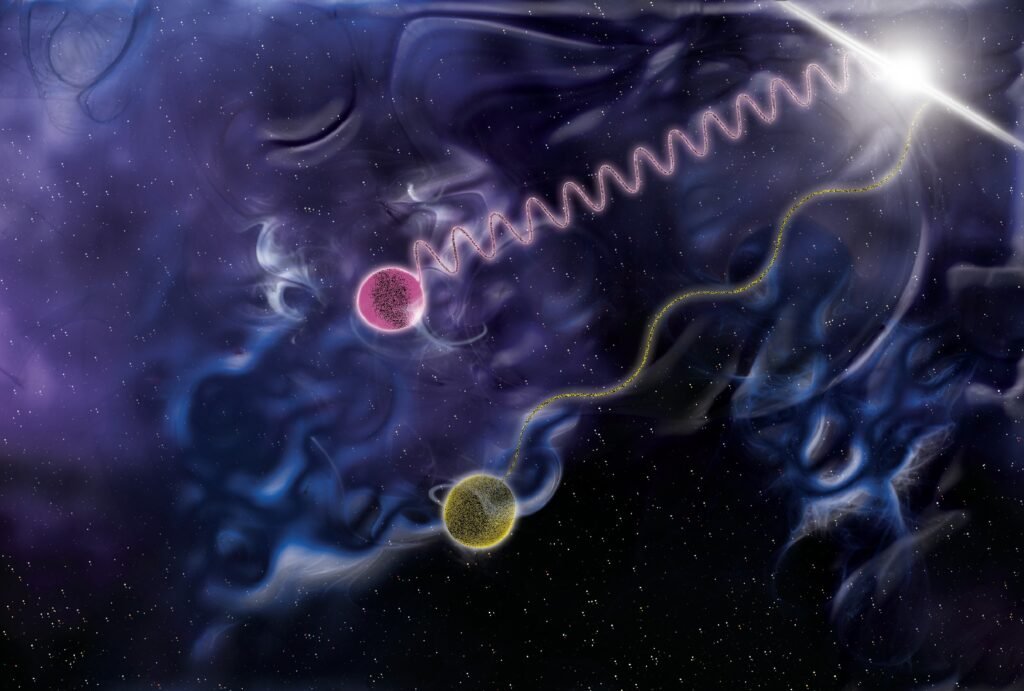
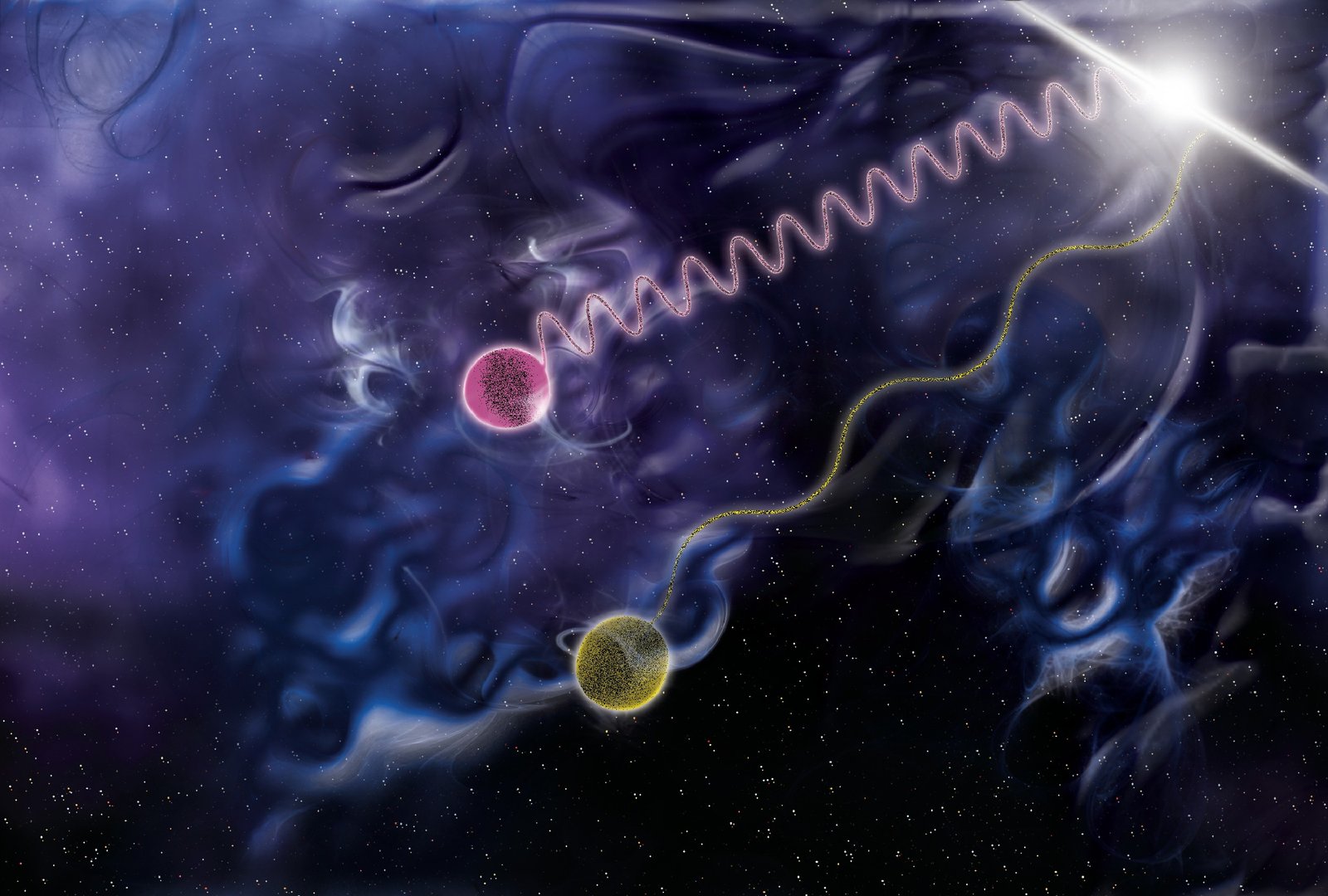
A Long-Standing Puzzle in Physics (Image Credits: Upload.wikimedia.org)
Vienna – Researchers at TU Wien have developed a quantum reinterpretation of particle trajectories in spacetime, potentially reshaping how scientists view the intersection of quantum mechanics and general relativity.
A Long-Standing Puzzle in Physics
Efforts to merge quantum mechanics with Einstein’s theory of general relativity have puzzled physicists for decades. Quantum mechanics excels at describing the subatomic world, while relativity governs massive cosmic structures like stars and galaxies. The two frameworks clash in extreme conditions, such as black holes or the universe’s origin.
Traditional relativity posits that particles follow precise curves called geodesics through spacetime warped by gravity. These paths represent the shortest distances in curved geometry. Yet quantum effects introduce uncertainty, suggesting particles might not adhere strictly to these classical routes.
Unveiling the Q-Desic Equation
The TU Wien team introduced the q-desic equation, a quantum analog to geodesics. This formulation accounts for spacetime’s quantum fluctuations. Particles navigating such a landscape could exhibit subtle deviations from Einstein’s predictions.
By adapting geodesic principles to quantum principles, researchers created a mathematical tool that aligns particle motion with probabilistic quantum behavior. The equation emerged from rigorous analysis of curved spacetime infused with quantum properties. Early models indicate these deviations remain minor but significant for precision tests.
Key Deviations and Their Mechanisms
In classical relativity, a particle’s path remains deterministic amid gravity’s curve. Quantum spacetime, however, vibrates with inherent uncertainty. The q-desic equation predicts particles will occasionally stray, influenced by these microscopic ripples.
Such shifts challenge experiments probing gravity at quantum scales. Researchers anticipate applications in particle accelerators or astrophysical observations. The deviations grow pronounced near intense gravitational fields.
Pathways to Quantum Gravity
This work advances quests for a unified theory encompassing all forces. String theory and loop quantum gravity have vied for this role, but the q-desic approach offers a targeted refinement. It builds directly on relativity’s strengths while injecting quantum realism.
Future validations could involve collider data or gravitational wave detectors. The equation provides testable predictions distinct from classical outcomes. Collaboration across institutions may accelerate these verifications.
Common challenges in unifying quantum mechanics and gravity include:
- Incompatible mathematical frameworks: quantum probabilities versus relativistic determinism.
- Scale mismatches: quantum effects dominate the tiny, gravity the massive.
- Renormalization issues: infinities arise when merging equations.
- Experimental gaps: no direct tests in regimes where both theories apply fully.
- Conceptual hurdles: time’s role differs between the theories.
Key Takeaways
- The q-desic equation reimagines geodesics for quantum spacetime.
- Particles may show slight deviations from classical paths.
- This step edges closer to reconciling quantum mechanics and gravity.
This breakthrough at TU Wien signals progress in one of physics’ toughest riddles, hinting that Einstein’s elegant paths might bend under quantum scrutiny. As research unfolds, it promises deeper insights into the universe’s fabric. What implications do you see for future discoveries? Share your thoughts in the comments.