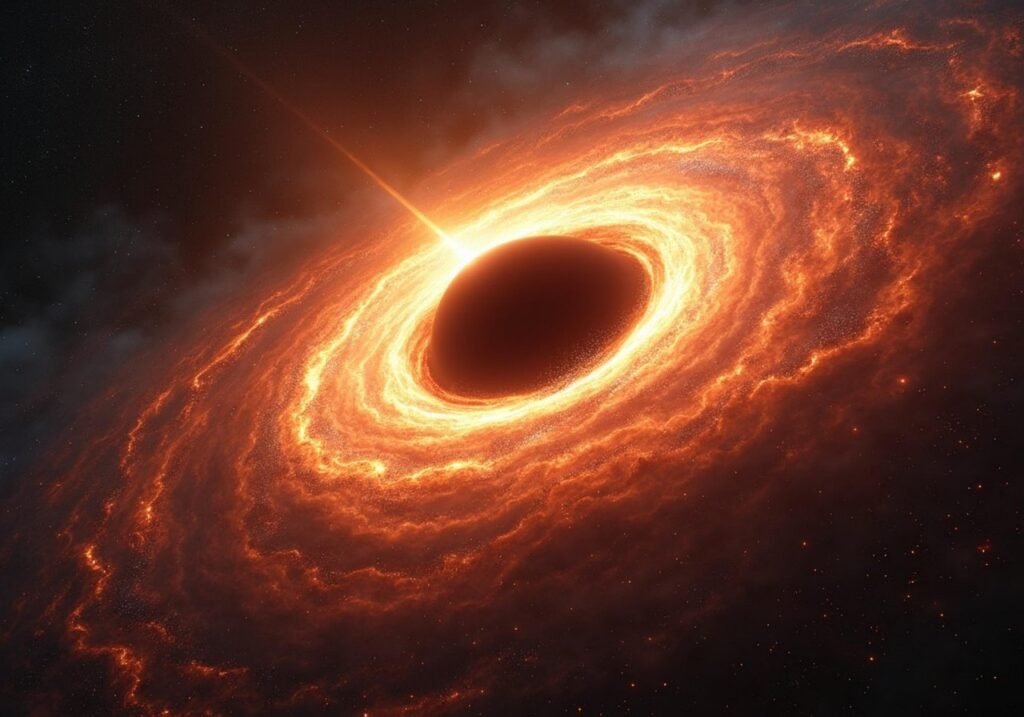
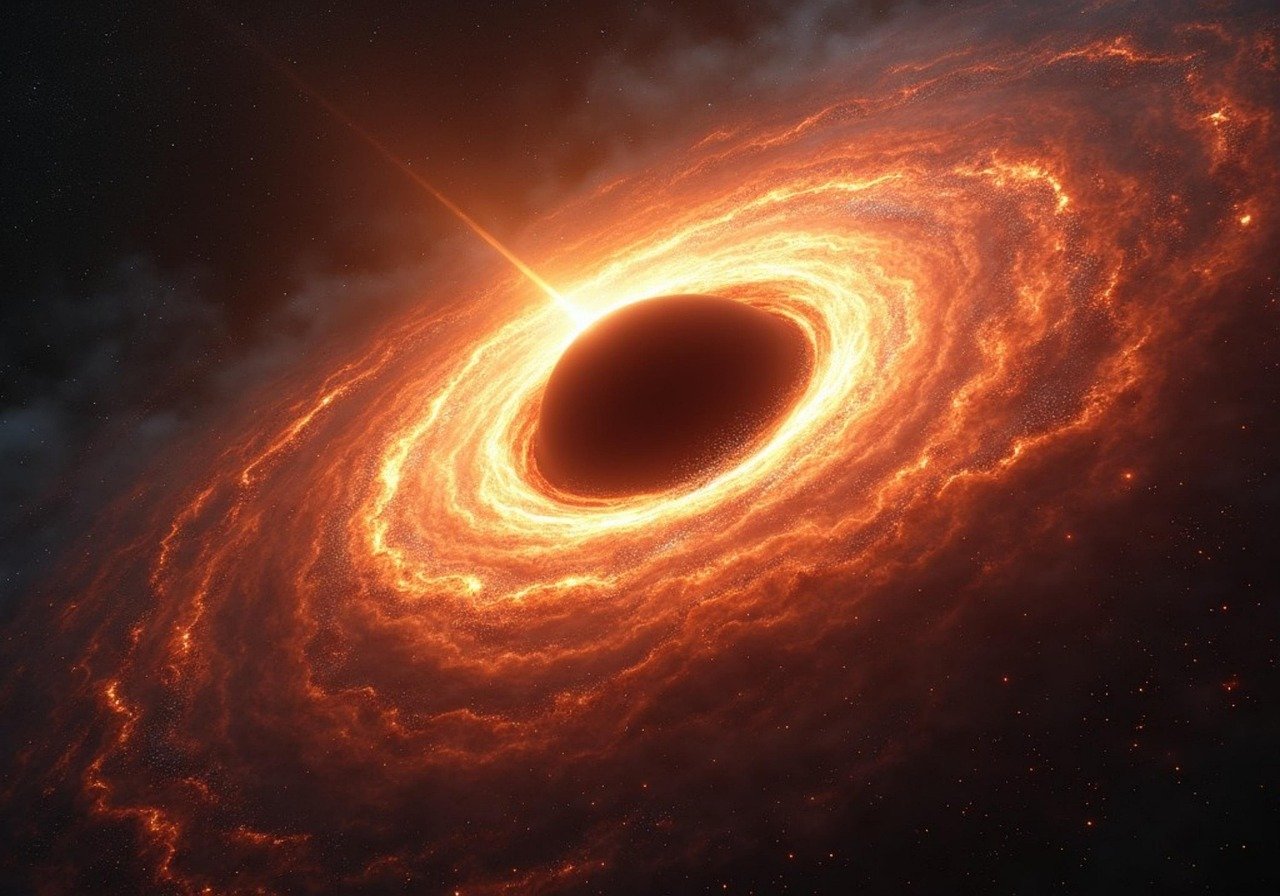
A Puzzling Signal from 2019 (Image Credits: Pixabay)
Berlin, Germany – European scientists are scrutinizing gravitational wave detections to determine if some apparent black hole mergers actually stem from compact dark matter structures known as boson stars.[1][2]
A Puzzling Signal from 2019
The gravitational wave event GW190521, detected in 2019, initially appeared as the collision of two black holes each tens of times the Sun’s mass.[1] Detectors in the LIGO-Virgo-KAGRA network captured the ripples in space-time, marking one of the most massive mergers observed at the time. Yet recent analysis suggests this signal aligns slightly better with a boson star merger than a standard black hole union.
Physicist Carlos Herdeiro of the University of Aveiro in Portugal noted that such patterns could reveal exotic alternatives. The event’s peculiarities have prompted researchers to revisit over 150 cataloged black hole mergers since 2015, including candidates from the O4 observing run that spanned May 2023 to November 2025.[2]
Unpacking Boson Stars
Boson stars consist of ultralight dark matter particles, such as axions, which are trillions of times lighter than an electron. These hypothetical objects pack Sun-like masses into planet-sized volumes, mimicking black holes from afar but lacking an event horizon. Instead of a sharp boundary, they present a fuzzy exterior dense with dark matter.
Unlike black holes, which trap everything beyond their point of no return, boson stars allow subtle differences in gravitational wave signatures during mergers. Nico Sanchis-Gual of the University of Valencia described the concept as extreme yet compelling. Simulations show these stars could collide much like stellar-mass black holes, producing detectable waves across billions of light-years.[3]
The NewFunFiCO Initiative
The EU-funded NewFunFiCO project, running from 2023 to 2026 under the Marie Skłodowska-Curie Actions, coordinates this effort. Herdeiro leads the team, which spans Portugal, Spain, Italy, Germany, Mexico, Brazil, and China. Researchers compare real LIGO-Virgo-KAGRA data against theoretical waveforms to spot deviations from black hole norms.
The collaboration fosters international exchange, blending astrophysics with particle physics. About 250 O4 candidates await scrutiny, offering a prime opportunity to hunt for new physics. Advances in detector technology, like laser interferometry, not only aid this work but also benefit fields such as medical imaging and precision manufacturing.[1]
Exotic Alternatives on the Table
Boson stars represent one possibility, but the team examines others that challenge conventional views.
- Mixed stars: Neutron stars with dark matter cores, blending ordinary remnants of exploded stars with invisible matter.
- Gravastars: Configurations that replicate black hole exteriors but harbor different internal structures, again without event horizons.
| Feature | Black Hole | Boson Star/Gravastar |
|---|---|---|
| Event Horizon | Present | Absent |
| Composition | Gravitational singularity | Dark matter particles |
| Edge Appearance | Sharp boundary | Fuzzy |
Each imprints unique waveforms, enabling potential identification amid the data surge.[2]
Key Takeaways
- Boson stars could explain ambiguous signals like GW190521.
- NewFunFiCO targets dark matter clues through waveform analysis.
- Confirmation would redefine cosmic structures and invisible matter.
Discovering even one such object promises to illuminate dark matter’s role, which outweighs visible matter yet eludes direct detection. This pursuit not only tests gravity’s limits but also hints at unseen cosmic architecture. What signals might future runs uncover? Share your thoughts in the comments.