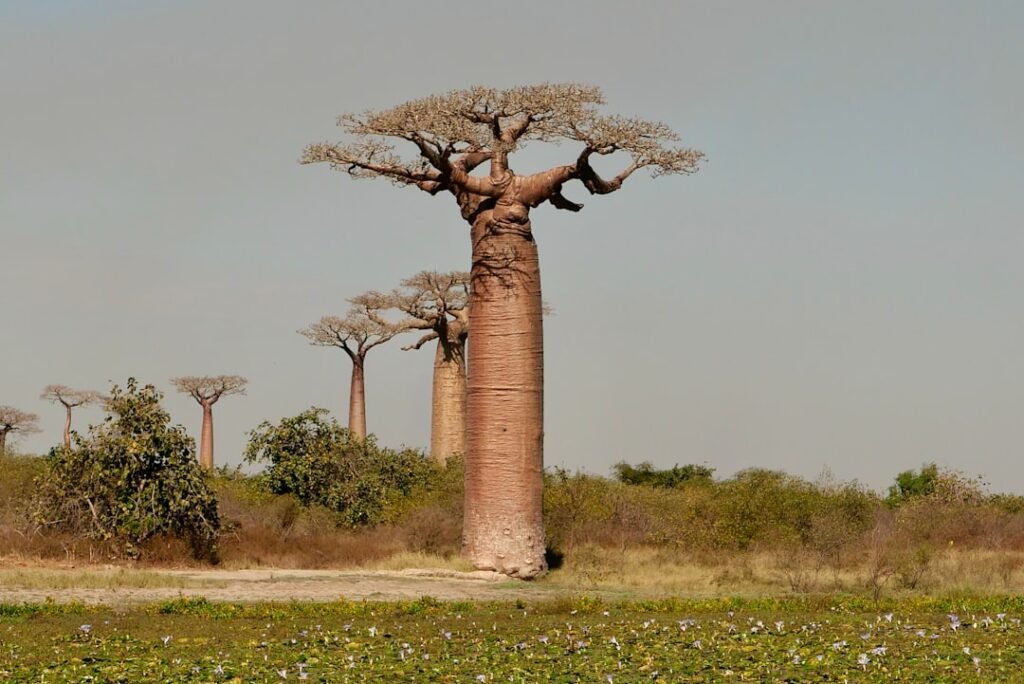
Landmark Survey Reveals Unprecedented Tree Deaths (Image Credits: Unsplash)
Oman – A beetle infamous for devastating mango orchards in Asia has claimed its first known victims among adult baobab trees, prompting urgent warnings about potential spread to the African mainland.[1][2]
Landmark Survey Reveals Unprecedented Tree Deaths
Researchers documented the first cases of an insect killing mature baobab trees during a survey in Oman’s Dhofar Mountains. Sarah Venter, a baobab ecologist at the University of the Witwatersrand, collaborated with Omani scientists Ali Salem Musallm Akaak and Mohammed Mubarak Suhail Akaak to examine 91 trees in the Wadi Hinna valley. They found that six trees, or about 4 percent of the population, had died from the infestation. An additional 12 trees, representing 13 percent, harbored larvae within their trunks.[2][1]
The first collapse occurred in 2021, when an adult baobab fell after larvae tunneled through its core. Venter noted the severity of the threat: “The mango stem borer is different; it produces many hundreds of larvae which spend months eating the wood of the baobab tree until it finally falls over under its own weight and dies.”[1] This marked a historic shift, as no insect had previously been recorded causing such mortality in these ancient giants.
How the Beetle Infests and Destroys Hosts
Batocera rufomaculata, a longhorn beetle native to Southeast Asia, targets trees with moist, nutrient-rich wood. Adult females slice slits into bark with their mandibles, lay up to 200 eggs, and seal them in. The larvae emerge and bore zigzag tunnels through living tissue, feeding for nearly a year and disrupting water flow.[3]
Baobabs’ water-storing trunks make ideal hosts, allowing hidden devastation until sudden failure. Adults live two to three months, feeding on shoots before reproducing, and can fly up to 14 kilometers nightly. The pest has long plagued mango, jackfruit, mulberry, and fig trees across Asia and the Middle East.
- Mango and jackfruit orchards suffer widespread losses.
- Fig plantations in the Middle East faced outbreaks since the 1950s.
- Frankincense trees in Oman declined in the 1990s from similar attacks.[1]
Baobabs’ Ancient Presence in Oman
Adansonia digitata reached Oman’s southeastern peninsula over 1,500 years ago through Indian Ocean trade routes. Nomadic fishers and merchants exchanged the trees alongside other valuables between Africa, the Persian Gulf, and South Asia. Today, roughly 100 baobabs persist in isolated Wadi Hinna, a semiarid valley.[3]
Local authorities have contained the outbreak with targeted measures suited to the small group. They deploy systemic pesticides adapted from mango protections, nighttime light traps, and manual larva extraction using wire hooks. These methods have curbed spread so far, though scaling them to vast African landscapes would prove challenging.
Urgent Biosecurity Push to Shield Africa
The beetle has appeared on islands like Madagascar, Réunion, and Mauritius, but mainland Africa remains unaffected. Venter stressed prevention: “We need to ensure biosecurity protocols for live plants at all ports of entry into Africa.” Travelers often unwittingly carry infested cuttings or wood, heightening risks via global trade.[1]
Experts advocate biological controls, such as parasitic mites and nematodes tested in Asia, alongside monitoring networks. Baobabs underpin ecosystems and livelihoods with over 300 uses, from food to fiber. Recent studies affirmed their resilience to climate stressors, underscoring this pest as a distinct peril.[3]
Authorities and researchers call for collaboration across borders to develop defenses before infestations take hold.
Key Takeaways
- Six baobab trees died and 12 were infested in Oman’s surveyed population.[2]
- The beetle spreads via trade in live plants and wood, absent from mainland Africa so far.
- Biosecurity and biological controls offer the best defense against outbreak.
Baobabs have endured millennia as symbols of endurance, but the mango stem-borer introduces a stealthy vulnerability demanding swift action. Vigilance at ports could preserve these keystone species for generations. What steps should African nations take to protect their baobabs? Share your thoughts in the comments.