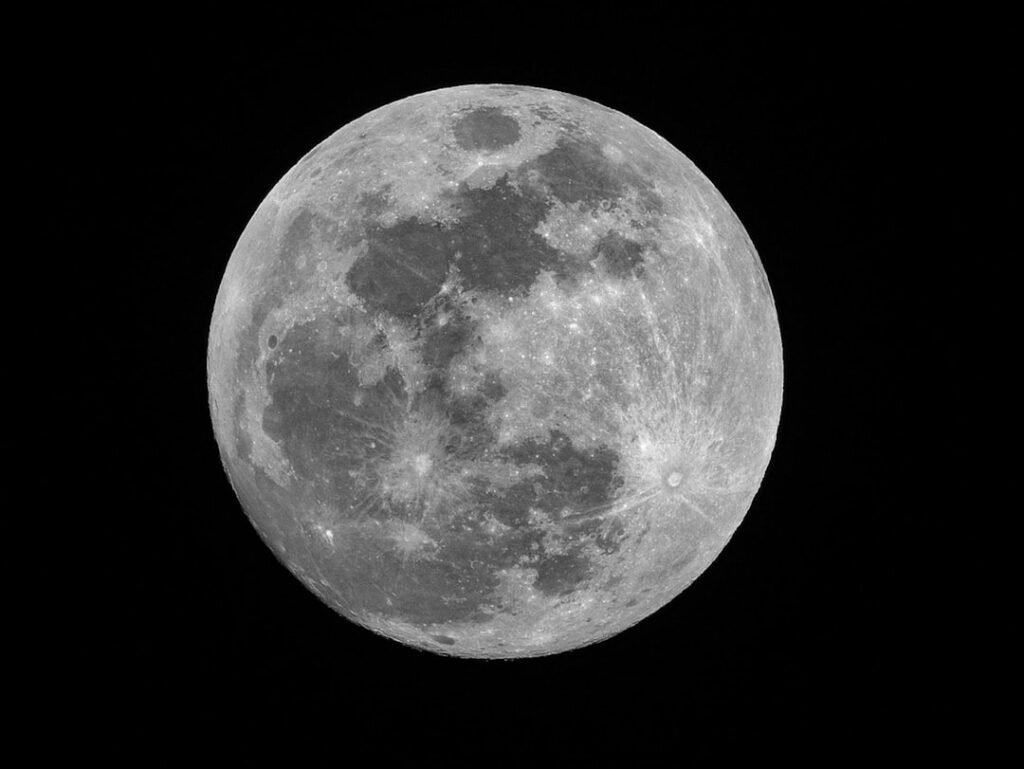

A Dynamic Moon Challenges Old Assumptions (Image Credits: Unsplash)
Researchers from the Smithsonian Institution released the first comprehensive map of subtle ridges across the moon’s vast basaltic maria, offering fresh evidence that the lunar surface remains geologically restless.[1]
A Dynamic Moon Challenges Old Assumptions
Long viewed as a geologically inactive world, the moon surprised scientists with signs of recent crustal movement. The new study cataloged thousands of small mare ridges in the dark, flat volcanic plains on the near side. These features formed through compression, much like the more prominent lobate scarps scattered across the highlands.[1]
The map drew from high-resolution images captured by NASA’s Lunar Reconnaissance Orbiter. It identified 1,114 previously undocumented ridges, bringing the total to 2,634. Such widespread evidence points to ongoing global contraction of the moon’s interior.[1]
Deciphering the Ridges’ Youthful Origins
Analysis dated these mare ridges to an average age of 124 million years, strikingly young in geological terms. This timeline aligns closely with the 105-million-year average for lobate scarps. Both types stem from thrust faults where the lunar crust buckled under shrinking forces.[1]
Historical observations from Apollo missions had noted wrinkle ridges in regions like Oceanus Procellarum. The Smithsonian effort expanded this view into a complete global inventory. “Our detection of young, small ridges in the maria, and our discovery of their cause, completes a global picture of a dynamic, contracting moon,” stated Tom Watters, lead researcher.[1]
| Feature | Location | Average Age (Million Years) |
|---|---|---|
| Small Mare Ridges | Lunar Maria (Near Side) | 124 |
| Lobate Scarps | Lunar Highlands | 105 |
Implications for Lunar Seismicity and Exploration
These ridges may serve as sources for moonquakes, detected by Apollo seismometers decades ago. Recent activity raises concerns for surface stability at landing sites. Future missions must account for potential seismic hazards.[1]
Cole Nypaver, a co-author, emphasized the study’s relevance. “We are in a very exciting time for lunar science and exploration. Upcoming lunar exploration programs, such as Artemis, will provide a wealth of new information about our moon. A better understanding of lunar tectonics and seismic activity will directly benefit the safety and scientific success of those and future missions.”[1]
The research appeared in The Planetary Science Journal on December 24, 2025. For full details, see the published paper or the Smithsonian release.[1]
Unveiling the Moon’s Inner Workings
This mapping advances knowledge of the moon’s thermal evolution and seismic past. It integrates mare ridges with highland scarps for a unified model of lunar contraction. Scientists now anticipate deeper insights from upcoming landers and orbiters.[1]
- Comprehensive catalog: 2,634 ridges mapped globally.
- Data source: NASA’s LRO high-resolution imagery.
- Geologic process: Crustal compression from cooling interior.
- Risk factor: Potential moonquake epicenters.
- Mission impact: Enhanced safety protocols for Artemis.
Key Takeaways:
- The moon contracts actively, forming young faults across diverse terrains.
- Mare ridges average 124 million years old, signaling recent dynamism.
- Findings bolster preparations for human return to the lunar surface.
As lunar exploration accelerates, this discovery reframes the moon not as a relic, but as a world still subtly reshaping itself. What do you think about these signs of lunar vitality? Tell us in the comments.