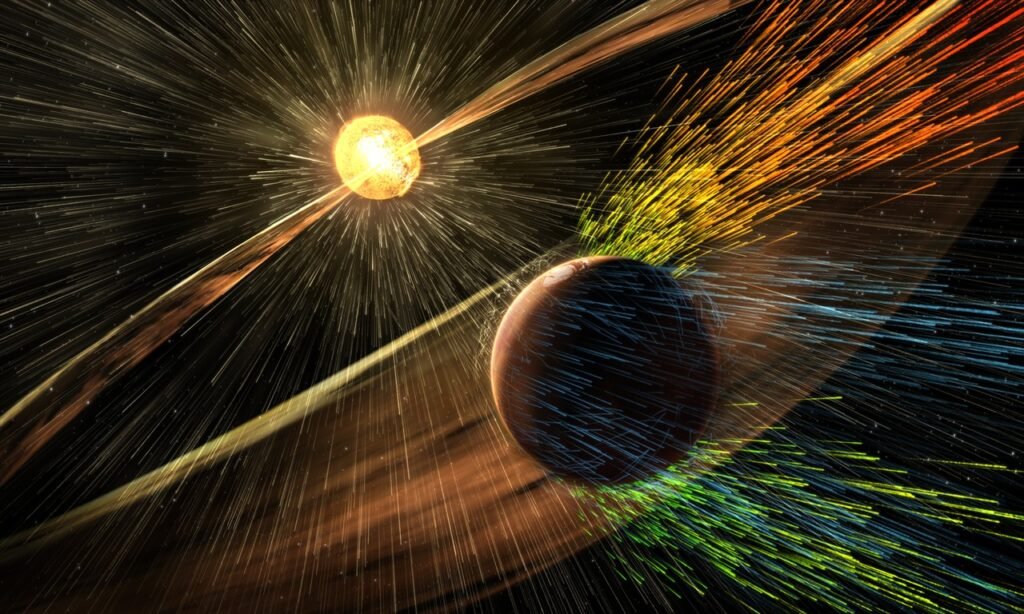
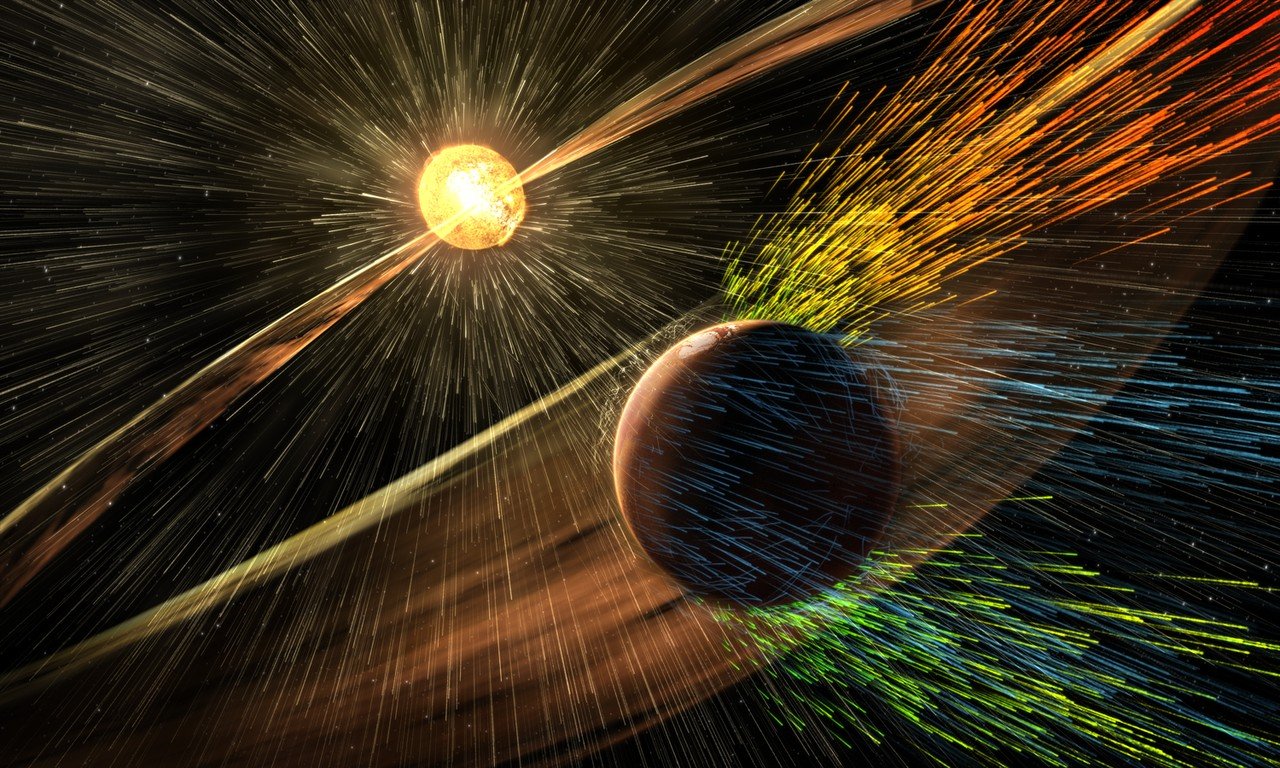
Biggest Atmospheric Shockwave Ever Detected (Image Credits: Cdn.mos.cms.futurecdn.net)
Mars endured a ferocious solar superstorm in May 2024, with ESA’s Mars Express and ExoMars Trace Gas Orbiter capturing its dramatic effects on the planet’s thin atmosphere.[1][2]
Biggest Atmospheric Shockwave Ever Detected
Researchers described the event as the most intense solar storm response observed at Mars to date. The superstorm flooded the upper atmosphere with electrons, swelling key ionospheric layers to record sizes. Electron densities surged by 278 percent in the lower layer around 109 kilometers altitude and 45 percent in the higher layer near 152 kilometers.[1][2]
This marked the highest electron counts ever measured in Mars’ lower ionosphere. Both layers also rose by 6.5 kilometers, while a new distinct layer appeared at 245 kilometers with a density of 9.6 x 10^9 electrons per cubic centimeter. The observations came just 10 minutes after an X3-class solar flare peaked, part of a barrage including high-energy particles and a coronal mass ejection.[2]
“The impact was remarkable: Mars’s upper atmosphere was flooded by electrons,” stated Jacob Parrott, lead author of the study and ESA Research Fellow. “It was the biggest response to a solar storm we’ve ever seen at Mars.”[1]
Pioneering Technique Unlocks Hidden Details
The spacecraft employed mutual radio occultation, a cutting-edge method where Mars Express beamed signals to the Trace Gas Orbiter as it dipped behind the planet. Atmospheric layers refracted the radio waves, revealing electron profiles through precise frequency analysis and inverse Abel transforms.[1][2]
Data processing involved fast Fourier transforms and Doppler corrections to isolate ionospheric effects. NASA’s MAVEN orbiter provided confirming in-situ measurements of soft X-ray fluxes, which tripled during the flare. Such spacecraft-to-spacecraft occultations occur only about twice weekly, making the timing fortuitous.[1]
“Currently we’re only performing two observations per week at Mars, so the timing was extremely lucky,” Parrott noted. Colin Wilson, ESA project scientist for both missions, highlighted the technique’s novelty at Mars, building on decades of planetary use but newly adapted between orbiters.[1]
Spacecraft Feel the Storm’s Fury
The onslaught triggered computer glitches on both orbiters, a common hazard from energetic particles. Radiation monitors on the Trace Gas Orbiter logged a dose equivalent to 200 normal days in merely 64 hours. Surface rovers like NASA’s Curiosity recorded specks in navigation camera images from incoming charged particles.[1][3]
Engineers designed the probes with radiation-hardened parts and auto-correction systems, enabling swift recovery. “The storm also caused computer errors for both orbiters – a typical peril of space weather,” Parrott explained. These incidents underscore vulnerabilities for future crewed missions.[1]
Lessons for Mars’ Past and Future
Solar storms like this deposit energy and particles that historically stripped away much of Mars’ atmosphere and water over billions of years. Electron-packed layers could now disrupt radio signals for radar mapping of the surface, complicating mission designs.[1]
Unlike Earth, protected by its magnetic field, Mars lacks such shielding, amplifying storm effects. The findings, detailed in a March 2026 Nature Communications paper, refine models of ionospheric responses and space weather forecasting across the solar system.[2]
- Electron density peaked at 5.32 x 10^{10} cm^{-3} in M1 layer (278% increase).
- M2 layer reached 1.27 x 10^{11} cm^{-3} (45% up), both altitudes elevated 6.5 km.
- TGO radiation: 200 days’ worth in 64 hours; orbiters glitched but recovered.
These rare observations advance our grasp of planetary space weather, vital for safeguarding explorers on the road to Mars. How might such storms shape humanity’s plans for the Red Planet? Share your thoughts in the comments.