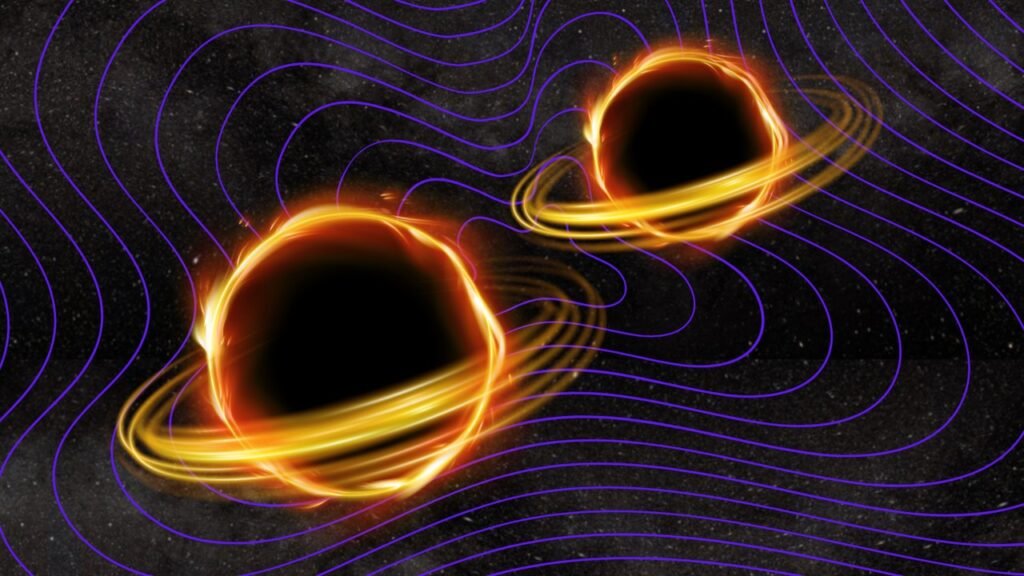
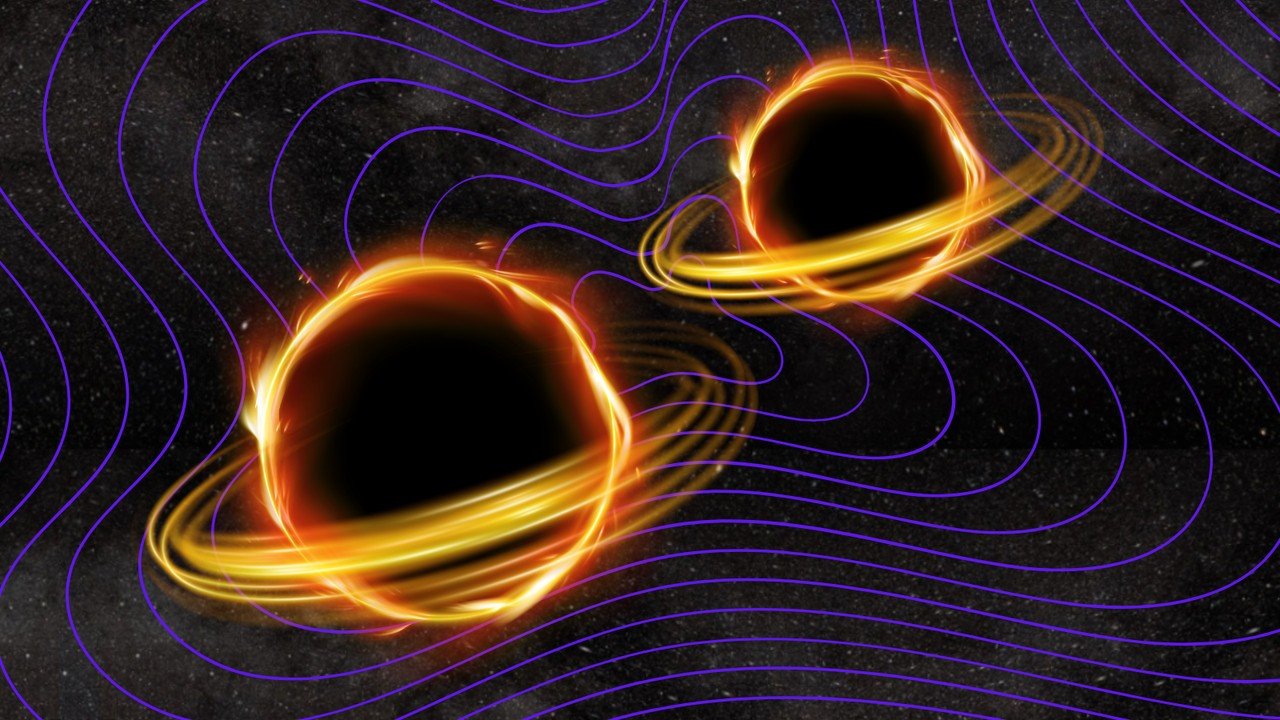
128 New Signals Reshape the Cosmic Landscape (Image Credits: Cdn.mos.cms.futurecdn.net)
The international LIGO-Virgo-KAGRA collaboration unveiled its latest gravitational-wave catalog, more than doubling the tally of detected spacetime distortions from violent cosmic collisions.[1][2]
128 New Signals Reshape the Cosmic Landscape
Researchers announced the release of GWTC-4, the Gravitational-Wave Transient Catalog version 4.0, which added 128 new candidates to the previous count of 90 from earlier runs. This expansion stemmed from the first phase of the fourth observing run, known as O4a, spanning May 2023 to January 2024. Detectors at LIGO’s sites in Hanford, Washington, and Livingston, Louisiana, primarily captured these signals during that nine-month period.[1]
The influx marked a pivotal moment in gravitational-wave astronomy. Most events involved binary black hole mergers, though two stood out as black hole-neutron star pairings. Such a haul highlighted the field’s rapid progress over the past decade, from initial detections to hundreds of observations.[3]
Heavyweights and Oddballs Dominate the Lineup
Among the highlights, GW231123_135430 emerged as the heaviest binary black hole merger yet recorded, featuring two black holes each around 130 times the sun’s mass. Another standout, GW231028_153006, showcased black holes spinning at about 40 percent the speed of light – likely remnants of prior mergers. GW231118_005626 revealed an unusually lopsided pair, with one black hole twice as massive as its partner.[1]
These extremes expanded the known range of black hole properties. Masses varied from a few solar masses to over 100, with spins ranging from negligible to rapid. The detections suggested that early-universe black holes might have spun faster than later ones, refining models of stellar evolution.[2]
- Heaviest pair: ~130 solar masses each (GW231123_135430)
- Highest-spin binary: ~40% speed of light (GW231028_153006)
- Most asymmetric: Mass ratio of 2:1 (GW231118_005626)
- Two black hole-neutron star events
- Primarily binary black holes (~30 solar masses average)
Sharper Detectors Unlock Distant Echoes
Upgrades to LIGO’s interferometers boosted sensitivity dramatically. The instruments now detect binary neutron star signals up to 360 megaparsecs – roughly a billion light-years – away, while black hole binaries appear from even greater distances. Advanced analysis techniques further enhanced the search for faint ripples.[1]
Nergis Mavalvala, dean of MIT’s School of Science, noted, “The beautiful science that we are able to do with this catalog is enabled by significant improvements in the sensitivity of the gravitational-wave detectors as well as more powerful analysis techniques.” These advances allowed scientists to probe uncharted parameter space, revealing more massive and unusual objects.[1]
Insights into Black Holes and Beyond
The catalog offered fresh tests of general relativity. Signals like GW230814_230901, one of the loudest, passed most checks despite surrounding noise challenges. Researchers also refined the Hubble constant to 76 kilometers per second per megaparsec, aiding measurements of cosmic expansion.[3]
Stephen Fairhurst of Cardiff University observed, “These observations enable us to better understand how black holes form from the collapse of massive stars, probe the cosmological evolution of the universe and provide increasingly rigorous confirmations of the theory of general relativity.” Future runs promise even sharper precision and potential new physics signatures.
| Event Type | Key Examples | Distance Range |
|---|---|---|
| Binary Black Holes | GW231123_135430, GW231028_153006 | Tens of billions of light-years possible |
| Black Hole-Neutron Star | Two new detections | Up to 1 billion light-years |
Key Takeaways:
- GWTC-4 more than doubles the catalog to over 200 events.
- Reveals heaviest, fastest-spinning black holes observed.
- Advances tests of Einstein’s theory and cosmic expansion rate.
This catalog cements gravitational waves as a cornerstone of modern astronomy, unveiling the universe’s most violent dramas. As detectors grow keener, the symphony of spacetime ripples will only grow richer – what mysteries await in the next run? Share your thoughts in the comments.