Main Sequence to Advanced Burning (Image Credits: Unsplash)
Massive stars, dozens of times the Sun’s heft, churn through escalating nuclear reactions in their cores until gravity overwhelms fusion, triggering a core-collapse supernova.
Main Sequence to Advanced Burning
These behemoths spend their early lives on the main sequence, where intense pressure and heat fuse hydrogen into helium in the core.[1][2]
Once hydrogen depletes, the core contracts and heats, igniting helium fusion that produces carbon and oxygen. This phase lasts about a million years for stars around 20 solar masses. Subsequent stages accelerate dramatically. Carbon burning follows, enduring roughly 1,000 years and yielding neon and sodium.[2]
Neon burning generates oxygen and magnesium, while oxygen burning creates silicon and sulfur. Silicon burning, the penultimate step, forges iron-peak elements in mere days. Each transition shortens as fusion efficiency rises with atomic number.[1]
The Layered Inferno Within
By late stages, the star resembles an onion, with concentric shells of fusing elements around an inert core. Hydrogen burns outermost, encasing helium, carbon-oxygen, neon, silicon, and finally iron layers.[1]
This structure arises from shell burning: as inner cores exhaust fuel, surrounding shells ignite sequentially. The iron core grows to about 1.4 solar masses, nearing the Chandrasekhar limit where electron degeneracy pressure falters.[3]
- Hydrogen shell: Fuses to helium.
- Helium shell: Produces carbon and oxygen.
- Carbon shell: Yields neon and magnesium.
- Neon/oxygen shells: Form silicon and sulfur.
- Silicon shell: Builds iron-group elements.
- Iron core: No further exothermic fusion.
Iron’s Deadly Threshold
Iron fusion marks the endgame because it consumes rather than releases energy. Photons break iron nuclei apart more easily than they fuse, cooling the core rapidly.[1]
Without thermal pressure to counter gravity, the core destabilizes. In seconds, it implodes at a fraction of light speed, photodisintegrating heavier nuclei back to helium and freeing neutrons via electron capture.[2]
From Implosion to Stellar Detonation
The collapsing core rebounds at nuclear densities, launching a shock wave outward. Neutrinos, flooding from neutronization, deposit heat to revive the stalled shock.[1]
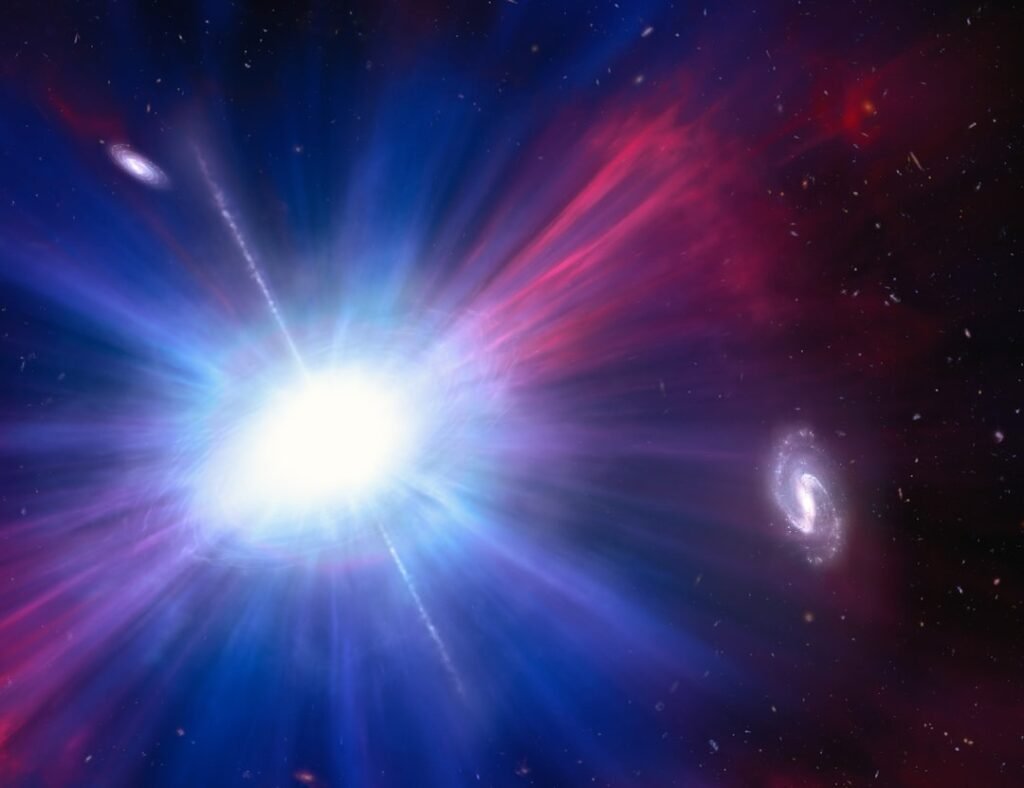
This blast rips through shells, synthesizing elements beyond iron before ejecting them at high speeds. The star’s outer layers explode, briefly outshining its galaxy and seeding the cosmos with heavy elements. A neutron star or black hole remains.[4]
Key Takeaways
- Massive stars fuse elements up to iron in shrinking timeframes, from millions of years for helium to days for silicon.
- The onion-like layers reflect sequential shell burning around a doomed iron core.
- Core collapse unleashes neutrinos and a shock wave, powering the Type II supernova.
Supernovae from these giants not only dazzle but forge the universe’s building blocks, from gold to uranium. What aspect of a star’s fiery end captivates you most? Tell us in the comments.