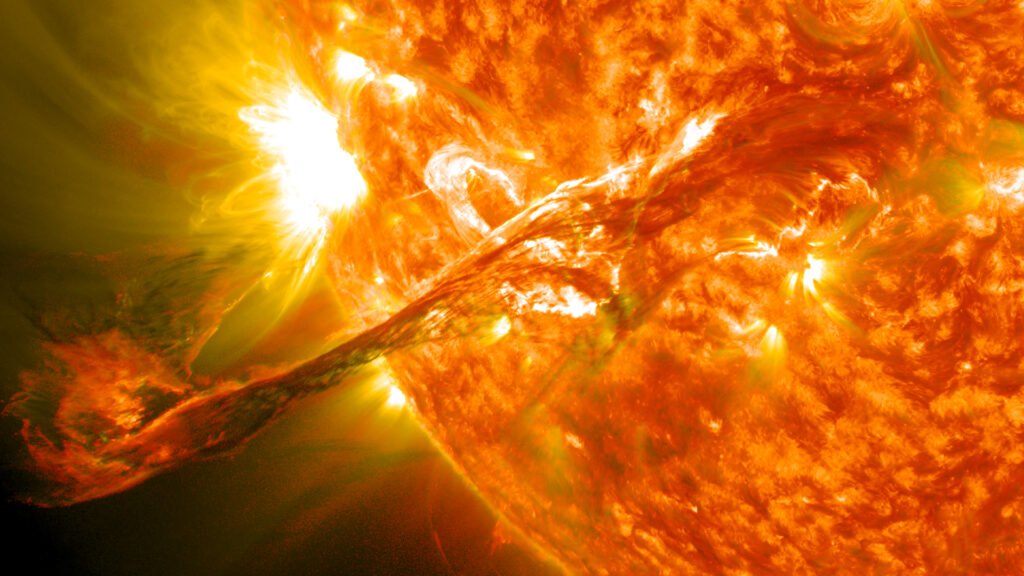

A Blinding Burst from the Sun’s Surface (Image Credits: Upload.wikimedia.org)
The Sun unleashed its most intense solar event of the year so far, sending a colossal plume of charged particles racing toward our planet.
A Blinding Burst from the Sun’s Surface
Sunspot region AR4341 erupted with an X1.95-class solar flare on January 18, 2026, marking the strongest outburst since the solar cycle peaked last year. This powerful explosion released a torrent of X-ray and ultraviolet radiation, briefly disrupting radio communications across parts of the globe. Observatories like NASA’s Solar Dynamics Observatory captured the event in vivid detail, showing the flare’s brilliant flash lighting up the solar atmosphere.
Experts at the Space Weather Prediction Center noted that such flares occur when magnetic fields in the Sun’s corona twist and snap, propelling energy outward at speeds exceeding a million kilometers per hour. While the flare itself posed no direct threat to Earth, its timing raised immediate concerns about follow-on effects. Initial scans revealed material lifting off the Sun’s surface, hinting at a larger ejection to come. By late afternoon, confirmation arrived: a partial halo coronal mass ejection had joined the fray.
The Oncoming Storm: CME’s Path to Impact
This coronal mass ejection, or CME, blasted away from the Sun at over 600 kilometers per second, carving a path straight toward Earth. Models from NOAA and NASA projected arrival as early as January 20, potentially within the next 24 hours from the flare’s onset. The ejection’s full halo appearance suggested a broad sweep, with a significant portion aimed at our planet’s magnetic field.
Upon impact, the CME could compress Earth’s magnetosphere, triggering geomagnetic storms rated up to G3 on the five-point scale. Such disturbances often enhance auroral displays, pushing the northern lights southward into mid-latitudes. However, they also carry risks for satellites, power grids, and high-frequency radio signals. Aviation authorities already issued advisories for polar routes, where radiation levels might spike.
Understanding the Mechanics of Solar Fury
Solar flares and CMEs stem from the same turbulent processes deep within the Sun’s convective zone, where plasma churns like boiling water. When sunspots – cooler, magnetically complex regions – align unfavorably, they store immense energy until release. The X-class designation indicates peak intensity, with this event clocking in at X1.95, just shy of the cycle’s record holders from 2024 and 2025.
Historical precedents abound: similar ejections in recent years sparked widespread blackouts and satellite glitches, underscoring the Sun’s reach into modern life. Scientists track these via a network of satellites, including GOES and STEREO, which provide real-time data on flare strength and ejection trajectories. For this instance, early imagery from STEREO-A confirmed the CME’s Earth-directed component, prompting heightened vigilance.
Potential Ripples Across Technology and Skies
Beyond the spectacle, the incoming CME holds practical implications for global infrastructure. Power operators in vulnerable regions prepared contingency plans, recalling the 1989 Quebec blackout from a comparable event. GPS signals could waver, affecting navigation for ships and aircraft, while astronauts aboard the International Space Station monitored radiation forecasts closely.
On a brighter note, skywatchers in northern climes geared up for possible aurora borealis shows extending to the U.S. Midwest and Europe. Social media buzzed with anticipation, as posts on platforms like X highlighted the event’s rarity early in the year. Still, officials urged caution, emphasizing that while thrilling, these solar tantrums demand respect.
- Monitor official alerts from NOAA’s Space Weather Prediction Center for updates.
- Prepare backup power for critical systems if in a high-risk area.
- Check aurora forecasts via apps from space agencies for viewing opportunities.
- Avoid non-essential high-altitude flights during peak storm hours.
- Stay informed through reliable sources like EarthSky or SpaceWeatherLive.
Key Takeaways
- The X1.95 flare from AR4341 on January 18 signals rising solar activity in 2026.
- Expected CME impact on January 20 could yield G3 geomagnetic storms and vivid auroras.
- Global tech sectors remain on watch, balancing risks with the event’s natural wonder.
As the Sun reminds us of its dynamic power, this episode highlights the delicate interplay between our star and daily life. What auroral displays have you witnessed from past solar events? Share your stories in the comments.