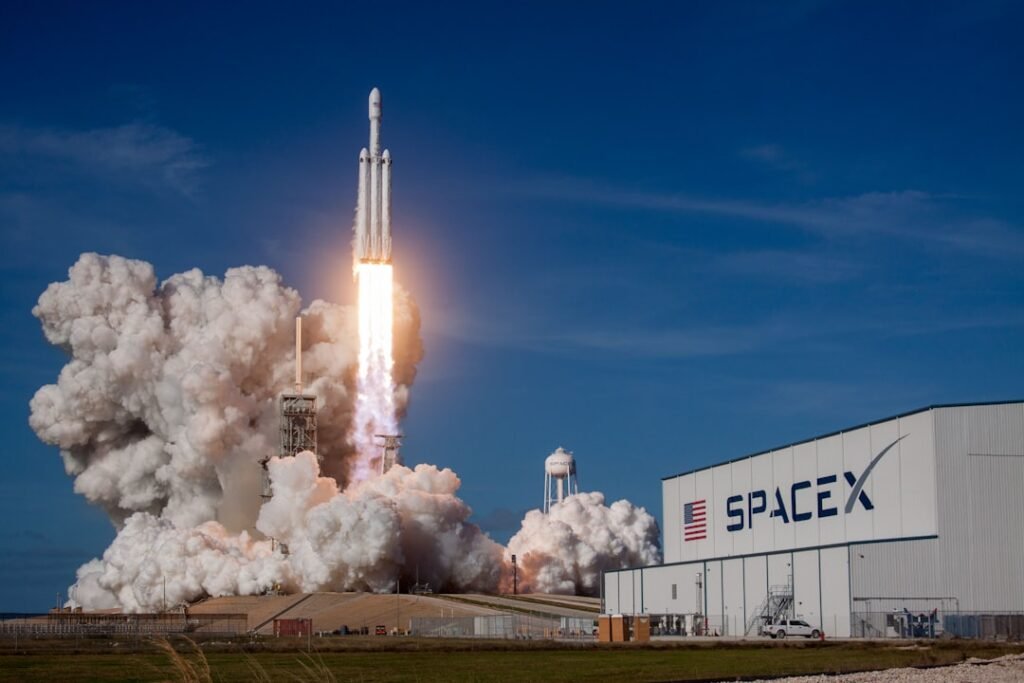

A Milestone Liftoff Under the Stars (Image Credits: Unsplash)
Vandenberg Space Force Base, California – A Falcon 9 rocket pierced the night sky on January 16, carrying a classified payload of U.S. spy satellites into orbit as SpaceX initiated its national security missions for the year.
A Milestone Liftoff Under the Stars
The mission, designated NROL-105, represented SpaceX’s inaugural collaboration with U.S. defense entities in 2026, underscoring the company’s growing prominence in sensitive space operations.
Viewers worldwide tuned in for the live broadcast, which captured the rocket’s ascent from the coastal base. The launch occurred shortly after 10 p.m. local time, with the first stage booster separating cleanly and returning to a droneship at sea. This precision landing highlighted SpaceX’s reusable technology, now a staple in such high-stakes endeavors.
Details about the satellites remained closely guarded, typical for National Reconnaissance Office payloads. Yet the event signaled continued investment in orbital surveillance capabilities amid evolving global threats.
The Strategic Edge of Orbital Intelligence
NROL-105 formed part of a broader effort to expand America’s constellation of reconnaissance assets, enhancing real-time monitoring from space.
These satellites, once deployed, would contribute to a proliferated architecture designed for resilience against potential disruptions. Unlike larger, singular spacecraft, this approach distributes intelligence-gathering across multiple smaller units. The U.S. Space Force oversees such integrations, ensuring seamless data flow to ground stations.
Experts note that proliferated systems offer advantages in coverage and redundancy. For instance, they can provide persistent observation over key regions, from conflict zones to maritime routes. This mission’s success bolstered confidence in the network’s expansion throughout the year.
SpaceX’s Evolving Partnership with Defense
SpaceX has solidified its position as a key player in national security launches, with this event marking the company’s 12th mission for the National Reconnaissance Office in recent years.
The Falcon 9’s reliability stems from iterative improvements in design and operations. Over 600 launches to date, the vehicle has demonstrated a track record that rivals traditional aerospace contractors. This reliability allows for more frequent and cost-effective deployments.
Government contracts like these not only fund SpaceX’s ambitions but also accelerate innovations applicable to commercial ventures. Meanwhile, the company balances these classified tasks with its Starlink constellation and crewed missions.
Global Context and Future Horizons
The launch drew international attention, especially as other nations ramp up their space programs. Reports indicate China’s plans for a massive satellite fleet, prompting discussions on orbital competition and security.
In response, the U.S. emphasizes alliances and technological superiority. Missions such as NROL-105 ensure that intelligence advantages remain robust. Upcoming launches will likely build on this foundation, incorporating advanced sensors and AI-driven analytics.
Challenges persist, including space debris management and international regulations. Still, the seamless execution here affirmed the viability of public-private partnerships in space defense.
- The NROL-105 payload consisted of small reconnaissance satellites for enhanced global surveillance.
- SpaceX’s Falcon 9 achieved a successful booster recovery, promoting sustainability in launches.
- This mission highlighted the shift toward proliferated satellite networks for greater operational resilience.
- Live streams engaged thousands, demystifying classified space activities to some extent.
- Future missions in 2026 will likely expand this intelligence architecture further.
Key Takeaways
- SpaceX’s launch advanced U.S. national security through cutting-edge satellite deployment.
- Proliferated systems improve surveillance reliability in an era of geopolitical tensions.
- Reusable rocket technology continues to lower barriers for frequent space access.
As space becomes a contested domain, events like this launch remind us of the delicate balance between innovation and security. What implications do you see for international relations in the coming years? Share your thoughts in the comments.