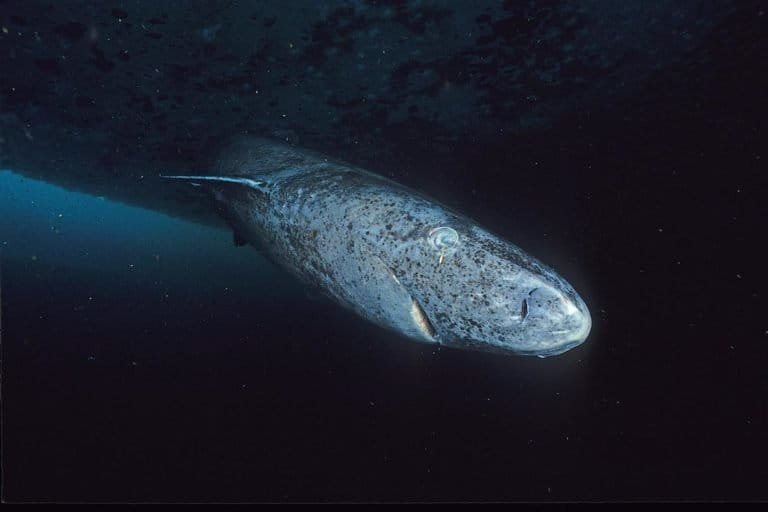

Challenging Long-Held Assumptions (Image Credits: Imgs.mongabay.com)
Deep in the icy waters of the North Atlantic and Arctic Oceans, Greenland sharks glide through perpetual twilight, their ancient bodies challenging everything scientists thought they knew about aging and sight.
Challenging Long-Held Assumptions
Researchers long assumed that Greenland sharks, the longest-living vertebrates on Earth, suffered from near-total blindness. These massive creatures, which can exceed 20 feet in length and weigh over a ton, inhabit light-scarce environments where parasites often cloud their eyes. Yet a recent study revealed that even sharks estimated at 200 years old possess fully functional vision, adapted for the dimmest conditions.
The discovery came from an international team including scientists from the University of California, Irvine, and the University of Basel. They examined eye tissues from captured specimens and analyzed genetic material. What they found overturned decades of speculation: the sharks’ visual systems remain robust, with no significant degradation over centuries. This resilience points to unique biological mechanisms that preserve ocular health far beyond typical lifespans.
Parasites like the copepod Ommatokoita elongata attach to the cornea, causing opacity that mimics blindness. However, the underlying retina and neural pathways function effectively. Field observations confirmed this, as sharks tracked lights from submersibles and responded to nearby movements on deck.
Genetic Adaptations for Eternal Clarity
At the heart of the Greenland shark’s enduring vision lies a sophisticated DNA repair system. The study, published in Nature Communications, identified active genes in the retina that mend cellular damage caused by time and environmental stress. These mechanisms, particularly robust expression of repair-related proteins, maintain retinal integrity throughout the shark’s lifespan, which spans 250 to 500 years.
Dorota Skowronska-Krawczyk, an associate professor at UC Irvine, highlighted the implications during her observations. “You see it move its eye,” she noted while reviewing footage of a shark responding to light in the murky depths. Her team’s analysis of rhodopsin genes showed adaptations for blue-light sensitivity, ideal for the ocean’s abyssal zones. This spectral shift, common in deep-sea species, ensures the sharks detect prey and navigate effectively.
Comparisons with other chondrichthyans, like sleeper sharks, underscored these traits as evolutionary specializations. The sharks reach sexual maturity around 150 years, suggesting their vision supports hunting and reproduction over immense timescales. Such findings could inform human efforts to combat age-related eye diseases like macular degeneration.
Implications for Longevity Research
The Greenland shark’s ability to retain sight offers a window into broader secrets of extreme longevity. Unlike most animals, where vision declines with age due to oxidative stress and protein buildup, these sharks evade such pitfalls through efficient cellular maintenance. Scientists now explore whether similar DNA repair pathways exist in other long-lived species.
Lily Fogg from the University of Basel, who collaborated on the eye tissue analysis, described the specimens’ structures as “beautifully intact.” Her team sequenced the shark’s genome and found no degradation in vision-critical genes, even in older individuals. This intactness challenges models of senescence in vertebrates and sparks interest in bioengineering applications for human health.
- DNA repair genes actively protect retinal cells from damage.
- Blue-light sensitive rhodopsin enables detection in low-visibility waters.
- Parasitic infections affect the surface but not deeper visual functions.
- Visual responses observed in wild and captive settings confirm functionality.
- Potential parallels to preventing human vision loss from aging.
Conservation Challenges in the Arctic
While the research illuminates biological marvels, it also underscores threats to these ancient swimmers. Climate change warms Arctic waters, potentially disrupting their habitat and food sources. Bycatch in fishing operations remains a primary danger, as the slow-growing sharks reproduce infrequently.
Efforts to protect Greenland sharks gained momentum after their longevity was confirmed in 2016. International agreements limit targeted fishing, but enforcement lags in remote areas. Understanding their vision enhances tracking methods, aiding conservation by revealing how they perceive and avoid threats.
Preserving these sharks could safeguard genetic treasures for future medicine. Their slow metabolism and resilient physiology provide models for studying not just sight, but overall aging resistance.
Key Takeaways
- Greenland sharks maintain clear vision for centuries, defying typical age-related decline.
- Advanced DNA repair mechanisms in the retina ensure long-term eye health.
- This discovery could inspire treatments for human vision impairments linked to aging.
As scientists delve deeper into the Greenland shark’s world, their story reminds us of nature’s untapped potential for revelation. These silent giants of the deep not only endure but thrive, offering lessons in resilience that could extend human lifespans. What insights from the ocean might transform our understanding of our own biology? Share your thoughts in the comments.