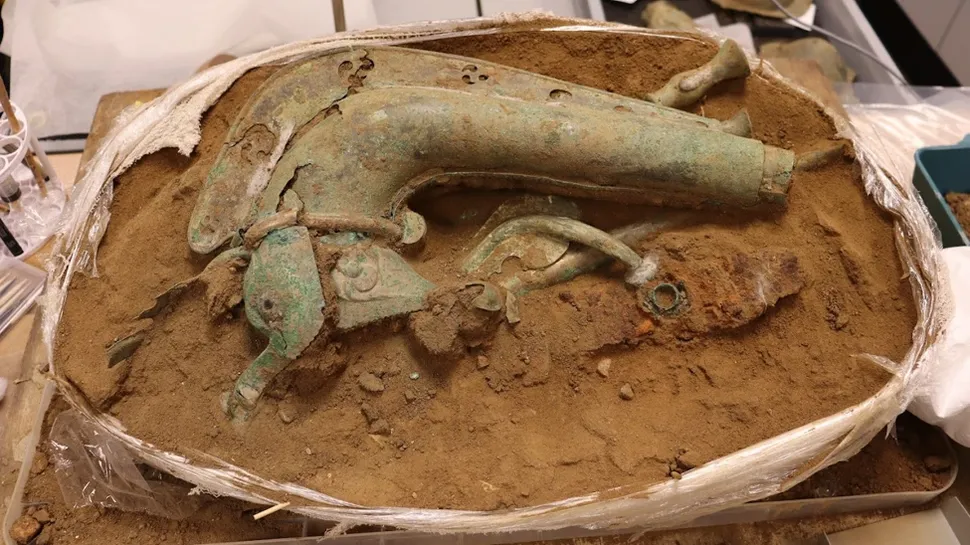
A remarkable 2,000-year-old Celtic war trumpet, known as a carnyx, has been unearthed in West Norfolk, England, in what experts are calling one of the most significant Iron Age discoveries in decades. The nearly complete bronze instrument — one of only a handful ever found in Britain and among the best preserved examples in Europe — was discovered alongside other remarkable artifacts during routine archaeological excavations ahead of a housing development.
The find is possibly linked to the Celtic Iceni tribe and its famed warrior queen Boudica, whose revolt against Roman rule in AD 60 is a defining chapter in ancient British history. While researchers continue conservation and analysis, the discovery already promises to deepen our understanding of Iron Age warfare, ritual and cultural expression in the centuries before and after Roman conquest.
An Exceptional Survival of Iron Age Sound
The artifact at the heart of this discovery is a carnyx, a tall, vertical bronze wind instrument whose bell takes the form of an open-mouthed animal head — in this case likely a boar. These instruments were used by Celtic warriors to intimidate enemies and rally troops, producing a distinctive, harsh sound described in ancient sources.
Carnyx finds are incredibly rare: this example is only the third ever unearthed in Britain and one of the most complete known across Europe. Its preservation allows researchers to reconstruct not just the object’s physical form but potentially what it sounded like and how it would have been used within Iron Age military contexts.
A Hoard of Martial Artifacts
The trumpet was found as part of a hoard of metal artifacts that included five shield bosses and a bronze boar’s head battle standard — both associated with Iron Age Celtic martial culture. Shield bosses decorated the centers of shields, while the boar motif was a powerful symbol of strength and ferocity.
This assemblage suggests the objects were deliberately buried together, possibly as a ritual deposition or a deliberate act to hide valuable items during times of conflict, highlighting the cultural and symbolic weight these items carried for their owners.
Norfolk and the Iceni Connection
West Norfolk sits within territory once occupied by the Iceni tribe, a powerful Celtic group that played a leading role in resisting Roman rule in eastern Britain. The dating of the trumpet and associated items to around the first century AD — just before or around the time of Boudica’s 60 AD revolt — raises the tantalizing possibility that this hoard may have belonged to her people.
While researchers caution that direct evidence linking the find to Boudica herself remains speculative, the context firmly places these artifacts within the cultural landscape that shaped her rebellion against Rome, offering a rare material window into the lives of people who lived through that turbulent era.
Conservation and Ongoing Investigation
Because the trumpet and other metal objects are extremely fragile after two millennia underground, the entire hoard was extracted in a block of soil and transported to laboratories for X-ray imaging, CT scanning and careful conservation work. This approach protects delicate details and allows archaeologists to study the items without risking further damage.
Experts involved in the project, including representatives from Historic England and the National Museum of Scotland, say the conservation process is revealing new details about Iron Age metallurgy, artistic style and cultural interaction that are simply not available from more fragmentary finds.
What This Means for Iron Age Studies
This extraordinary discovery enriches our understanding of Iron Age Europe, particularly the role of music, symbolism and social identity in Celtic societies. Carnyces were not merely functional war instruments; they were deeply entwined with ideology, intimidation and group identity — a sonic embodiment of power on the battlefield.
The find also underscores the breadth of connections between communities in Britain and continental Europe, where similar instruments have been found. Such objects emphasize shared artistic traditions and the movement of ideas and people across ancient networks long before Roman infrastructure dominated the landscape.
More Than a Musical Relic
This rare carnyx find is more than a striking archaeological object — it is a voice from Britain’s Iron Age, hinting at cultural practices that combined sound, symbol and warfare in ways we are only beginning to appreciate. The possible link to Boudica’s Iceni tribe adds a compelling narrative thread that connects material evidence to legendary historical events.
Yet even beyond its headline potential, this discovery reminds us of how much remains unseen beneath our feet, waiting to reshape familiar histories. Far from static museum pieces, artifacts like this trumpet act as bridges to the past, challenging modern assumptions and inviting us to listen — literally and figuratively — to the complex rhythms of ancient life.