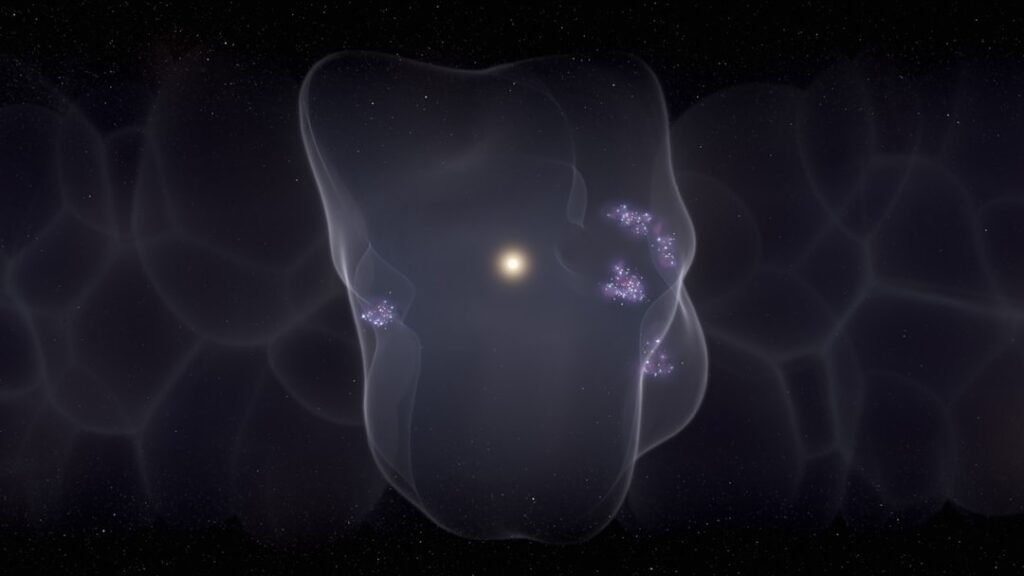

The Dawn of Cosmic Clarity (Image Credits: Unsplash)
The early universe, once shrouded in neutral hydrogen, underwent a profound transformation as the first galaxies began to emit powerful radiation that pierced the cosmic fog.
The Dawn of Cosmic Clarity
Approximately one billion years after the Big Bang, the Epoch of Reionization marked a pivotal shift when ultraviolet light from nascent stars ionized the pervasive neutral gas in the intergalactic medium. This process cleared pathways for light to travel freely, fundamentally altering the universe’s structure. Astronomers have long puzzled over how these photons managed to escape their host galaxies, given the dense barriers of gas and dust that surrounded them.
Recent studies highlighted the role of star-forming galaxies in driving this reionization. These galaxies generated sufficient ionizing radiation to account for the observed changes in the cosmic landscape. Yet, the exact mechanisms allowing this radiation to break free remained elusive until advanced simulations and observations began to illuminate the details.
Mechanisms Behind Photon Escape
Feedback from young stars played a central role in carving out escape routes for ionizing photons. In stellar clusters, radiation pressure and expanding fronts of ionization naturally evacuated low-density channels within the interstellar medium, often aided by pre-existing turbulence and fragmentation.
Supernovae explosions further amplified this process through a two-stage burst of mechanical and radiative feedback. Initial blasts cleared initial pathways, which intense radiation then widened, allowing photons to stream outward. In more mature stellar populations, repeated supernova events lifted neutral gas and dust, creating sustained leaks in the galactic envelope.
These dynamics underscored the multiscale nature of the phenomenon, spanning from individual star formations to galaxy-wide outflows. Researchers emphasized that without such interventions, the dense circumgalactic medium would have absorbed most photons, preventing widespread reionization.
Insights from James Webb Space Telescope Observations
Early data from the James Webb Space Telescope revealed that galaxies at redshifts greater than six produced ample Lyman continuum photons, sufficient to ionize the intergalactic medium. These findings challenged prior models by showing brighter and more efficient early galaxies than anticipated.
However, direct detection of escaping photons proved challenging due to absorption along sightlines. Indirect signatures, such as low-density channels and outflow velocities, provided clues to the underlying physics. Studies integrated multi-wavelength observations to map these pathways, confirming the interplay of radiation pressure, stellar winds, and supernovae.
The telescope’s resolution brought into focus how these processes operated across scales, from interstellar clouds to the broader circumgalactic environment. This bolstered evidence that star-forming galaxies dominated the reionization effort, rather than alternative sources like quasars.
Charting the Path Forward
Astronomers now plan a next-generation ultraviolet integral field spectrograph to dissect these escape mechanisms with unprecedented detail. This instrument will target high-redshift galaxies, resolving spatial variations in photon leakage and linking them to feedback signatures.
By combining spectroscopy with simulations, the observatory aims to quantify escape fractions and their evolution over cosmic time. Such data will refine models of galaxy formation and the timeline of reionization, addressing lingering uncertainties about the universe’s early ionizing budget.
- Radiation pressure from young stars evacuates turbulent channels.
- Supernovae provide mechanical clearing in a two-stage process.
- Stellar winds and outflows sustain long-term photon leaks.
- Dust lifting in evolved systems enhances escape efficiency.
- Multiscale feedback connects micro to macro cosmic evolution.
Key Takeaways
- Star-forming galaxies generated enough ionizing photons to drive reionization, as confirmed by JWST data.
- Feedback mechanisms like supernovae and radiation pressure created essential low-density escape routes.
- Future UV observatories will map these processes at multiple scales, unlocking deeper cosmic insights.
As research unveils the intricate dance of light and matter in the universe’s infancy, it reminds us how fragile yet resilient the path to cosmic transparency proved. What aspects of the early universe’s reionization intrigue you most? Share your thoughts in the comments.