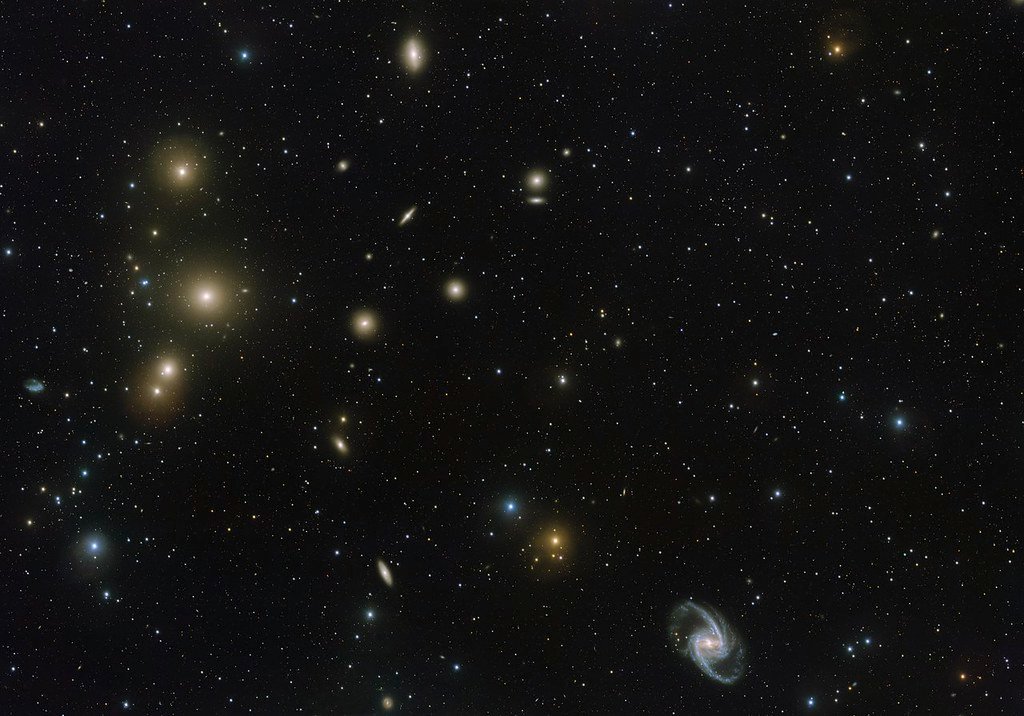

The Building Blocks of Cosmic Megastructures (Image Credits: Flickr)
Astronomers have long puzzled over the origins of galaxy clusters, the colossal assemblies that dominate the cosmic landscape.
The Building Blocks of Cosmic Megastructures
Galaxy clusters represent the universe’s most massive bound systems, each harboring hundreds to thousands of galaxies bound by gravity. These immense structures, spanning millions of light-years, contain not only stars and galaxies but also vast reservoirs of hot gas and dark matter. Scientists view them as the endpoints of a long evolutionary process that began billions of years ago.
At the heart of this evolution lie protoclusters, the embryonic versions of these clusters. Formed in the early universe, protoclusters appear as loose gatherings of young galaxies undergoing rapid star formation. Observations suggest these regions were already bustling with activity just a billion years after the Big Bang, setting the stage for the dense packs we see today. Researchers rely on powerful telescopes to detect these distant precursors, which offer crucial insights into gravitational collapse and galaxy interactions.
Recent Discoveries Challenge Formation Models
A groundbreaking observation has revealed a protocluster core so energetic it defies traditional theories of early universe development. Detected using the National Science Foundation’s Karl G. Jansky Very Large Array and the Atacama Large Millimeter/submillimeter Array, this structure – known as SPT2349-56 – exists at a redshift of about 4.3, corresponding to roughly 1.4 billion years post-Big Bang. The cosmic lens effect from a foreground galaxy amplified the signal, allowing detailed mapping of its components.
This protocluster hosts over 30 galaxies in a compact area, with gas temperatures soaring to extremes that current simulations did not anticipate. Star formation rates here outpace expectations, fueled possibly by multiple supermassive black holes injecting energy into the surrounding medium. Such findings, published in recent astronomical journals, indicate that protoclusters assembled faster and hotter than previously modeled, prompting revisions to our understanding of dark matter’s role in early clustering.
From Infancy to Maturity: The Evolutionary Path
Protoclusters start as extended filaments in the cosmic web, where density fluctuations from the universe’s infancy draw galaxies together over eons. By redshift z=2, about 10 billion years ago, these groupings span up to 35 million parsecs, with only a fraction of mass concentrated in a central halo. Over time, mergers and infall consolidate this material, transforming scattered settlements into tightly knit urban centers of galaxies.
Simulations like the Millennium Run, combined with semi-analytic models, illustrate this progression. They show that many protoclusters lack a dominant central galaxy early on, instead evolving through a network of smaller halos. Environmental factors, such as proximity to massive stars or black holes, accelerate starburst activity, enriching the intergalactic medium with metals. This process repeats across diverse regions, highlighting the varied paths to cluster formation.
Key Insights from High-Redshift Observations
Telescopes such as the James Webb Space Telescope have spotlighted protoclusters at unprecedented distances, revealing their structures in infrared light. One notable example involves a group of seven galaxies predicted to grow into one of the densest clusters known, observed 13 billion years ago. These views confirm that protoclusters occupy nodes in the cosmic web, seeded by primordial density waves.
To grasp their diversity, astronomers classify protoclusters by evolutionary state:
- Early-stage: Diffuse, with minimal central dominance and spread-out galaxy populations.
- Mid-stage: Emerging main halos, increased star formation, and initial mergers.
- Late-stage: Compact cores forming, with hot gas envelopes signaling imminent cluster status.
- Transitioning: Halos merging rapidly, driven by dark energy’s influence on expansion.
- Mature precursors: Dense packs resembling present-day clusters but at high redshift.
These categories underscore how protoclusters adapt to their cosmic neighborhoods, influencing galaxy quenching and morphology.
| Stage | Typical Redshift | Key Feature |
|---|---|---|
| Early | z > 4 | Extended filaments |
| Mid | z = 2-4 | Rapid infall |
| Late | z < 2 | Central halo dominance |
Key Takeaways
- Protoclusters form the seeds of galaxy clusters, evolving from loose galaxy groups to massive bound systems.
- Recent detections like SPT2349-56 reveal unexpectedly hot and active early environments, challenging models.
- Understanding these structures illuminates the universe’s large-scale architecture and dark matter dynamics.
As telescopes peer deeper into the cosmos, protoclusters continue to rewrite the story of universal growth, reminding us that the grandest structures arose from humble, hyperactive beginnings. What aspects of cosmic evolution intrigue you most? Share your thoughts in the comments.