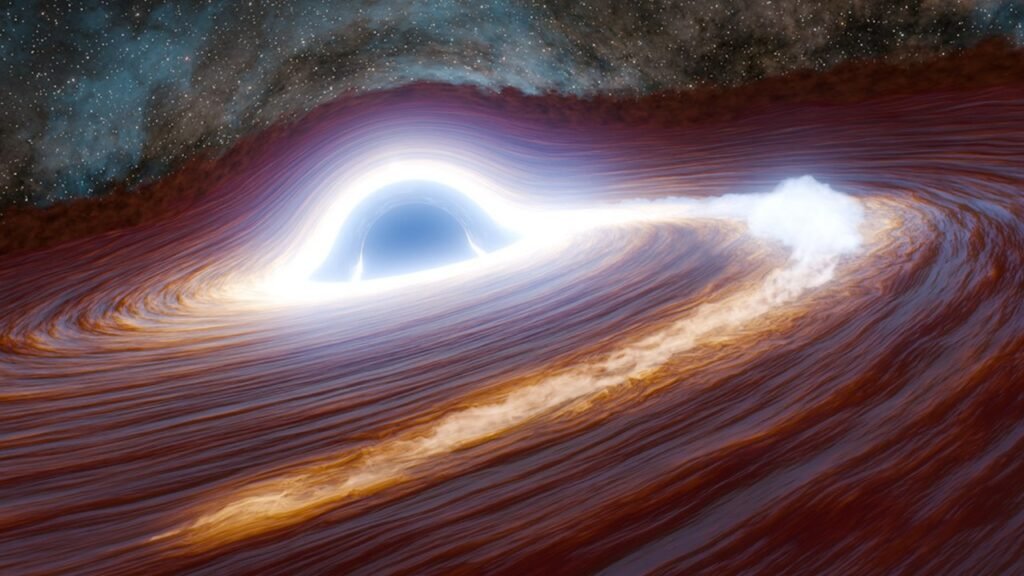
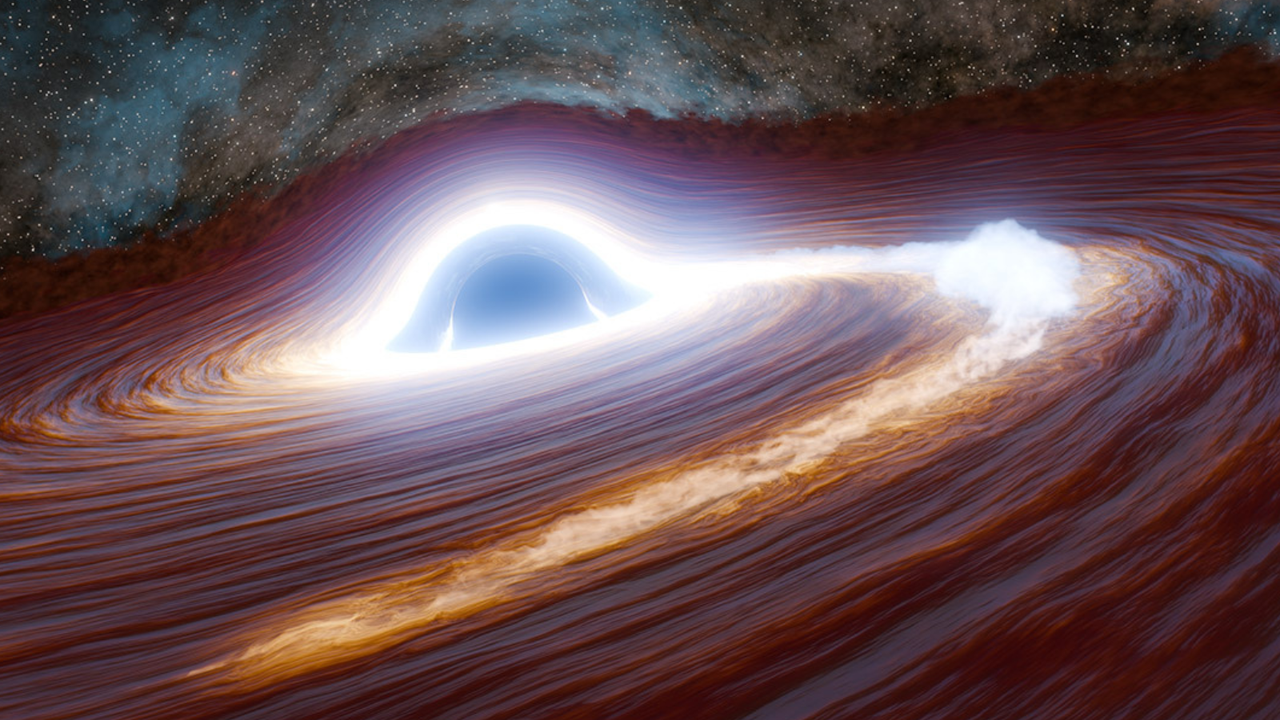
Unprecedented Power in the Void (Image Credits: Cdn.mos.cms.futurecdn.net)
Astronomers have captured a rare cosmic spectacle where a supermassive black hole tore apart a massive star, unleashing an eruption of energy rivaling 400 billion suns.
Unprecedented Power in the Void
The event, dubbed the Whippet, stands out as one of the most luminous disruptions ever observed. Scientists announced the discovery during the American Astronomical Society’s annual meeting, highlighting how this black hole interaction dwarfed typical stellar fates. The star, far larger than our sun, met its end in a distant galaxy, its material stretched and shredded by the black hole’s immense gravity.
Unlike ordinary supernovae, this tidal disruption event released a burst of light and radiation that outshone entire galaxies for a brief period. Researchers detected the flare using ground-based telescopes and space observatories, which tracked the outburst’s evolution over months. The energy output, equivalent to 400 billion suns, stemmed from the star’s gas heating up as it spiraled inward, creating a blazing accretion disk around the black hole.
This phenomenon not only showcases the destructive force of black holes but also offers clues about their growth mechanisms in the universe’s early stages.
How the Shredding Unfolded
The process began when the star ventured too close to the black hole, crossing the event horizon’s boundary known as the Roche limit. Gravity warped the star’s structure, pulling one side faster than the other until it fragmented into a stream of plasma. This debris formed a glowing tail that astronomers likened to a cosmic whip cracking through space.
Observations revealed the event’s peak brightness occurred shortly after detection, with the light fading gradually as the black hole consumed the remnants. The Whippet’s distance – billions of light-years away – meant the light reaching Earth originated from an era when the universe was younger and more chaotic. Telescopes in multiple wavelengths, from X-rays to optical, confirmed the black hole’s role by identifying characteristic spectral lines from superheated gas.
Such events remain elusive because they require precise alignment for detection, making the Whippet a jackpot for astrophysicists studying stellar evolution near galactic centers.
Insights into Black Hole Dynamics
The Whippet challenges existing models of how black holes interact with their surroundings. Traditional theories predicted less intense flares from similar disruptions, but this one exceeded expectations by orders of magnitude. Scientists noted that the black hole’s mass, likely millions of times that of the sun, amplified the energy release through efficient matter conversion.
Further analysis showed the star was a “super star,” unusually massive and bright, which intensified the spectacle. The event’s duration – spanning weeks to months – allowed for detailed monitoring, unlike fleeting gamma-ray bursts. Researchers emphasized that these disruptions fuel quasars, the brightest objects in the universe, by providing black holes with fresh material.
Understanding such processes helps explain the formation of supermassive black holes that anchor most galaxies.
Key Observations and Future Hunts
Astronomers pinpointed the Whippet through automated surveys that scan the sky for transient events. The flare’s blue hue and rapid rise distinguished it from standard explosions, prompting follow-up studies. Data from observatories like the Zwicky Transient Facility played a crucial role in early detection.
To grasp the event’s scale, consider these comparative facts:
- The energy release equaled the sun’s output for 400 billion years.
- It outluminosed a typical galaxy by a factor of 100 during its peak.
- The star’s mass was at least 10 times the sun’s, accelerating its demise.
- Similar events occur roughly once per decade per galaxy, but most go unseen.
- The Whippet’s light travel time: over 10 billion years from its origin.
These details underscore the rarity and value of the observation for refining cosmic simulations.
Key Takeaways
- The Whippet reveals black holes’ role in recycling stellar material across the cosmos.
- Advanced telescopes are unveiling more such events, bridging gaps in astrophysical knowledge.
- This discovery highlights the universe’s violent yet formative processes.
The Whippet serves as a stark reminder of the universe’s raw power, where creation and destruction intertwine on a grand scale. As detection technologies improve, more of these stellar tragedies will come to light, deepening our grasp of black holes’ influence. What aspects of this cosmic drama intrigue you most? Share your thoughts in the comments.