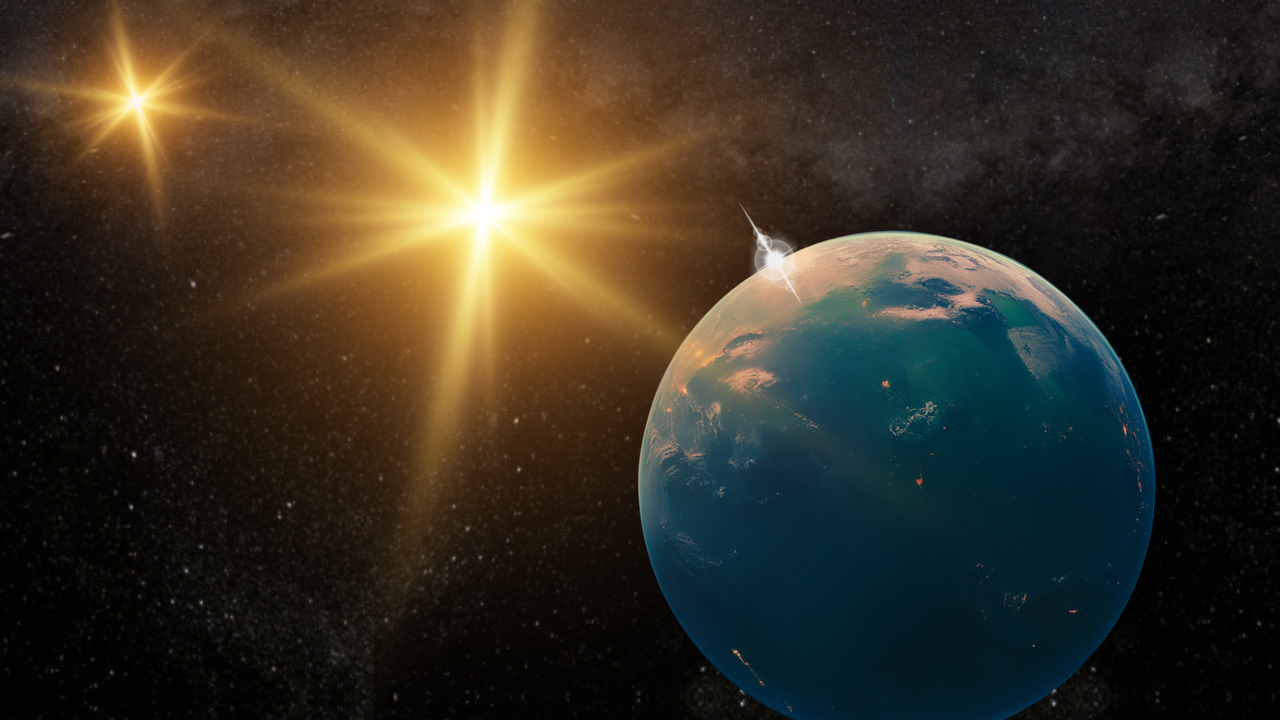
A Sci-Fi Dream Turns Real (Image Credits: Cdn.mos.cms.futurecdn.net)
Picture a distant world bathed in the warm, dual glow of two stars, where the passage of seasons stretches across generations, turning every orbit into an epic tale of cosmic patience.
A Sci-Fi Dream Turns Real
Ever watched Star Wars and wondered about those double sunsets on Tatooine? Well, astronomers just found something eerily similar out there in the void. This new exoplanet orbits a pair of stars, mimicking that fictional setup, but with a twist that has experts scratching their heads.
The discovery came from digging through old telescope data, revealing a planet that’s not just rare, but downright puzzling. It’s the closest such world to its twin suns we’ve ever imaged directly. That proximity adds layers of intrigue to an already wild find.
Uncovered from a Decade-Old Archive
Teams from Northwestern University sifted through observations from 10 years back, spotting what they missed at first. Advanced imaging techniques brought this hidden gem into focus, showing the planet’s position against its starry backdrop.
It’s like finding a forgotten photo in an old album that changes everything you thought you knew. This exoplanet, dubbed a circumbinary world, challenges our models of how planets form around multiple stars.
The Orbit That Defies Expectations
Here’s the real head-scratcher: this planet takes a whopping 300 years to complete one lap around its dual hosts. That’s longer than many human civilizations have lasted on Earth. Scientists aren’t entirely sure how it stays stable in such a setup.
Unlike typical planets hugging their stars tight, this one keeps a respectful distance, yet closer to the pair than any Tatooine-like world before. The mechanics of its path remain a mystery, with gravity playing a complex game of tug-of-war.
What Sets This World Apart
Circumbinary planets aren’t brand new, but this one’s orbit stands out for its eccentricity and scale. It circles the binary stars at a pace that suggests a formation story full of surprises, perhaps born from a chaotic disk of gas and dust.
At about 120 light-years away, it’s too far for detailed probes, but the images give clues to its size and temperature. Cooler than inner planets, it might harbor conditions we can only speculate about.
Implications for Alien Life and Beyond
Could anything survive on a world where a “year” spans centuries? The twin stars could mean wild climate swings, with periods of intense light followed by long twilights. Yet, that stability in orbit hints at potential safe zones.
This find pushes our understanding of planetary systems. It shows that weird orbits aren’t just possible, they’re out there, waiting to be found. Future telescopes might reveal atmospheres or even signs of water.
Peering Deeper into the Cosmos
Astronomers plan more observations to map this orbit precisely. Combining data from ground-based scopes and space assets could unlock why this planet behaves as it does.
Discoveries like this remind us how much of the universe hides in plain sight. As tech improves, we’ll likely spot more of these binary oddities.
- Twin-star system, much like Tatooine’s binary suns.
- 300-year orbital period, far longer than Earth’s 365 days.
- Directly imaged for the first time in this configuration.
- Located roughly 120 light-years from our solar system.
- Challenges current theories on planetary formation.
Key Takeaways
- This exoplanet orbits closer to its stars than any similar world imaged before.
- The 300-year cycle raises questions about long-term stability.
- Found in archived data, proving old observations still hold new secrets.
In a universe full of surprises, this Tatooine twin shows us that reality often outpaces fiction, one slow orbit at a time. What do you think – could double sunrises be the next big thing in space exploration? Share your thoughts in the comments.
Jan loves Wildlife and Animals and is one of the founders of Animals Around The Globe. He holds an MSc in Finance & Economics and is a passionate PADI Open Water Diver. His favorite animals are Mountain Gorillas, Tigers, and Great White Sharks. He lived in South Africa, Germany, the USA, Ireland, Italy, China, and Australia. Before AATG, Jan worked for Google, Axel Springer, BMW and others.