
Have you ever questioned whether the world around you is truly what it seems? Let’s be real, the idea sounds crazy at first. Yet physicists and cosmologists are seriously investigating concepts that would make the most creative science fiction writer jealous. These aren’t idle fantasies. These are legitimate scientific theories being explored in labs and through complex mathematics right now, in 2026.
The universe might be far stranger than you’ve ever imagined. From multiple versions of yourself living parallel lives to the possibility that everything you see is a projection from a distant cosmic boundary, modern science is pushing into territory that challenges every assumption about existence. What follows might leave you questioning the very ground beneath your feet.
The Many Worlds Interpretation: Every Choice Creates a New Universe
Picture this: every quantum event splits reality into countless parallel universes where every possible outcome actually happens. When you flip a coin, there’s a universe where it lands heads and another where it lands tails. Both are equally real.
This interpretation has become mainstream in quantum mechanics, sitting alongside more traditional views. Recent simulations using powerful computers have confirmed that large-scale branching still occurs, and as objects grow by thousands of particles, they eventually end up in a world obeying classical physics. The math works. The implications? Absolutely staggering.
Think about it. Every possible outcome of a quantum event exists in its own world, potentially resolving paradoxes like Schrödinger’s cat. There’s a version of you reading this article who made different breakfast choices this morning. Another version who took a different career path entirely.
Quantum Computing and the Multiverse Connection
Here’s where things get wild. Google Quantum AI founder Hartmut Neven has argued that their quantum chip’s success supports the idea of quantum computation occurring in many parallel universes, echoing theories from physicist David Deutsch. This isn’t just theoretical musing anymore.
Deutsch’s multiverse interpretation proposes that particles exist in multiple states simultaneously, a phenomenon that quantum computers leverage for their computational power. Your laptop processes information sequentially. A quantum computer? It’s potentially calculating across multiple realities at once.
The chip’s ability to perform calculations exponentially faster relies on superposition, where qubits exist in multiple states simultaneously, and in the multiverse interpretation, these states correspond to computations occurring across parallel universes. If true, we’re already building technology that operates between dimensions. Let that sink in for a moment.
The Simulation Hypothesis: Are We Living in a Computer Program?
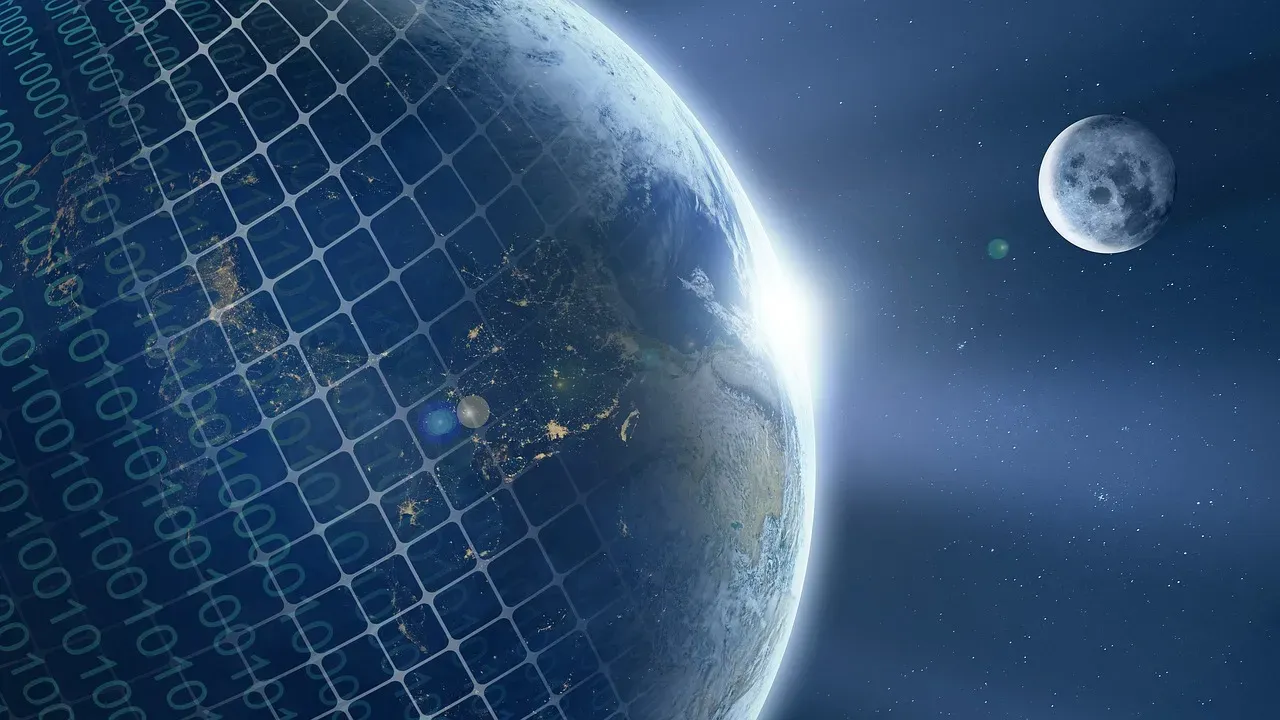
You’ve probably heard this one. What if our entire universe is actually an elaborate computer simulation? It sounds like a plot device from a movie, yet serious physicists have been grappling with this possibility.
Under the assumption of finite computational resources, the simulation of the universe would be performed by dividing spacetime into a discrete set of points, which may result in observable effects such as an anisotropy in the distribution of ultra-high-energy cosmic rays. Scientists have actually proposed experiments to test this.
However, recent research has thrown cold water on the hypothesis. Drawing on mathematical theorems related to incompleteness and indefinability, researchers demonstrate that a fully consistent description of reality cannot be achieved through computation alone, requiring non-algorithmic understanding beyond computation, meaning this universe cannot be a simulation. The debate continues, though. Some argue the test itself could be simulated.
The Holographic Universe: Reality as a Two-Dimensional Projection
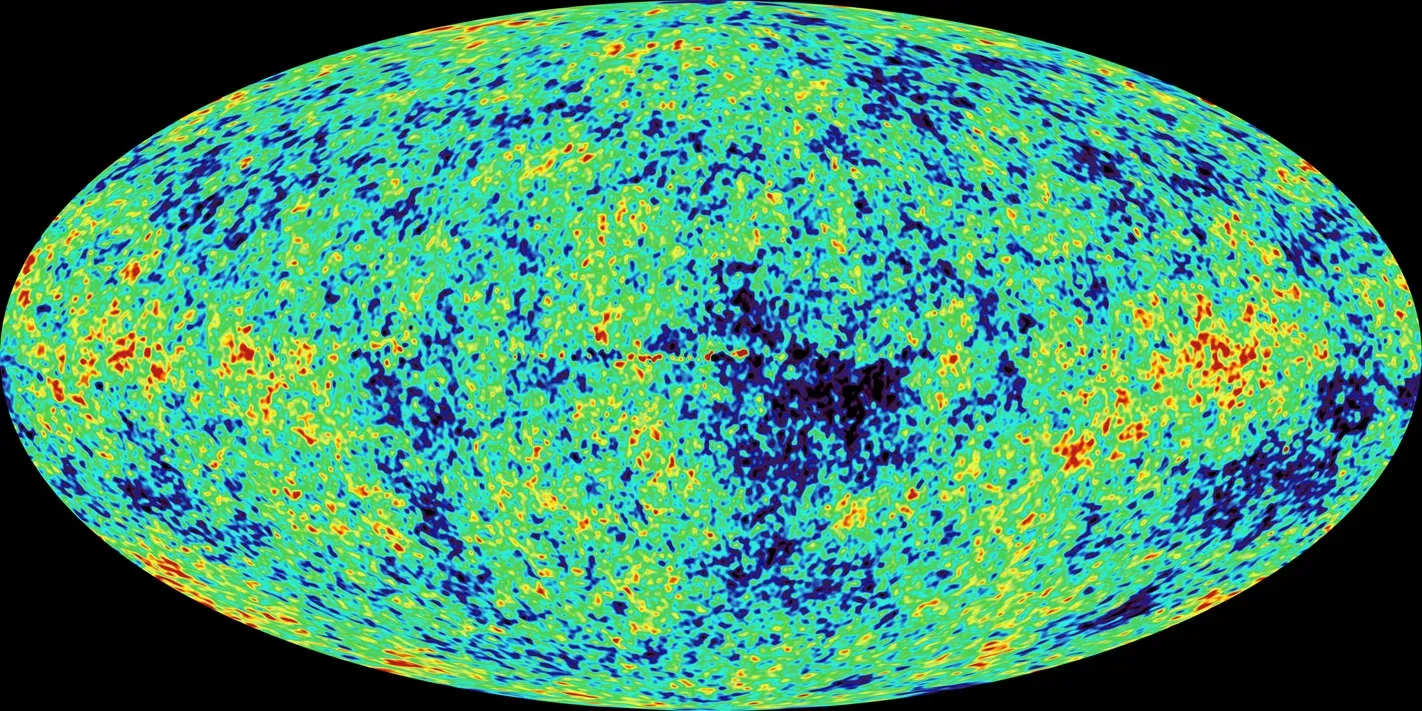
Prepare for your mind to bend. The holographic principle states that the description of a volume of space can be encoded on a lower-dimensional boundary to the region, and according to physicist Leonard Susskind, the three-dimensional world of ordinary experience is a hologram, an image of reality coded on a distant two-dimensional surface.
Everything you experience in three dimensions might actually be information stored on a distant cosmic screen. Juan Maldacena suggested that our universe could be a hologram, where our universe’s four-dimensional spacetime could be a holographic projection of a lower-dimensional reality. It’s like watching a movie in a theater, except you can’t step outside the projection.
A UK, Canadian and Italian study provided what researchers believe is the first observational evidence that our universe could be a vast and complex hologram, investigating irregularities in the cosmic microwave background. Honestly, this theory has more experimental support than you might expect.
The Observer Effect: Does Consciousness Shape Reality?
A notable example of the observer effect occurs in quantum mechanics, as demonstrated by the double-slit experiment, where physicists have found that observation of quantum phenomena by a detector or instrument can change the measured results. Particles behave differently when watched.
Here’s the thing: Despite the observer effect being caused by the presence of an electronic detector, some have interpreted the results to suggest that a conscious mind can directly affect reality, though the need for the observer to be conscious is not supported by scientific research. Most physicists agree the detector itself causes the change, not consciousness.
Yet some researchers continue exploring this frontier. Some branches of probability called QBism argue that an observer’s personal beliefs about a quantum system could result in the observation of distinct outcomes or realities. Whether consciousness truly creates reality or simply observes it remains one of the deepest mysteries in physics. I know it sounds crazy, but the question refuses to go away.
Decoherent Histories: How Classical Reality Emerges from Quantum Chaos
Researchers have worked with a concept known as decoherent histories, which asserts that every physical process is the result of a series of steps in a definite sequence that provides a record of past behavior. This attempts to explain how the weird quantum world produces the solid, predictable reality we experience daily.
Simulations deliver hints on how the multiverse produced according to the many-worlds interpretation might be compatible with our stable classical universe, with a set of worlds with classical features naturally emerging from a complex quantum system. The transition isn’t instantaneous or mysterious. It’s gradual.
The work relates to ideas from statistical mechanics, and researchers interpret their main result as arising from an inherent randomization of quantum phases at the microscale, similar to how macroscopic features such as pressure and temperature arise from chaotic microscopic motion. Order emerges from chaos. Our everyday experience is built on quantum uncertainty.
Information as the Foundation: Reality Made of Data
The physical universe is widely seen to be composed of matter and energy, but a current trend suggests scientists may regard the physical world as made of information, with energy and matter as incidentals. Information might be more fundamental than atoms.
Today’s cutting-edge theory, quantum gravity, suggests that even space and time aren’t fundamental but emerge from something deeper: pure information existing in what physicists call a Platonic realm, a mathematical foundation more real than the physical universe we experience. This flips everything on its head.
Think of it like this: your body isn’t the fundamental thing. The information describing your body is. Space and time are emergent properties, not the stage on which reality plays out. Thermodynamic entropy and Shannon entropy are conceptually equivalent, meaning the number of arrangements counted by Boltzmann entropy reflects the amount of Shannon information needed to implement any particular arrangement of matter and energy. Physics and information theory converge.
The Big Crunch and Imaginary Time: A Holographic Alternative
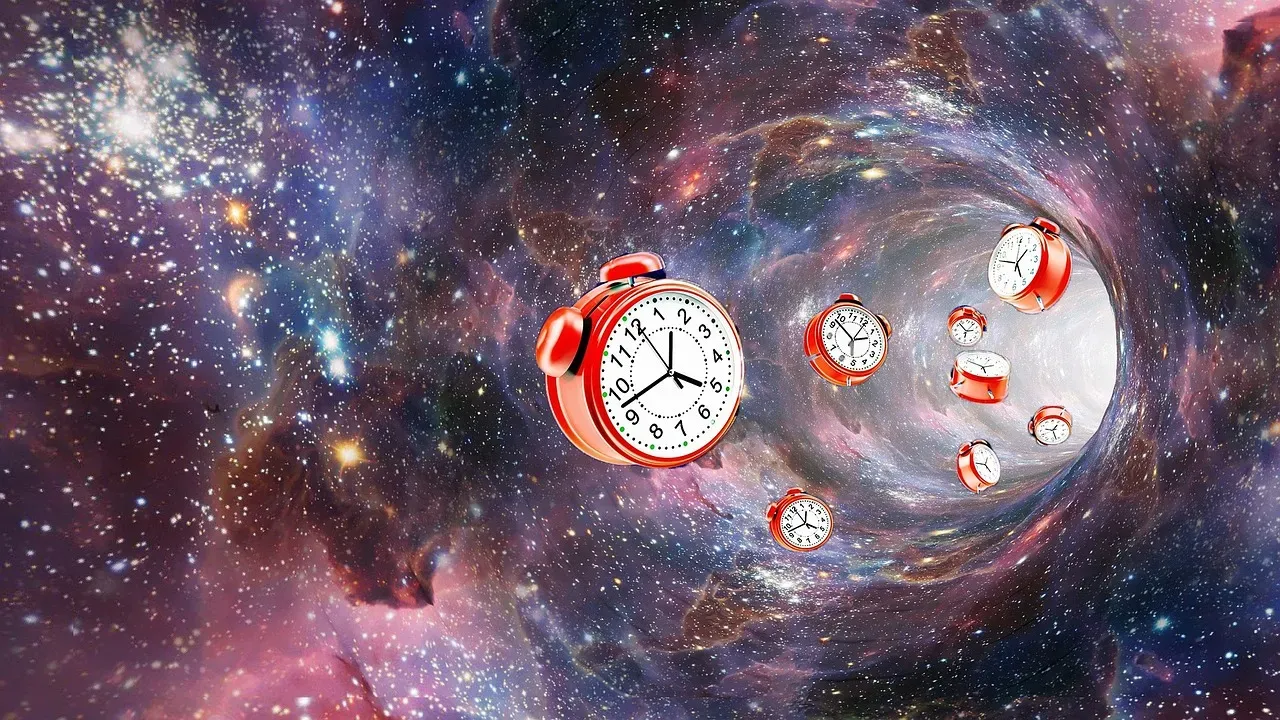
Associate professor of physics Brian Swingle and collaborator Mark Van Raamsdonk have devised a possible explanation involving imaginary time, a wormhole, and a doomsday concept in physics called the Big Crunch. Yes, you read that correctly. Imaginary time is a real concept.
Imaginary time is not unreal or made up but connected to imaginary numbers, involving multiplying the value of real time by the square root of negative one, and as a result ends up being more like space than our usual time, and it is at the end of this new space that the holographic screen is supposed to live. Hard to picture? Absolutely.
In this model, the plane of space in imaginary time interacts most directly with time in our universe about halfway through our universe’s lifetime, and as a consequence, the current expansion of our universe will stop, with the universe eventually collapsing under its own gravity in a black hole singularity called the Big Crunch. Our universe might have an expiration date written into its holographic code.
Recursive Universe Simulations: Simulations Within Simulations
A new paper by SFI Professor David Wolpert introduces the first mathematically precise framework for what it would mean for one universe to simulate another, showing that several longstanding claims about simulations break down once the concept is defined rigorously, including the possibility that a universe capable of simulating another could itself be perfectly reproduced inside that very simulation.
The framework raises the question of whether it’s possible to have infinite chains of simulated universes or closed loops of universes simulating universes, and it also changes philosophical accounts of identity by raising the possibility of there being more than one version of you in different simulations. You could exist in multiple simulations simultaneously, all of which are mathematically you.
The physical Church-Turing thesis holds that any physical process we can observe could in principle be reproduced by a standard computer program, and Kleene’s second recursion theorem explains how a program can generate and run an exact copy of itself, implying that if some universe can simulate ours accurately, nothing prevents our universe from simulating that universe in return. Reality might be turtles all the way down. Or rather, simulations all the way down.
Where Does This Leave Us in 2026?
Standing at the frontier of understanding, honestly. These nine theories represent humanity’s most daring attempts to understand what reality actually is. Some will prove correct. Others will be abandoned. Many might contain pieces of a larger truth we haven’t yet glimpsed.
Physicists hope that insights will get them to a theory of quantum gravity for our own universe, which is one of the biggest open problems in physics, and one fundamental insight is that any theory of quantum gravity will most likely be holographic. The pieces are starting to fit together, slowly.
What strikes me most is how these theories challenge the assumption that our everyday experience reflects fundamental reality. Space, time, matter, even consciousness itself might be emergent properties of something far stranger beneath. We’re living in an era where the boundaries between physics, philosophy, and metaphysics are blurring.
The universe is under no obligation to make sense to us. Yet here we are, using mathematics and experiments to peek behind the curtain. What do you think? Does one of these theories resonate with how you see reality? The journey to understanding has never been more thrilling or more humbling.