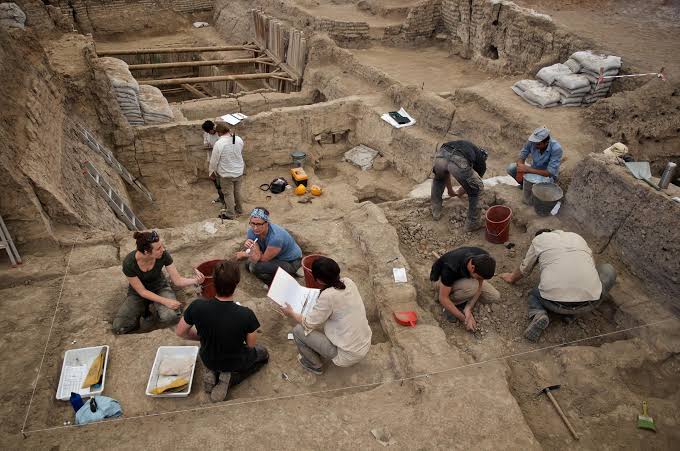

Most people assume “primitive” and “ancient” mean the same thing. They don’t. Across the archaeological record, researchers keep unearthing objects so precise, so chemically advanced, or so chronologically impossible that they force textbooks to be rewritten. These aren’t fringe claims from tabloid archaeology – they’re peer-reviewed findings that quietly upended what we thought ancient people were capable of.
A Greek shipwreck hides a mechanical computer nobody expected to find. A Roman drinking cup uses nanotechnology no one could explain until the 1990s. A Turkish hilltop predates farming by two thousand years, and a pillar in Delhi has refused to rust for sixteen centuries straight. Here’s what the evidence actually says – starting with the tiny wooden bird that still splits Egyptologists down the middle.
#14 – The Saqqara Bird That Still Splits Egyptologists
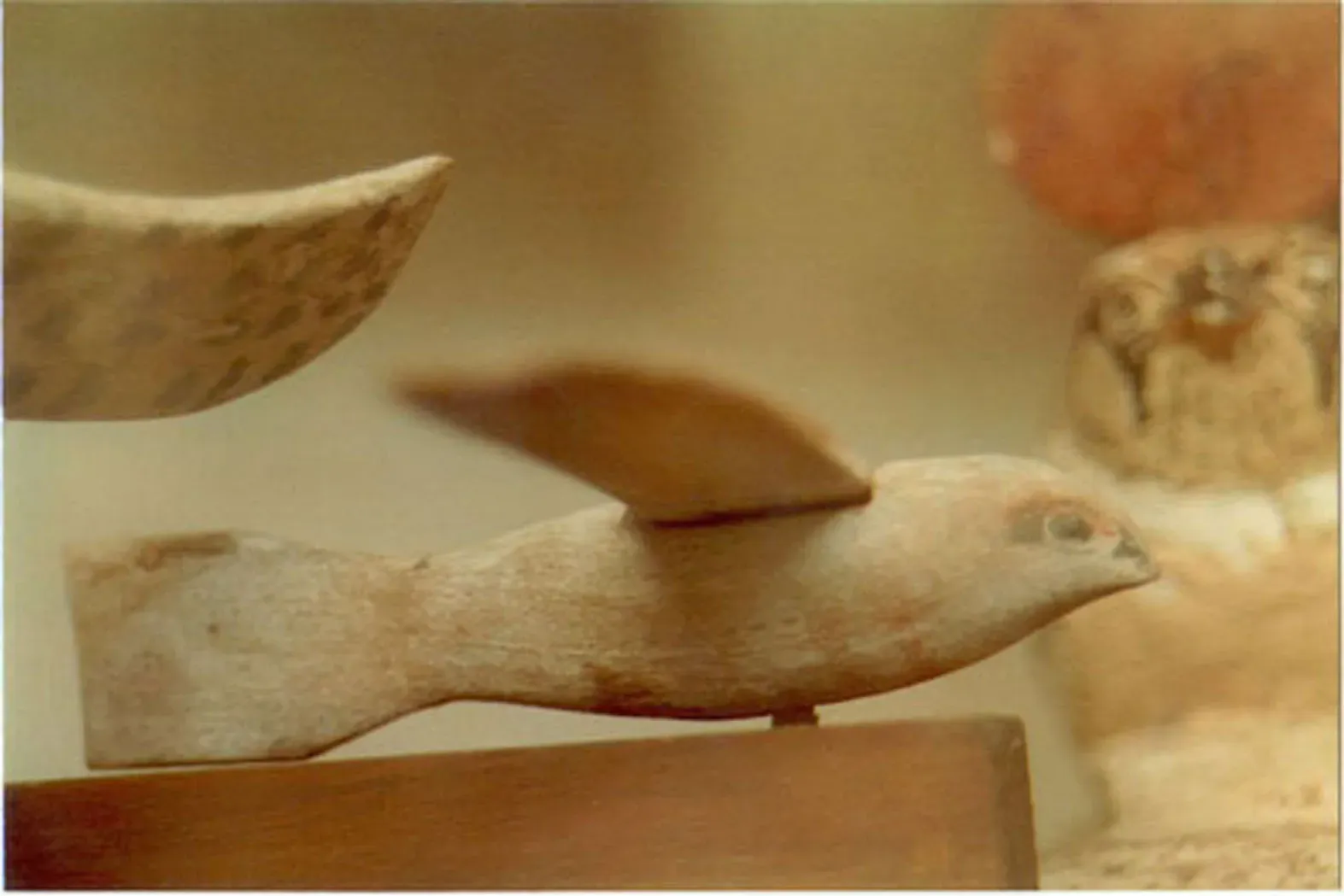
A tiny wooden falcon found in an Egyptian tomb has sparked one of archaeology’s longest-running arguments about aerodynamics versus symbolism.
Carved from sycamore wood around 200 BCE, the Saqqara Bird has a flat, wing-like body, a straight tail, and no legs – a shape some engineers argue mimics a modern glider more than any bird in nature. Its proportions have been tested in wind tunnels, with a few researchers claiming it could theoretically glide if launched. Most Egyptologists disagree, insisting it’s a stylized weathervane, ceremonial toy, or symbolic falcon representing the god Horus, since no other evidence of ancient flight technology exists anywhere in the historical record. The debate has never fully resolved, and the object still sits on display in Cairo precisely because nobody can definitively rule out either explanation.
The controversy says less about ancient aviation and more about how easily shape can be mistaken for function. But that’s nothing compared to what turned up at #13.
#13 – Roman Dodecahedra: Precision Objects With Zero Written Explanation
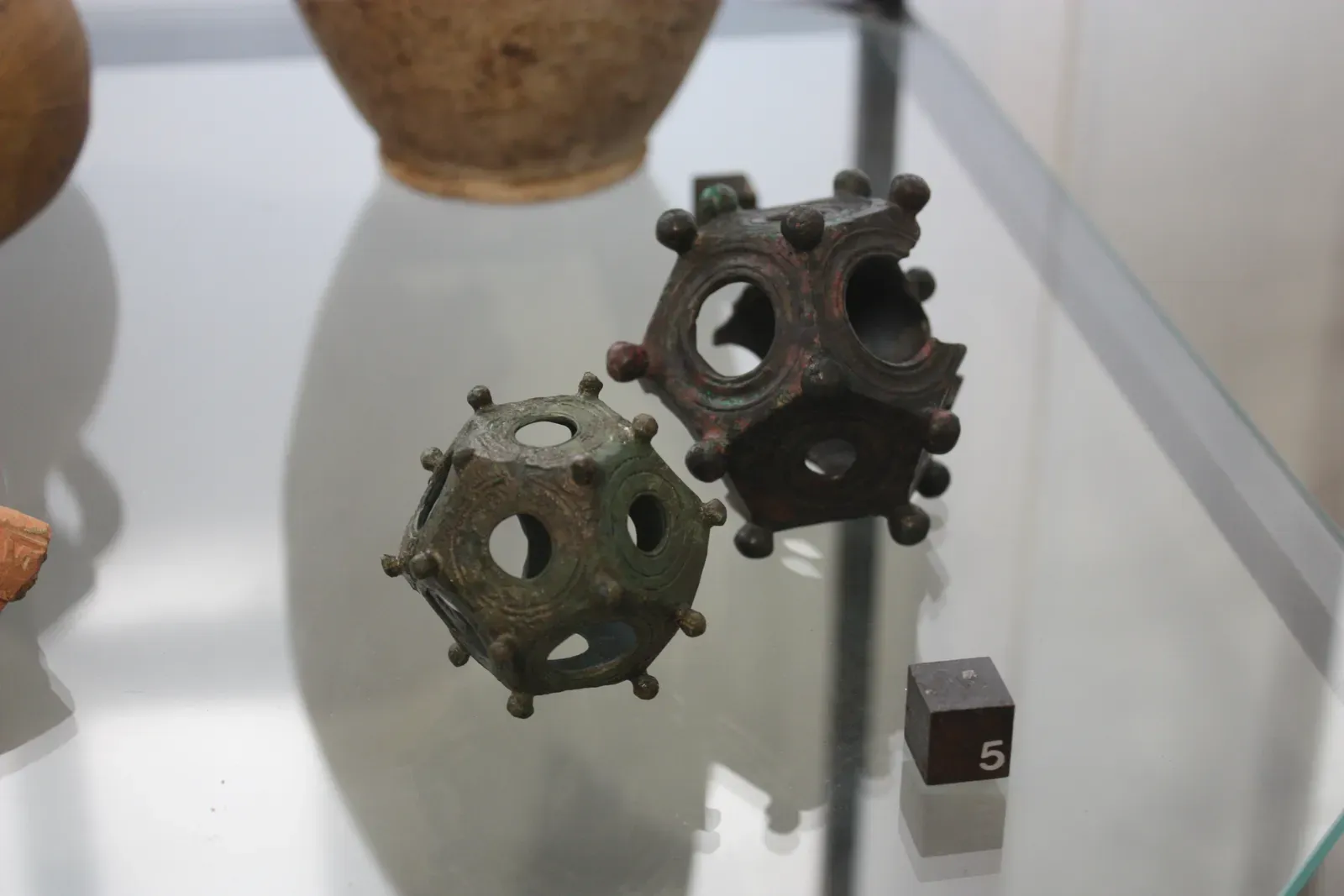
More than a hundred small bronze dodecahedra have been dug up across the old Roman Empire, and not a single ancient text mentions what they were for.
Each object has twelve flat pentagonal faces, a hollow center, and circular holes of varying diameters cut into every face – a level of geometric consistency that demanded real metalworking skill. Some were found in coin hoards and jewelry boxes, hinting they held value, while others turned up in what looked like tool caches. Theories range from candlestick holders and dice to religious objects, or even devices for measuring sword sheaths and calculating astronomical distances. No two dodecahedra are exactly the same size, which rules out any single obvious measuring function. Historians now generally treat them as regional ritual or status objects, but the total silence in Roman writing about something so widely distributed remains genuinely strange.
If a common Roman object can vanish from the historical record entirely, imagine what happened to rarer technology. That’s exactly the mystery waiting in #12.
#12 – The Phaistos Disc’s Impossible Printing Technique

Discovered in Crete in 1908, the Phaistos Disc uses a technique that looks disturbingly close to movable type – nearly 3,000 years before Gutenberg.
The clay disc is stamped, not carved, with 241 symbols arranged in a spiral, using 45 distinct stamps pressed into wet clay individually and repeated across the surface. That method – pre-made, reusable stamps combined to form text – is functionally identical to the logic behind printing presses, yet it appears on a single object with no known predecessor or successor anywhere in the Minoan record. Linguists still cannot read the script, and no comparable disc has ever surfaced despite over a century of searching Crete’s ruins. Some scholars have even questioned its authenticity, though clay composition tests support an ancient origin.
Fast Facts
- Discovered in Crete in 1908
- 241 symbols arranged in a spiral
- 45 distinct stamps pressed into wet clay
- Predates Gutenberg’s printing press by nearly 3,000 years
- Script remains undeciphered to this day
An unreadable object using a “future” technique is unsettling enough. Wait until you see what pre-Columbian goldsmiths were shaping in #11.
#11 – Quimbaya Gold Figures With Unnervingly Clean Lines

Pre-Columbian goldsmiths in what is now Colombia produced small zoomorphic figurines with a level of symmetry and casting precision that metallurgists still study today.
The Quimbaya people used lost-wax casting to produce gold-copper alloy pieces, some depicting insects, birds, and bats with elongated bodies, delta-shaped wings, and triangular tails. Their smooth curves have led a handful of fringe writers to claim the shapes resemble aircraft, though mainstream archaeologists overwhelmingly identify them as accurate stylized animals rooted in regional fauna and artistic tradition. What’s genuinely impressive – and often overshadowed by that debate – is the metallurgical sophistication: the tumbaga alloy required precise control of gold-to-copper ratios and depletion gilding to achieve a gold-like finish, all without a single written formula.
Real chemistry hiding behind a controversial shape is one thing. Solid granite carved into near-perfect spheres is another problem entirely – that’s #10.
#10 – Costa Rica’s Stone Spheres That Refuse to Explain Themselves
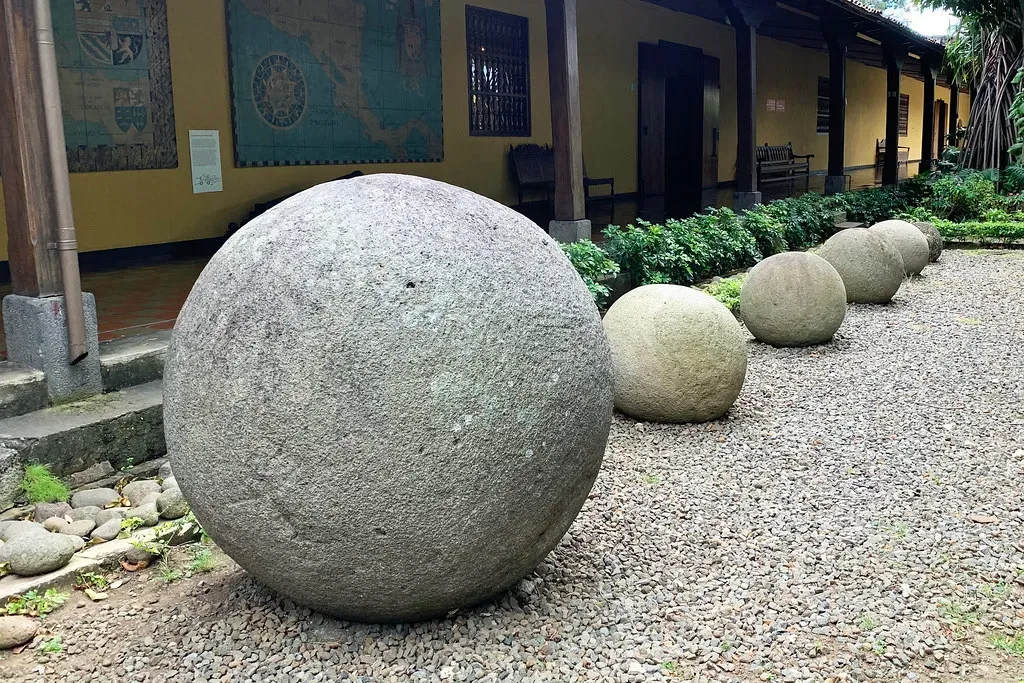
Scattered across the Diquís Delta in southern Costa Rica are hundreds of stone spheres, some over six feet wide, carved with a roundness that rivals modern manufacturing tolerances.
Made primarily from hard granodiorite, these balls were shaped using nothing but harder stone hammers and abrasive grinding – no metal tools have ever been found nearby that could account for the precision. Some spheres measure within a few millimeters of a perfect circle around their circumference, a tolerance achieved through nothing but percussion and patience. Their purpose is still debated: possible markers of social status, astronomical alignments, or boundaries for elite settlements dated between 300 BCE and 1500 CE. Many were bulldozed or dynamited by banana plantation workers before archaeologists could study their original placement, destroying context that might have solved the mystery for good. UNESCO finally added the surviving sites to its World Heritage list in 2014.
Losing the context around a mystery is bad. What happened to a supposed 2,000-year-old battery is arguably worse – that’s #9.
#9 – The Baghdad Battery That Might Predate Volta by 1,500 Years
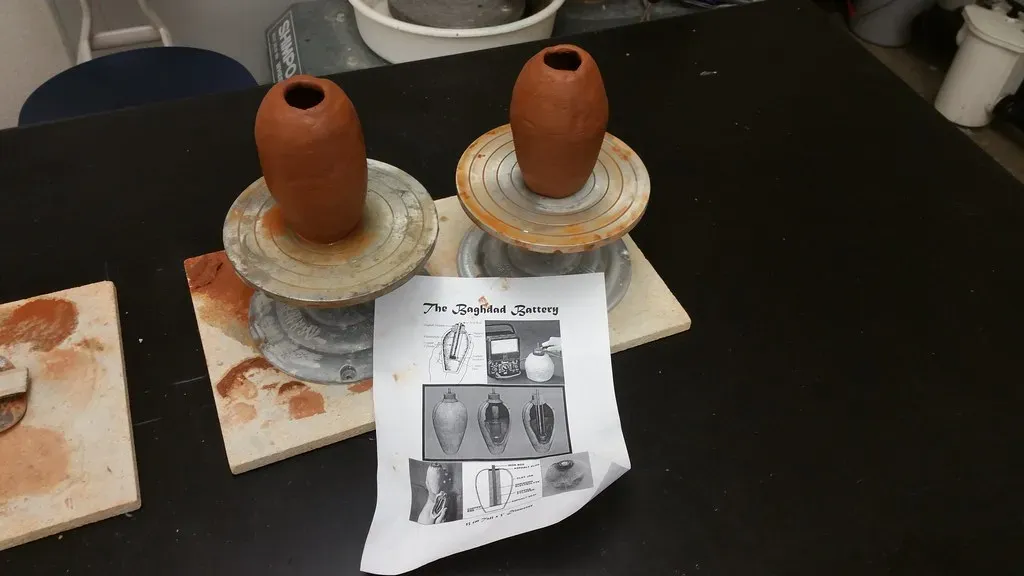
A set of clay jars found near Baghdad, containing a copper cylinder, an iron rod, and traces of acidic residue, has fueled one of archaeology’s most persistent “ahead of its time” debates since the 1930s.
German archaeologist Wilhelm König first proposed in 1938 that the jars, dated to the Parthian or Sassanid period, functioned as primitive galvanic cells – crude batteries – roughly 1,500 years before Alessandro Volta invented the modern battery in 1800. Replica versions built by researchers have successfully produced a small voltage when filled with an acidic liquid like vinegar or grape juice, proving the design could generate electricity even if that wasn’t its intended purpose. Most mainstream archaeologists now lean toward a far less dramatic explanation – that the jars stored sacred scrolls, with the metal rods serving a ritual or structural role rather than an electrical one. No wires or batteries in series from the same era have ever surfaced to support a wider “ancient electricity” system.
A possible battery is fascinating. A blade with a nanostructure scientists couldn’t replicate for centuries is on another level entirely. That’s #8.
#8 – Damascus Steel’s Accidental Nanotechnology
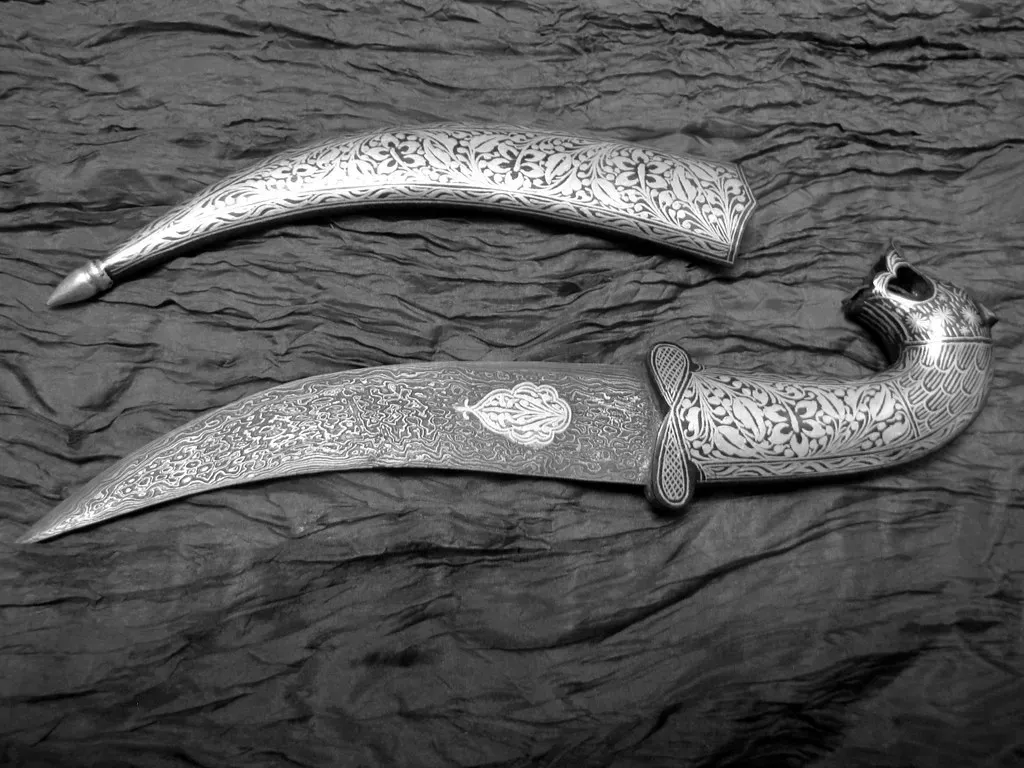
Legendary Damascus steel blades, prized for their strength and rippling surface pattern, turned out to contain structures that modern metallurgists didn’t have the tools to identify until the 21st century.
Made from wootz steel imported from India and Sri Lanka, these blades were forged in the Middle East from roughly 300 BCE onward, using techniques eventually lost by the 18th century – smiths simply stopped being able to reproduce the exact pattern. When researchers finally dissolved surviving blade fragments in acid for electron microscopy, they found carbon nanotubes and cementite nanowires embedded in the steel’s structure, decades before nanoscale materials science existed as a formal field. The impurities in the original ore, combined with a specific repeated forging and cooling process, appear to have created these structures by accident, not design.
Worth Knowing
- Forged from wootz steel imported from India and Sri Lanka
- Production dates back to roughly 300 BCE
- Original forging technique was lost by the 18th century
- Contains carbon nanotubes and cementite nanowires
- Nanostructures weren’t identified until electron microscopy in the 21st century
Nanoscale steel from antiquity sounds unbelievable. But concrete that heals its own cracks is arguably even harder to accept – see #7.
#7 – Roman Concrete’s Self-Healing Secret

Roman harbors, still standing after 2,000 years of relentless saltwater battering, hold a construction secret that modern concrete – which typically degrades within decades in the same conditions – has never matched.
Roman engineers mixed volcanic ash, lime, and seawater to create a concrete that actually gets stronger over time through chemical reactions between the ash and seawater, forming rare mineral structures within the material. Researchers examining samples from ancient piers found lime clasts capable of dissolving and re-crystallizing when tiny cracks form, effectively self-healing the concrete before failure can spread. Modern concrete is engineered for uniformity and strength at the moment it’s poured, not gradual mineral evolution, which is exactly why it degrades instead of improving. Engineers have spent the last decade trying to reverse-engineer the Roman recipe for sustainable modern construction, with promising but incomplete results.
If concrete can outlast civilizations, imagine a lens ground precisely enough to focus light nearly 3,000 years ago. That’s #6.
#6 – The Nimrud Lens’s Suspiciously Precise Curve
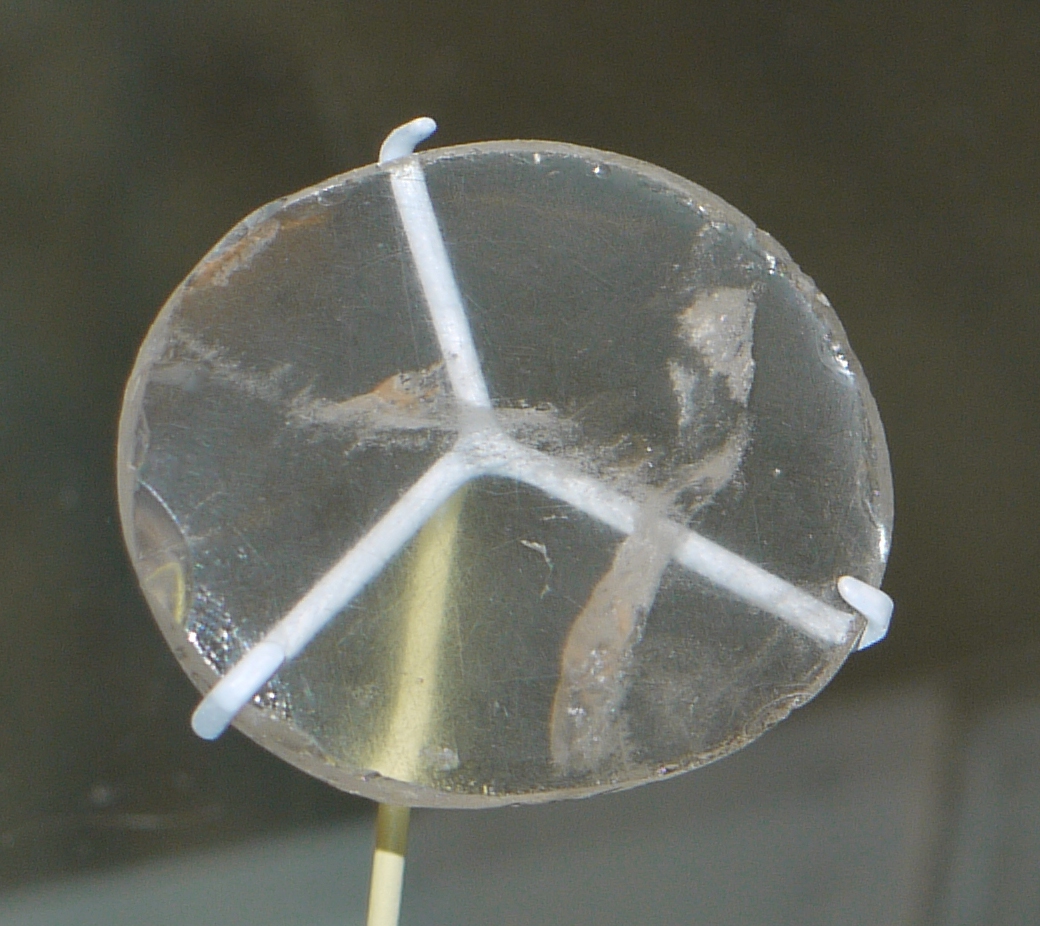
Pulled from the ruins of an Assyrian palace in 1850, a small piece of polished rock crystal has quietly challenged assumptions about when humans first understood optics.
Dating to the eighth century BCE, the Nimrud Lens is cited as an out-of-place artifact because its shape gives it optical properties equivalent to a 3X magnifying glass with a focal length of about 4.7 inches – an advanced level of optical design for its era. That precision has fueled speculation the Assyrians used it for detailed carving work, decorative inlay, or possibly even rudimentary astronomical observation, though its optical quality isn’t strong enough to prove it belonged to an ancient telescope. Whether the lens effect was intentional or accidental is still unresolved, and no comparable object from the same period has ever surfaced to settle the question.
An optical device from 750 BCE is impressive. An iron structure that has never rusted in 1,600 years might be even harder to believe – that’s #5.
#5 – The Iron Pillar That Refused to Rust for 1,600 Years

Standing in Delhi’s Qutb complex is a column that shouldn’t exist by ordinary metallurgical standards – a massive iron structure that has weathered monsoons for over a millennium without meaningfully corroding.
The Iron Pillar of Delhi is a 24-foot, six-ton column of 98 percent pure wrought iron, seemingly erected around 400 CE during the reign of the Gupta emperor Chandragupta II. For decades this baffled visitors and scientists alike, since ordinary iron left outdoors typically rusts through within a few decades. Scientific analysis in 2003 revealed the corrosion resistance comes from a thin, passive protective layer called misawite, formed because ancient Indian blacksmiths used a direct reduction process resulting in unusually high phosphorus and low sulfur content – a chemistry that, combined with Delhi’s dry climate, catalyzed the protective layer. The achievement wasn’t magic – it was expert craftsmanship exploiting a specific regional ore chemistry that modern industrial steel doesn’t typically replicate.
At a Glance
- 24 feet tall, weighing roughly six tons
- 98 percent pure wrought iron
- Erected around 400 CE under Gupta emperor Chandragupta II
- Protected by a thin layer called misawite
- Corrosion resistance confirmed by scientific analysis in 2003
A rust-proof pillar took skilled blacksmiths generations to perfect. What early Japanese hunter-gatherers accomplished with clay is even less expected – that’s #4.
#4 – Jomon Pottery: Ceramics Before Farming Existed
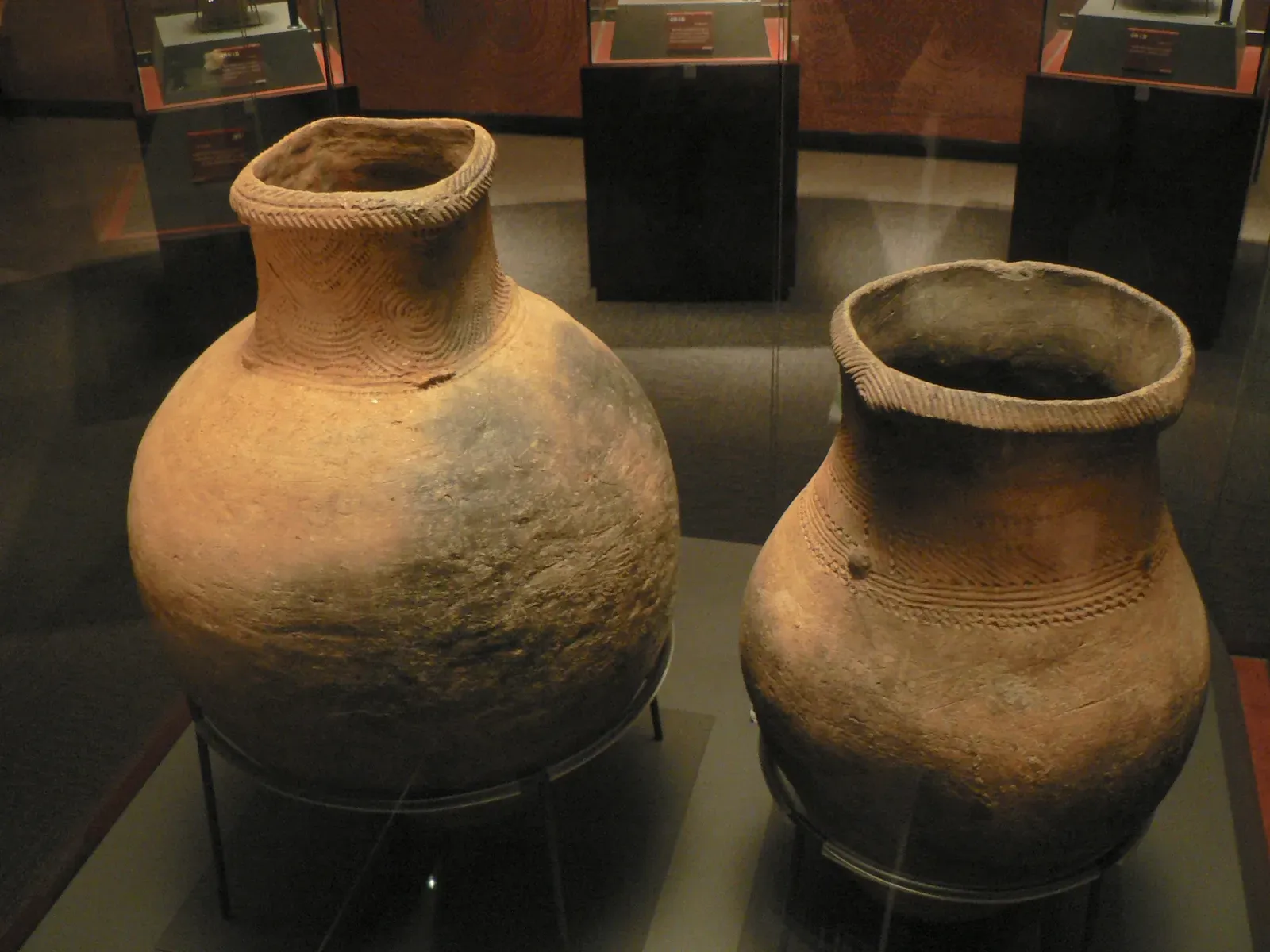
Long before agriculture reshaped human society, hunter-gatherers in prehistoric Japan were already producing something historians assumed required a settled farming life: fired ceramic vessels.
Jomon pottery has been dated to around 16,000 years ago and is regarded as the oldest in the world, though pottery of similar age has also turned up in southern China, the Russian Far East, and Korea. It preceded ceramics from Mesopotamia by over two thousand years, overturning the old assumption that pottery-making followed the rise of farming villages rather than preceding it. Thousands of examples have been excavated from Jomon sites, proving people made the craft on an industrial scale despite living a fully mobile hunter-gatherer lifestyle. Mobile foragers were mass-producing fired ceramics thousands of years before anyone in the Fertile Crescent tried it. That single fact quietly rewrote a core assumption in world history textbooks.
If pottery arrived early, wait until you see what arrived even earlier – an entire monumental complex predating farming altogether. That’s #3.
#3 – Göbekli Tepe: Monuments Before Agriculture Existed
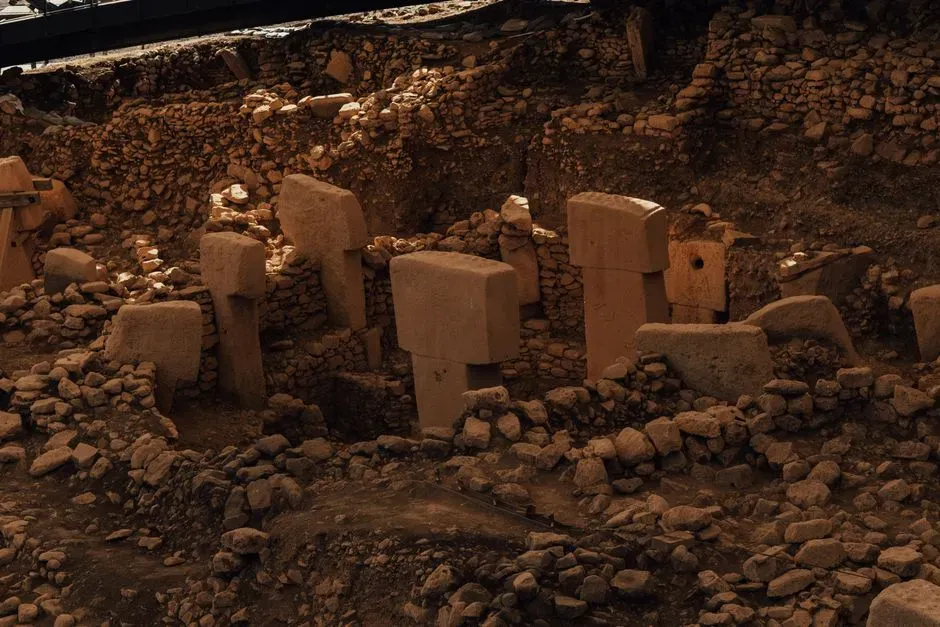
For most of the twentieth century, archaeologists assumed monumental architecture required farming, food surplus, and settled hierarchy first. A hilltop in southeastern Turkey proved that assumption completely backward.
Massive carved stones about 11,000 years old were crafted and arranged by people who had not yet developed metal tools or even pottery, and the megaliths predate Stonehenge by roughly 6,000 years. Every line of evidence – the stone tools, the absence of pottery, and the tens of thousands of animal bones recovered, all from wild species – points to a society of hunter-gatherers rather than farmers. These people had not yet taken up agriculture, yet they quarried and erected structures on a scale scholars once assumed required an agricultural surplus. The site essentially proves religion and ritual organization came before economics, not after it.
Why It Stands Out
- Roughly 11,000 years old
- Predates Stonehenge by about 6,000 years
- Built without metal tools or pottery
- Constructed by hunter-gatherers, not farmers
- Challenges the theory that agriculture came before religion
Rewriting the origin of civilization itself is a massive claim. But even that gets overshadowed by a glass cup that used chemistry we couldn’t explain until the 1990s – that’s #2.
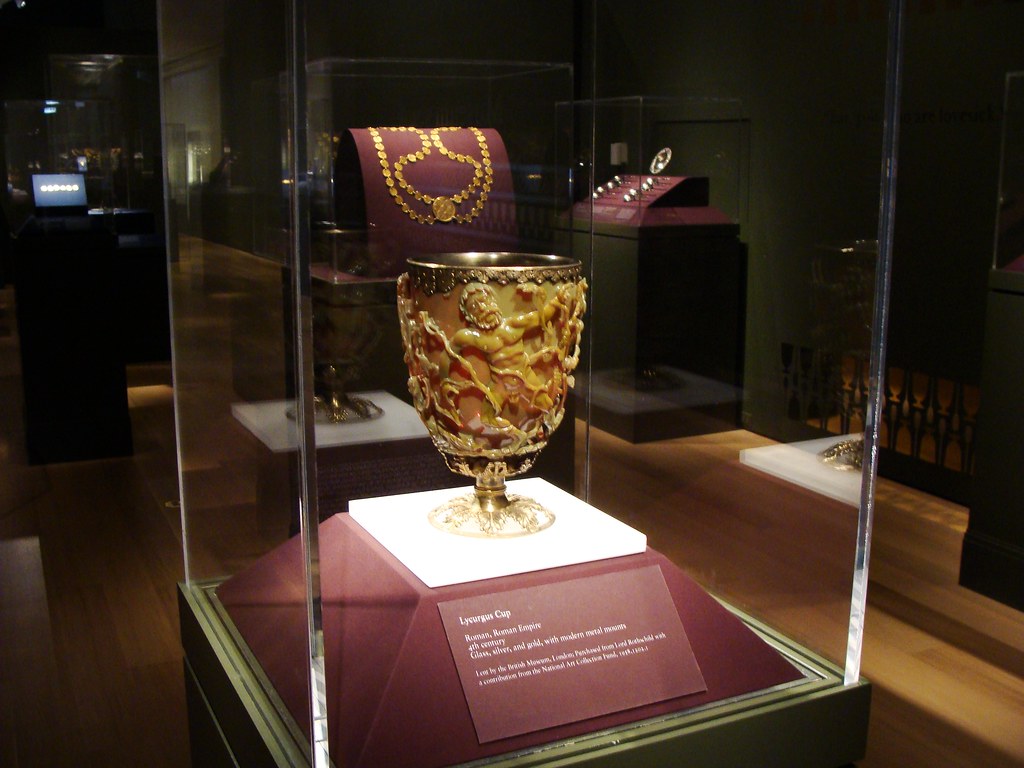
#2 – The Lycurgus Cup’s Accidental Nanotechnology
A 1,600-year-old Roman drinking cup sitting in the British Museum uses a physics trick that modern scientists didn’t fully understand until electron microscopes became powerful enough to look inside the glass.
The Lycurgus Cup exhibits dichroic properties, changing color from jade green to ruby red when backlit due to embedded colloidal gold and silver nanoparticles that alter the wavelength of transmitted light in a size-dependent way. The particles are as small as twenty nanometers in diameter – less than one thousandth the width of a grain of table salt – added during manufacturing. It’s the only fully intact ancient glass object displaying this optical property, and experts believe the effect was likely accidental, since it’s improbable ancient artisans fully grasped the underlying physics. Roman glassmakers stumbled into nanotechnology by trial and error, sixteen centuries before the field had a name.
An accidental nanotechnology breakthrough is remarkable. But nothing tops a 2,000-year-old device that modern researchers still call “out of this world” – that’s #1.
#1 – The Antikythera Mechanism: The Computer Nobody Expected
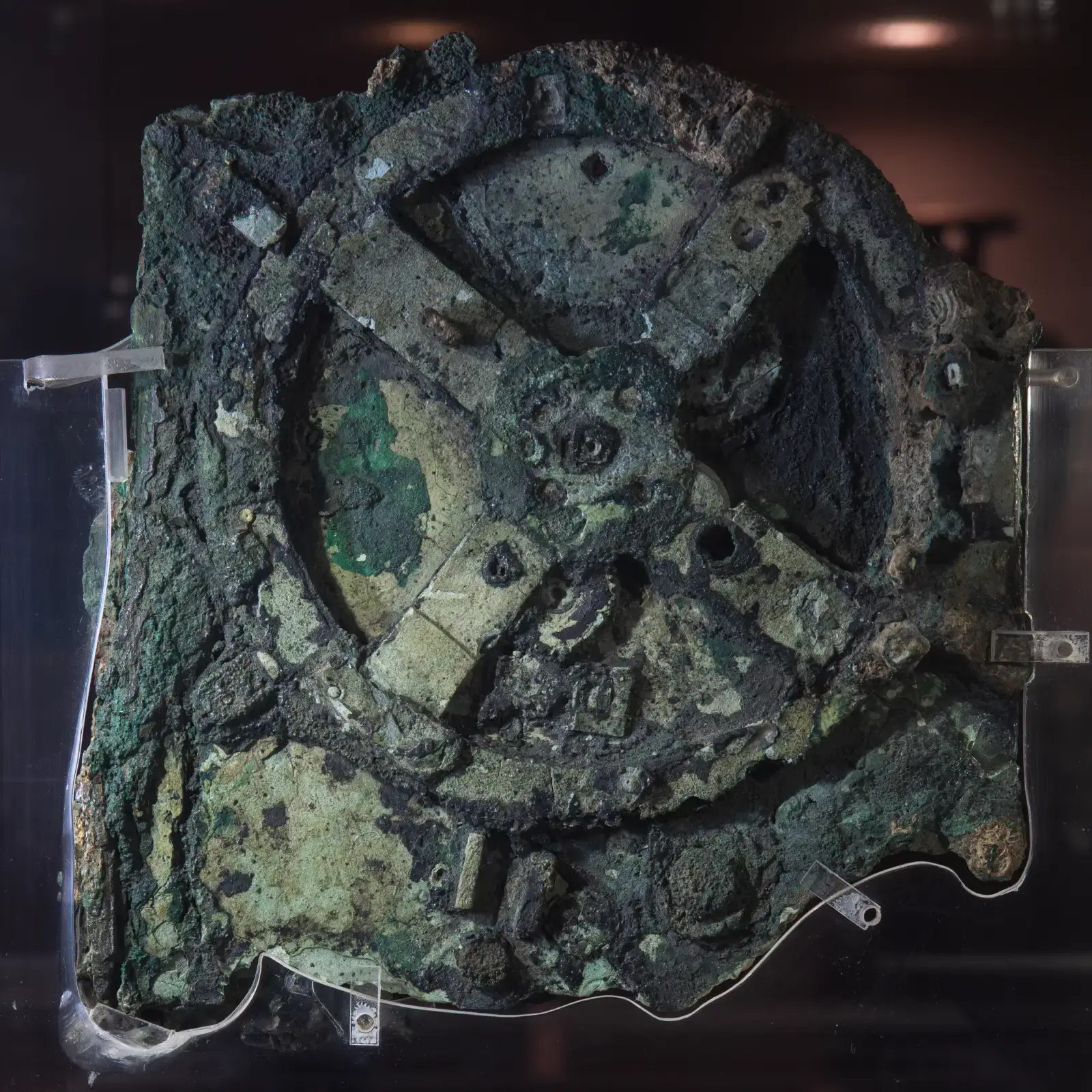
Pulled from a Roman shipwreck in 1901, a corroded lump of bronze sat misunderstood in a museum drawer for decades before anyone realized it was arguably the most sophisticated machine to survive from the ancient world.
Divers exploring the wreck off Antikythera found a baffling device – a complex arrangement of over 30 gears that could determine the position of the sun, moon, and planets, predict eclipses, and track the dates of the Olympic Games. The mechanism has challenged researchers ever since; now split into 82 fragments, only a third of the original survives, including 30 corroded bronze gearwheels. Researchers who finally modeled its full gear train were stunned by the gap between it and everything else from antiquity.
The distance between this device’s complexity and others made at the same time is infinite. Frankly, there is nothing like it that has ever been found.
Materials scientist, on the Antikythera Mechanism
Nothing built with comparable mechanical complexity would appear again for well over a thousand years.
The Bottom Line

None of these objects prove ancient people had secret modern technology handed to them. What they prove is simpler, and honestly more impressive: human ingenuity has never been evenly distributed across time.
A Roman glassmaker stumbled into nanoparticles. A Greek engineer built a mechanical cosmos out of bronze gears. Hunter-gatherers fired pottery and raised megaliths before “civilization” was supposed to have started at all.
The real lesson isn’t ancient mystery – it’s that we keep underestimating people who didn’t have our tools but clearly had our curiosity. Every one of these objects survived by accident, buried, lost, or simply overlooked, which means the ones we haven’t found yet are still out there, waiting to make the next textbook wrong.