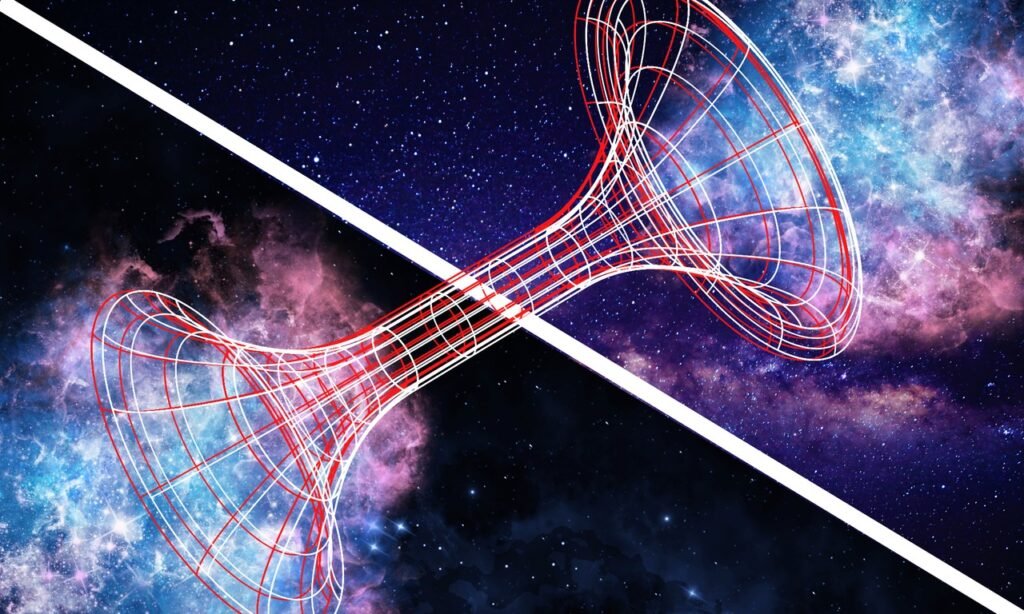

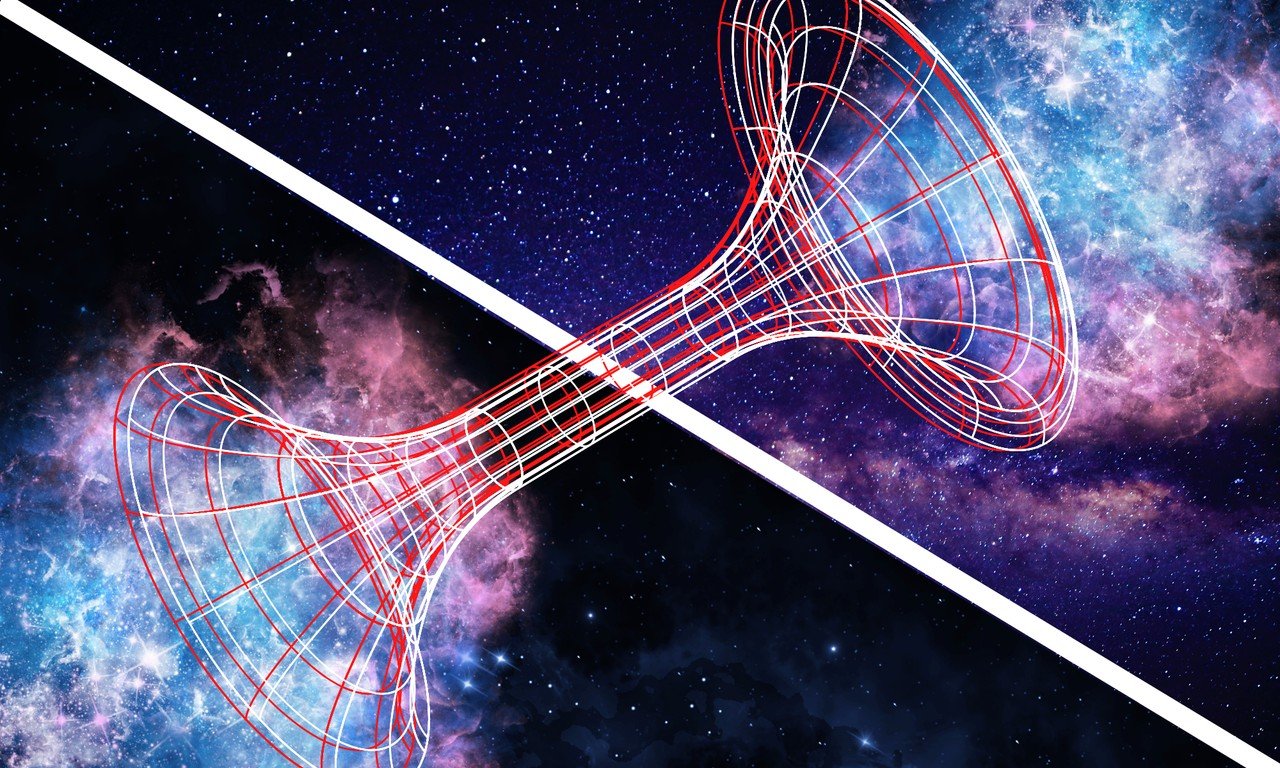
Popular Portals That Never Were (Image Credits: Cdn.mos.cms.futurecdn.net)
Physicists recently uncovered a fresh interpretation of Einstein-Rosen bridges that shifts focus from spatial tunnels to profound connections between forward and backward arrows of time.
Popular Portals That Never Were
Science fiction long portrayed wormholes as cosmic shortcuts, enabling instant travel across vast distances. Yet this vision stemmed from a misreading of foundational work.
In 1935, Albert Einstein and Nathan Rosen described a mathematical “bridge” linking symmetrical regions of spacetime. Their goal centered on resolving inconsistencies between quantum fields and extreme gravity, not crafting pathways for explorers. Decades later, theorists speculated about traversable versions, but calculations revealed instability: the structures collapsed faster than light could pass through.
Observational evidence for such features remains absent, leaving them as intriguing artifacts of theory rather than reality.
Time’s Hidden Symmetry Emerges
Fundamental physics laws treat past and future symmetrically, a principle recent analysis applied directly to Einstein-Rosen bridges. Researchers reframed them as mirrors uniting two quantum states: one with time advancing forward, the other reversed from a mirrored vantage.
This view ensures quantum evolution stays complete and reversible, even amid gravity’s curves. Near black holes or during cosmic expansion and contraction, both temporal directions prove essential for consistency. Everyday experience favors one arrow, driven by rising entropy, but microscopic reality demands balance.
Black Hole Paradoxes Dissolved
Stephen Hawking demonstrated in 1974 that evaporating black holes emit radiation, seemingly destroying information – a clash with quantum rules. Traditional fixes relied on single-directional time extended infinitely.
The new framework sidesteps this by incorporating reversed time across event horizons. Information persists, shifting to the mirror direction rather than vanishing. No exotic matter or theory tweaks required; symmetry alone suffices.
Cosmologists noted a subtle cosmic microwave background asymmetry for years, hinting at such dual structures. Standard explanations deemed it unlikely, but time-reversed components fit naturally.
A Bouncing Universe Takes Shape
The reinterpretation extends to cosmology, portraying the Big Bang not as an origin but a rebound from prior contraction.
Our expanding cosmos might nest inside a black hole from a parent universe that collapsed before bouncing outward. Temporal bridges, rather than spatial ones, link these epochs. Relics like primordial black holes could endure the transition, perhaps accounting for some dark matter.
- Black holes serve as gateways between cosmic phases.
- The bounce preserves quantum unitarity without singularities.
- Pre-bounce signatures may lurk in microwave background patterns.
- Smaller black holes from earlier eras could explain unseen mass.
- No need for inflation; symmetry handles early uniformity.
Key Takeaways
- Einstein-Rosen bridges connect time directions, not distant spaces.
- They resolve the black hole information loss without new physics.
- The Big Bang emerges as a temporal bounce to a hidden cosmic past.
This perspective harmonizes quantum mechanics and general relativity, revealing time’s bidirectional essence at fundamental scales. It discards hyperspace fantasies for a universe where history precedes the glow we call creation. What implications does a time-symmetric cosmos hold for our understanding of reality? Share your thoughts in the comments.