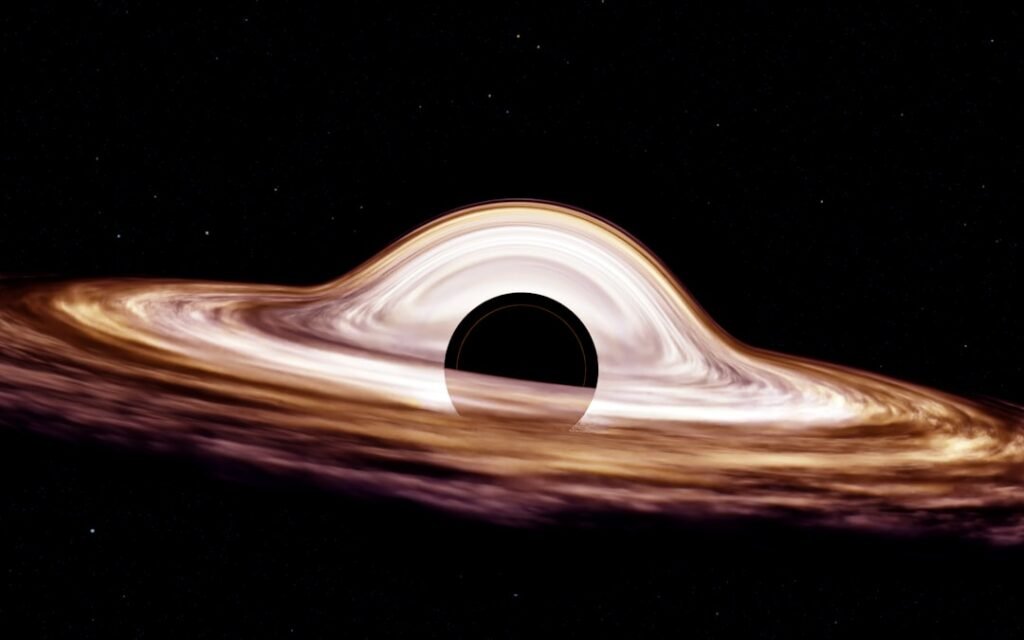

Doubts Surround the Schwarzschild Singularity (Image Credits: Unsplash)
Physicists in the 1950s questioned whether the Schwarzschild solution described a robust feature of spacetime or a delicate structure vulnerable to the slightest nudge.[1][2]
Doubts Surround the Schwarzschild Singularity
Researchers faced uncertainty about the Schwarzschild metric, which models the spacetime around a spherical, non-rotating mass. This solution featured a singularity at a critical radius, later understood as an event horizon. Many wondered if such a configuration could persist in nature.
Tullio Regge and John Archibald Wheeler took up the challenge in 1957. They examined whether small disturbances could destabilize this geometry. Their work predated the term “black hole,” coined by Wheeler a decade later, but targeted the same phenomenon.[1][2]
Their motivation stemmed from broader confusion in general relativity. Stellar collapse models suggested horizons formed, yet stability remained unproven. Regge and Wheeler sought to perturb the metric and observe the outcome.
Perturbations: Twisting and Stretching Spacetime
The duo introduced weak linearized perturbations to the Schwarzschild metric. They decomposed distortions using spherical harmonics, separating them into odd-parity (axial) and even-parity (polar) modes. Odd modes twisted spacetime like frame-dragging, while even modes compressed and expanded it.[3]
Gauge freedom complicated matters, as different coordinates could mimic varying physical effects. Regge and Wheeler devised the Regge-Wheeler gauge to eliminate non-physical terms. This simplification proved essential for analysis.[1]
- Odd-parity perturbations decoupled into a single master equation.
- Even-parity ones required coupled equations, later decoupled by Frank Zerilli in 1970.
- Boundary conditions ensured perturbations radiated away or grew unstably.
- Tortoise coordinates stretched the radial domain, making the horizon appear distant.
The Regge-Wheeler Equation Emerges
For axial perturbations, their efforts yielded the Regge-Wheeler equation: a Schrödinger-like wave equation in tortoise coordinates. It read as d²Q/dr*² + [ω² – V_RW(r)] Q = 0, where Q gauged perturbation amplitude, ω set frequency, and V_RW formed an effective potential barrier.[1][3]
Solutions revealed oscillatory behavior trapped by the potential. Waves entered, rang, and damped, dissipating energy as gravitational radiation. No runaway growth appeared, signaling stability.
Regge filled equations left blank by Wheeler during their collaboration in Leiden, Netherlands, in 1956. They submitted findings to Physical Review, concluding the Schwarzschild singularity endured.[2]
Quasinormal Modes and the Sneezing Ant
C.V. Vishveshwara built on this in 1970, proving full stability and identifying quasinormal modes – characteristic ringing frequencies unique to the black hole’s mass. These modes echoed regardless of disturbance source.[4]
He illustrated fragility risks with a sneezing ant: an unstable black hole would shatter from such a trivial event. Yet perturbations merely excited ringing that faded, affirming resilience.[1]
| Perturbation Type | Key Equation | Outcome |
|---|---|---|
| Axial (Odd) | Regge-Wheeler | Damped waves |
| Polar (Even) | Zerilli | Identical spectrum |
Resonating Through Gravitational Wave Era
The framework underpins modern analyses. LIGO detections of merging black holes feature ringdown phases matching quasinormal modes, testing general relativity and no-hair theorem.[1]
Extensions to rotating Kerr black holes via Teukolsky equation expanded applications. Black hole spectroscopy now probes masses, spins, and exotic alternatives.
Key Takeaways:
- Schwarzschild black holes resist tiny disturbances, ringing down stably.
- Regge-Wheeler gauge and equation remain tools for perturbation theory.
- Quasinormal modes enable gravitational wave “fingerprinting” of black holes.
Regge and Wheeler’s insight proved cosmic giants unshakeable, paving roads from theory to LIGO’s triumphs. What aspect of black hole physics fascinates you most? Share in the comments.