The Galaxy Formation Problem That Nobody Expected (image credits: wikimedia)
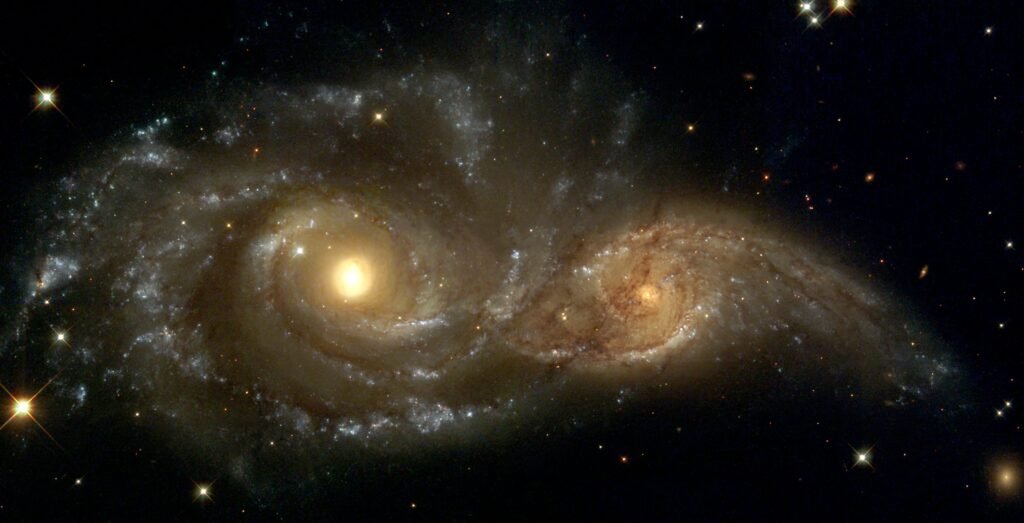
Astronomers have unveiled a breathtaking new image from the James Webb Space Telescope (JWST) paired with NASA’s Chandra X-ray Observatory that reveals a dramatic cosmic spectacle: two spiral galaxies in the midst of a slow gravitational collision that produces an intricate “web of chaos” of stars, dust, and gas 120 million light-years from Earth in the constellation Canis Major. This stunning composite image brings together JWST’s mid-infrared view of cooler structures and Chandra’s high-energy X-ray data to highlight both the serene and violent facets of this galactic encounter.
Far from a static snapshot, the scene offers scientists a rare, face-on glimpse of how colliding galaxies warp and intertwine their spiral arms, triggering star birth and reshaping their stellar neighborhoods over millions of years. The image, one of several recently released showing extraordinary cosmic activity, underscores the ongoing revolution in astrophysical imaging driven by Webb’s unprecedented sensitivity and resolution.
A Cosmic Collision Revealed
The interacting pair, known as NGC 2207 and IC 2163, are caught in a gravitational embrace that stretches and distorts their spiral arms, forming a spectacular lattice of material. As the galaxies tug on one another, regions of dust and gas are compressed, creating fertile zones for new stars to form within the tangled structure.
Viewed from Earth, this merger looks like a vast cosmic web—a dramatic and evolving tangle of light and dark patterns that speak to the immense forces at play. By combining infrared and X-ray data, scientists can distinguish between cooler, dust-enshrouded star-forming regions and the high-energy remnants of massive stellar events.
The Power of Multi-Wavelength Astronomy
The image blends JWST’s mid-infrared data, which highlights cooler dust and organic material in shades of white, gray, and red, with Chandra’s X-ray signals, shown in blue, identifying energetic phenomena such as supernova remnants and binary star systems. This multi-wavelength approach allows astronomers to see both the calm and chaos of galactic evolution in a single frame.
Such composite imagery provides a more complete understanding of how galaxies grow and interact. Infrared wavelengths penetrate dusty regions to show where stars are forming, while X-rays reveal the aftermath of past stellar deaths and the influence of compact, energetic objects.
Star Formation in the Midst of Turmoil
As tidal forces pull on these galaxies, star formation is sparked in regions where gas and dust accumulate. These newborn stars shine brightly in the infrared, illuminating the dark tendrils of the cosmic web and offering clues about how galactic collisions fuel stellar nurseries.
Colliding galaxies like NGC 2207 and IC 2163 serve as natural laboratories for studying the lifecycle of stars and the dynamics of galactic evolution. The interactions redistribute gas and dust, often leading to bursts of star formation that can outshine entire regions of the original galaxies.
What the “Web of Chaos” Tells Us
This newly released image is part of a series showcasing cosmic phenomena as captured by JWST and other observatories, including supernova remnants and star-forming regions. Studying such interactions helps scientists refine models of how galaxies merge and evolve over time—processes that have shaped the universe for billions of years.
The “web of chaos” structure itself is emblematic of the complexity inherent in galactic collisions, illustrating how gravitational forces can create a tapestry of light, motion, and matter that spans vast cosmic distances.
The Future of Deep-Space Imaging
As telescopes like JWST continue to deliver high-definition images of distant galaxies and cosmic events, astronomers anticipate even more revelations about the mechanics of the universe’s largest structures. These insights will deepen understanding of not only galactic interactions but also the environments that foster star formation and the life cycles of stellar systems.
By layering data from multiple observatories and wavelengths, researchers can build three-dimensional narratives of cosmic events, bringing these distant dramas into clearer focus for scientists and the public alike.
The latest image from the James Webb Space Telescope and Chandra X-ray Observatory is more than an eye-catching piece of art—it is a powerful scientific tool that reveals the dynamic processes governing our universe. This “intricate web of chaos” not only showcases the beauty of colliding galaxies but also highlights how far space observation has advanced. As we peel back the layers of cosmic history, the universe appears both more interconnected and more turbulent than we once imagined. These images remind us that the cosmos is not a static backdrop but a living, evolving arena of creation and destruction, where each collision tells a story of transformation on a grand scale.