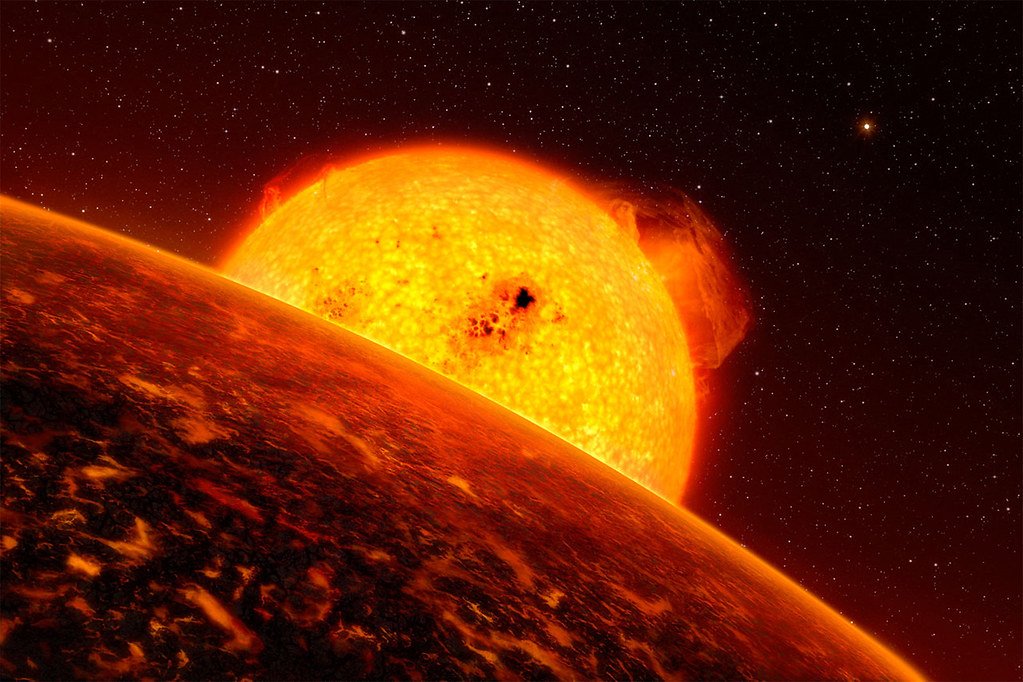
Starquakes Unveil the Enigmatic Spin of a Red Giant (Image Credits: NASA Goddard Space Flight Center)
Astronomers recently unraveled the peculiar backstory of a red giant star through faint oscillations detected in its light, exposing an orbit around a quiet black hole and a history marked by unexpected velocity and composition.
A Celestial Oddity Emerges from Vibrations
Researchers at the University of Hawaiʻi Institute for Astronomy identified subtle “starquakes” in the red giant’s light using data from NASA’s Transiting Exoplanet Survey Satellite. These vibrations, akin to seismic waves on Earth, provided a window into the star’s interior dynamics. The discovery highlighted a binary system where the red giant completes an orbit every 500 days around an unseen companion estimated to be a black hole of about three solar masses.
The black hole remains dormant, emitting no detectable radiation, which made the pair challenging to study until now. By analyzing the star’s oscillations, scientists measured its rotation rate at the surface – far exceeding typical speeds for such evolved stars. This rapid spin, combined with the star’s expanded envelope, suggested forces at play that defied standard evolutionary models.
Rapid Rotation Hints at a Violent Past
The red giant’s unusually high spin rate pointed to a disruptive event in its lifetime, likely a merger with a companion star. Such collisions can inject angular momentum, accelerating the survivor’s rotation to levels unseen in isolated red giants. In this case, the merger would have occurred when the star was still on the main sequence, altering its path dramatically.
Evidence from the starquakes supported this scenario, as the vibrations revealed an internal structure more akin to a younger star than one expected to be billions of years old. The core’s density and mixing patterns indicated recent upheavals that homogenized materials deep within. This mismatch between age indicators challenged astronomers to rethink how binary interactions shape stellar evolution.
Chemical Clues Paint a Contradictory Picture
Spectroscopic analysis of the star’s atmosphere uncovered an abundance of heavy elements, suggesting prolonged exposure to multiple stellar generations – traits of an ancient object. Yet, the internal models derived from asteroseismology contradicted this, estimating the star’s true age at around five billion years, relatively youthful for a red giant.
The discrepancy arose from the merger’s influence, which likely dredged up pristine material from the engulfed star, skewing surface compositions. Elements like carbon and nitrogen showed enhancements typical of processed interiors, but the overall profile remained puzzling. This dual nature underscored the complexities of binary systems in galactic evolution.
Implications for Binary Star Systems
Discoveries like this one illuminate the role of mergers in populating the galaxy with anomalous stars. In binary setups involving black holes, such events could explain the scarcity of observable companions, as mergers often leave behind compact remnants.
Future observations with telescopes like the James Webb Space Telescope may refine these findings, potentially detecting similar systems. The study, detailed in a recent publication, emphasized how asteroseismology bridges gaps in our understanding of hidden cosmic partnerships.
- Rapid surface rotation: Over 10 km/s, unusual for red giants.
- Starquake frequencies: Revealed a convective core larger than predicted.
- Chemical anomalies: High metallicity suggesting ancient origins, yet young interior.
- Orbital period: Approximately 500 days around a 3-solar-mass black hole.
- Merger evidence: Angular momentum boost from past collision.
Key Takeaways
- The red giant’s starquakes exposed a merger history that accelerated its spin.
- Surface chemistry indicates age, but internal structure suggests youth.
- This system offers insights into dormant black hole binaries.
This red giant’s story reminds us that the universe harbors survivors of cosmic crashes, reshaping our views on stellar lifecycles. As we decode more such enigmas, the tapestry of galactic history grows richer – what secrets might the next vibration reveal? Share your thoughts in the comments.