
Imagine looking up at the night sky and realizing that everything you can see – every star, every galaxy, every glowing nebula – makes up less than five percent of what actually exists. The rest? Invisible. Undetectable by any camera, any telescope, any instrument ever built. It’s not hiding in the shadows. It simply doesn’t interact with light at all. That’s the baffling reality of dark matter.
This isn’t science fiction, and it’s not a fringe theory cooked up in some obscure corner of academia. Dark matter is one of the most rigorously studied mysteries in all of modern physics, and yet we still can’t tell you what it’s made of. What scientists can tell you is that without it, you, me, this planet, and every galaxy in the universe probably wouldn’t exist. So let’s dive in.
The Invisible Glue Holding the Universe Together
Here’s the thing – when most people hear “dark matter,” they picture something sinister or exotic. But honestly, the concept is almost frustratingly simple. Dark matter is the invisible glue that holds the universe together. This mysterious material is all around us, making up most of the matter in the universe. Think of it like the metal rebar hidden inside a concrete structure. You can’t see it from the outside, but pull it out and the whole thing collapses.
A fundamental scientific problem with the universe is that there’s way more gravity than there should be. Basically, there’s not enough visible objects like stars, planets, and cosmic dust to create the amount of gravity that’s been observed on the galactic scale. One theory for the extra gravity is that there’s a ton of matter out there in the universe that we can’t see. It’s a bit like baking a cake and discovering it weighs five times more than the sum of your ingredients. Something is definitely going on, and you can’t just ignore it.
How Much of the Universe Is Actually Dark Matter?
Scientists estimate that ordinary matter makes up only about five percent of the universe, while dark matter makes up about twenty-seven percent. The rest is thought to be dark energy, which is its own mystery. Let that sink in for a moment. The stars, the planets, the oceans, your own body – all of that makes up just a tiny sliver of what the universe is composed of. Ordinary matter is, cosmically speaking, almost a rounding error.
Dark matter makes up about eighty-five percent of the matter in the universe. Scientists think it exists as an invisible web extending across the universe, creating a scaffold for all the stars and galaxies that we see around us. Without dark matter, the universe would be smooth and uniform all the way across – and we wouldn’t exist. If you find that statement unsettling, you’re not alone. It’s one of those facts that science keeps confirming, and the human brain keeps quietly refusing to fully accept.
Why Scientists Cannot Simply “See” Dark Matter
Unlike normal matter, dark matter does not interact with the electromagnetic force. This means it does not absorb, reflect or emit light, making it extremely hard to spot. Every tool we’ve ever used to observe the universe – optical telescopes, radio arrays, X-ray satellites – all of them rely on detecting electromagnetic radiation in one form or another. Dark matter simply refuses to play along with any of that.
Until now, scientists have only been able to study dark matter indirectly by observing how it affects ordinary matter, such as the way it produces enough gravity to hold galaxies together. Direct detection has not been possible because dark matter particles do not interact with electromagnetic force – meaning they do not absorb, reflect or emit light. It’s a bit like trying to prove a ghost exists by measuring the creak of a floorboard. You’re not seeing the ghost, but you are seeing its effect. That indirect evidence, however, turns out to be overwhelming.
The History of Dark Matter: Fritz Zwicky and the First Clue
In the early 1930s, Swiss astronomer Fritz Zwicky observed galaxies in space moving faster than their mass should allow, prompting him to infer the presence of some invisible scaffolding – dark matter – holding the galaxies together. This was a radical idea for its time, and the scientific community largely dismissed it. Zwicky was known for being brilliantly eccentric, and his colleagues weren’t quite sure what to make of the claim.
Later discoveries provided such strong evidence for dark matter that the concept was embraced by the scientific community. Today, while not all astronomers agree on what dark matter might be, its existence is widely accepted. What really changed the conversation was the work of astronomer Vera Rubin in the 1970s, who studied the rotation speeds of galaxies and found the same troubling pattern Zwicky had identified: stars at the outer edges of galaxies were spinning far too fast. The math simply didn’t work without something invisible providing extra gravitational pull.
Gravitational Lensing: Seeing Dark Matter by What It Does to Light
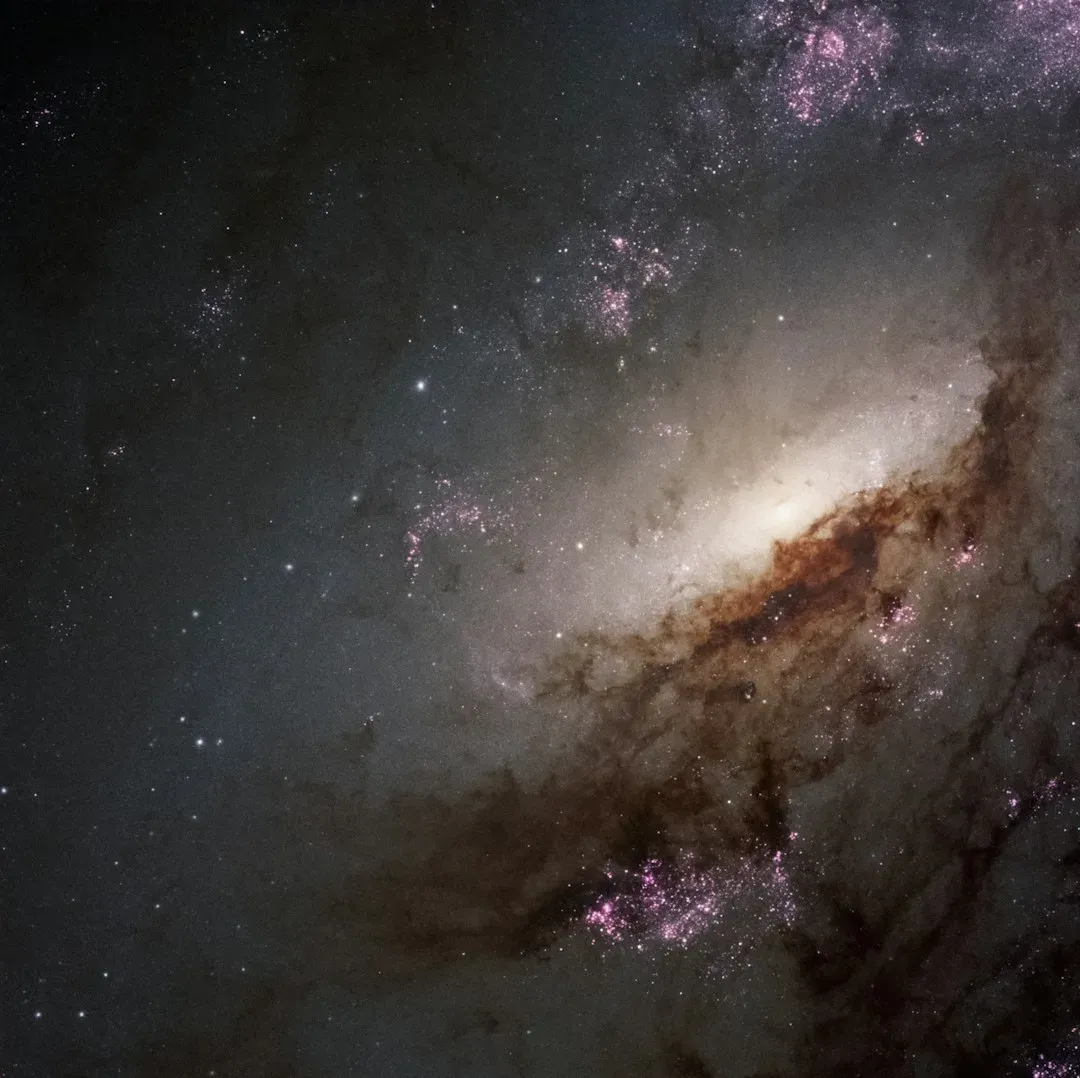
While dark matter doesn’t interact with light, its gravity can bend light from distant galaxies, creating an effect called gravitational lensing. Studying galaxies distorted by gravitational lensing can help scientists better understand dark matter and its place in the universe. Think of it like placing an enormous magnifying glass in the middle of space. Even though you can’t see the lens itself, you can see the distorted image it creates. That’s exactly what dark matter does to light passing by it.
Visible matter reveals itself by shining brightly, but astronomers detect dark matter by its gravitational influence on the light we see. By looking at the area around massive galaxy clusters, astronomers can identify warped background galaxies gravitationally lensed by the cluster and reverse-engineer their distortions. Mathematical models of these results shed light on the location and properties of the densest concentrations of matter in the cluster, both visible and invisible. It’s detective work on a cosmic scale, and honestly, it’s one of the most elegant strategies in all of science.
Dark Matter and the Cosmic Web: The Architecture of Everything
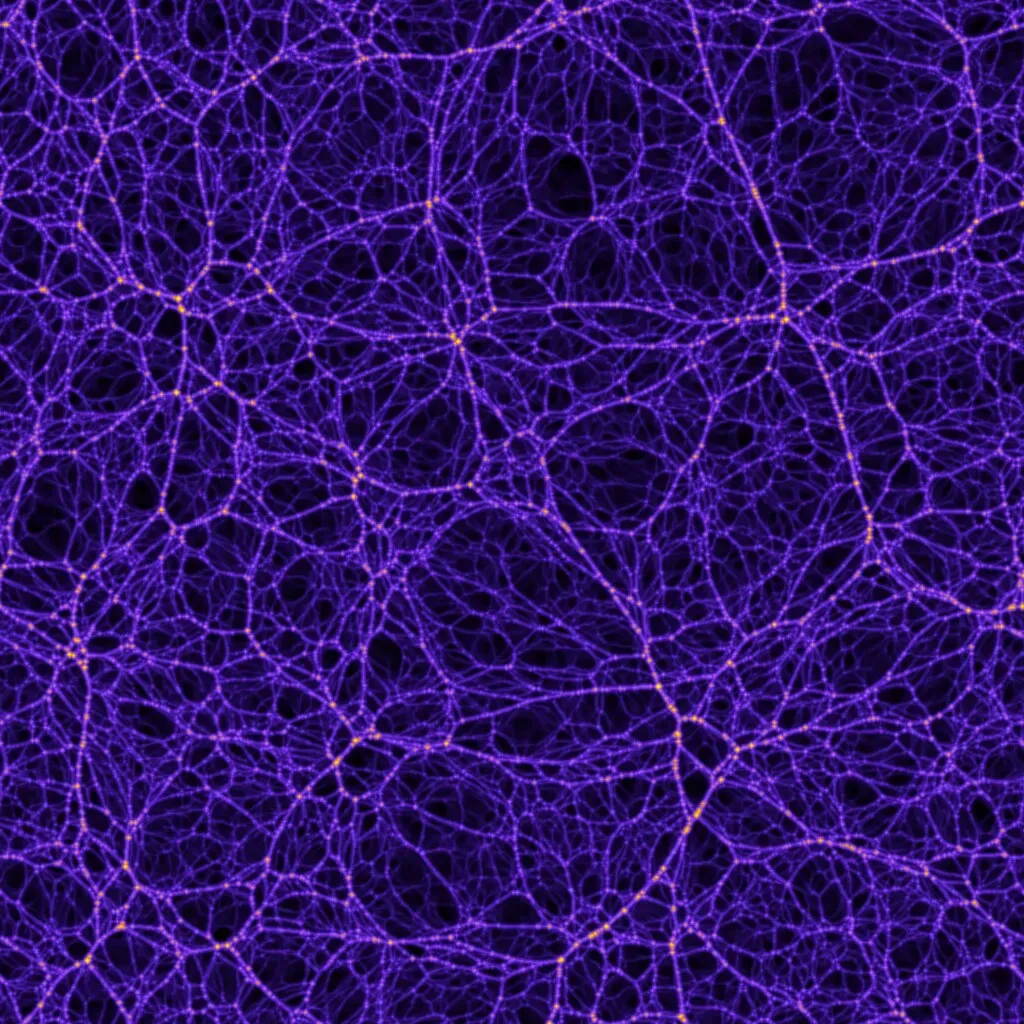
Dark matter is thought to serve as gravitational scaffolding for cosmic structures. After the Big Bang, dark matter clumped into blobs along narrow filaments with superclusters of galaxies forming a cosmic web at scales on which entire galaxies appear like tiny particles. Imagine a spider’s web stretched across the entire observable universe, with galaxies clustered at every intersection. That’s not a metaphor – that’s a description of real structure that scientists have mapped.
When the universe began, regular matter and dark matter were probably sparsely distributed. Scientists think dark matter began to clump together first and that those dark matter clumps then pulled together regular matter, creating regions with enough material for stars and galaxies to begin to form. In this way, dark matter determined the large-scale distribution of galaxies in the universe. By prompting galaxy and star formation to begin earlier than they would have otherwise, dark matter’s influence also played a role in creating the conditions for planets to eventually form. In other words, you can thank dark matter for your existence. Try explaining that at a dinner party.
The Leading Suspects: WIMPs, Axions, and Beyond

Many researchers hypothesize that dark matter is made up of something called weakly interacting massive particles, or WIMPs, which are heavier than protons but interact very little with other matter. Despite this lack of interaction, when two WIMPs collide, it is predicted that the two particles will annihilate one another and release other particles, including gamma ray photons. The WIMP hypothesis has dominated dark matter research for decades, largely because the math works out elegantly – a phenomenon physicists affectionately call the “WIMP miracle.”
Axions are now often cited as the leading dark matter candidate given the lack of WIMP signals. In fact, some physicists call the axion “the most likely dark matter candidate today.” Interest in axions has surged – new detection concepts are emerging, from microwave cavity arrays to NMR-like experiments and even gamma-ray telescopes. Other possibilities include primordial black holes and supermassive non-thermal relics. Each candidate has its own strengths, its own theoretical motivations, and its own set of experiments trying to prove or disprove it. It’s a scientific race with no clear front-runner – yet.
The Hunt: Detectors, Underground Labs, and Near Misses

The LUX-ZEPLIN experiment hunts for dark matter from a cavern nearly one mile underground at the Sanford Underground Research Facility in South Dakota. The experiment’s new results explore weaker dark matter interactions than ever searched before and further limit what WIMPs could be. The results analyze two-hundred-and-eighty days’ worth of data. Going underground is not a quirk – it’s a necessity. At the surface, cosmic rays bombard the detector constantly, creating false signals. Buried deep in the earth, researchers can filter out almost all of that noise.
In collaboration with an international team, physicists made a prototype dark matter detector. The detector is designed to create a snapshot of the moment a particle of dark matter hits one of the tiny particles in the detector. The prototype is designed to detect the smallest kinds of particles. They’ve been running their detector at an underground lab a mile below the French Alps to ensure it gets a clean signal when and if dark matter passes through. The lack of detection is very telling – not about what dark matter is, but what it likely isn’t. The result starts to narrow down what flavor of particle dark matter is most likely to be.
Are Scientists Finally Closing In? A Breakthrough in 2025
A University of Tokyo researcher analyzing new data from NASA’s Fermi Gamma-ray Space Telescope has detected a halo of high-energy gamma rays that closely matches what theories predict should be released when dark matter particles collide and annihilate. The energy levels, intensity patterns, and shape of this glow align strikingly well with long-standing models of weakly interacting massive particles, making it one of the most compelling leads yet in the hunt for the universe’s invisible mass. If confirmed, this would be the moment physicists have been waiting for since the 1930s – nearly a century of searching, finally rewarded.
Although the researcher is confident in his analysis, he emphasizes that independent confirmation is essential. Other researchers will need to review the data to verify that the halolike radiation truly results from dark matter annihilation rather than another astrophysical source. Further support could come from finding the same gamma ray signature in other regions rich in dark matter. Science, at its best, is cautious and self-correcting. This result is tantalizing, but extraordinary claims demand extraordinary evidence. The community is watching closely, and more data is on the way.
Conclusion: The Mystery That Shapes Everything
Dark matter is one of those rare scientific mysteries where the more you learn, the more astonishing it becomes. You are living inside a universe where the stuff you can touch, see, and measure is barely a footnote in the total cosmic inventory. The architecture of everything around you – galaxies, star systems, the very conditions that allowed life to arise – was sculpted by something that has never once been directly observed.
What makes this story genuinely exciting in 2026 is that scientists are no longer just philosophizing. The most promising way forward is the same approach that built the case for dark matter: converging evidence from laboratory experiments, astrophysical observations, and cosmological modeling. Detectors are getting more sensitive, telescopes are getting sharper, and the theoretical landscape is broader and more creative than ever. The answer might be closer than anyone expects.
We’ve spent nearly a century staring into the dark, learning its shape by the shadows it casts. One day soon, we may finally see what’s casting them. What do you think will be found first – and does it change how you think about the universe you’re living in?