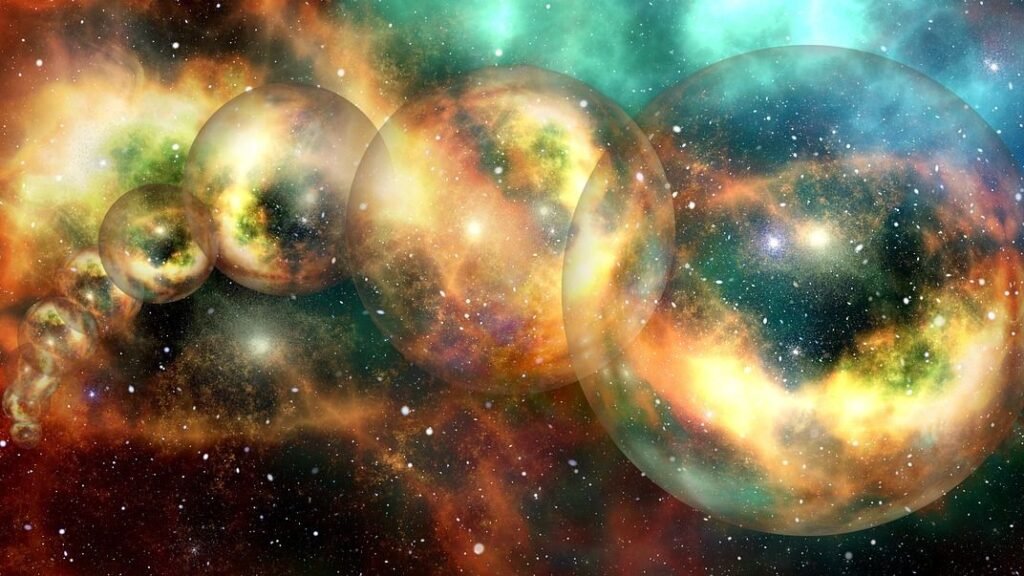

Imagine waking up in a universe where gravity pushes instead of pulls, where light can stand still, or where time loops back on itself like a Möbius strip. It sounds like pure science fiction, but modern physics is actually open to the possibility that other universes could follow rules that are not just slightly tweaked, but radically alien. Thinking about those universes is a bit like looking in a funhouse mirror: the distortions tell you something real about your own face.
We don’t have proof that other universes exist, let alone that they play by different rulebooks. But the idea shows up again and again in serious physics, from cosmology to quantum theory. Exploring these what‑ifs isn’t about escapism; it’s a way to stress‑test our understanding of why our universe is the way it is – and why we’re even here to ask the question in the first place.
The Strange Idea of “Other Universes” in Modern Physics
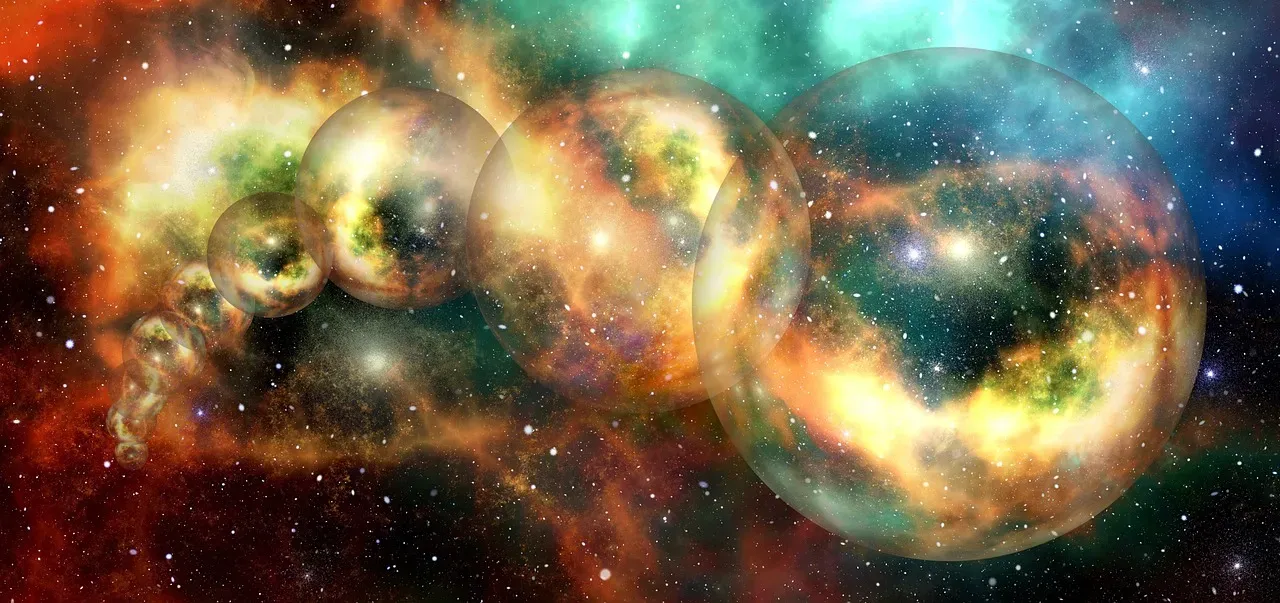
It’s tempting to write off other universes as a movie trope, but several mainstream theories in physics naturally produce something like a multiverse. In some versions of cosmic inflation, our universe is just one bubble in a vast foam of inflating space, each bubble potentially with its own physical constants and conditions. Other ideas, like certain versions of string theory, imagine a huge landscape of possible “vacua,” each with different ways that fundamental fields settle down and define their laws.
There’s also the many‑worlds interpretation of quantum mechanics, where every quantum event branches into different outcomes that all “exist” in parallel. In that picture, the underlying laws are the same across branches, but the histories are different. When people ask what happens if the laws change, they’re reaching beyond this kind of multiverse, toward a deeper question: are our laws unique, or just one option in a bigger cosmic menu?
What does it Mean to “Change the Laws of Physics”?

When we talk about different laws of physics, we’re not necessarily imagining a universe where anything goes, like a fantasy world where you can just wish away gravity. Physicists think in terms of changing numbers, relationships, and symmetries that sit underneath the things we experience. For example, the strength of gravity, the charge of the electron, or the ratio of particle masses could be different, while the overall framework – like quantum mechanics and relativity – might still apply.
On the other hand, it’s also conceivable that even the deep frameworks could differ. A universe might not have anything like our notion of space and time; it could be based on discrete “ticks” instead of continuous flows, or have extra spatial dimensions we don’t experience. The tricky part is that we only know one example of a working universe: ours. So when we speculate about different laws, we’re a bit like a fish trying to imagine life on land with nothing but water‑based intuition.
Gravity Turned Up, Turned Down, or Turned Off
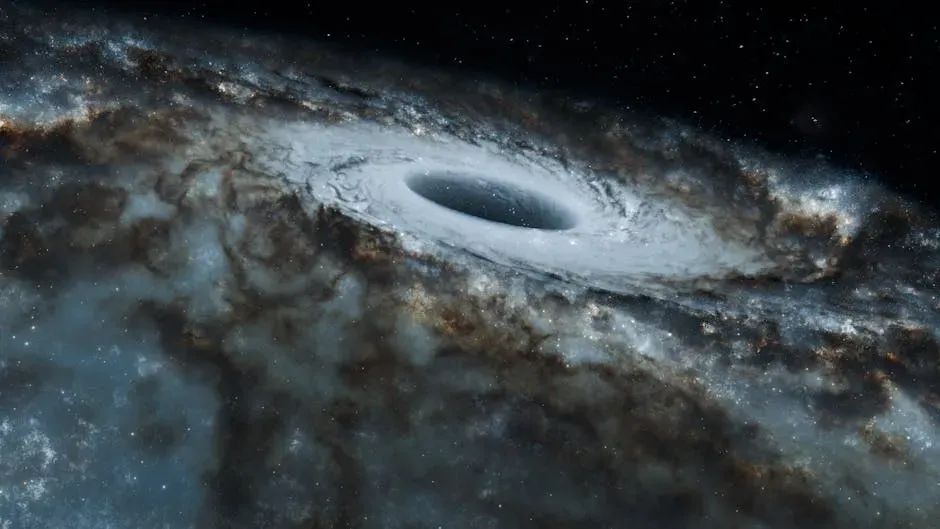
Gravity is the gentlest of the known forces, but it shapes the universe on the largest scales. If gravity were even modestly stronger relative to other forces, matter in the early universe might have collapsed so quickly that stars and galaxies never had time to form. If gravity were much weaker, matter could have spread out so thinly that stars would be rare, short‑lived, or maybe never ignite at all. Either way, the familiar night sky of steady stars and long‑lived galaxies might be impossible.
Some speculative models imagine universes where the law of gravity itself looks different – say, not falling off with distance in the same way, or acting in extra spatial dimensions. In such a place, planetary orbits might be unstable or impossible, and the calm, repeating paths that make seasons and climates in our universe might never arise. The ordinary experience of “down” could vanish entirely, replaced by something far stranger, like geometry that bends in ways our brains are not wired to grasp.
Dials and Knobs: Changing the Fundamental Constants
Physicists sometimes talk about “dimensionless constants,” pure numbers that seem built into reality, like the fine‑structure constant that governs how strongly light and matter interact. In our universe, these numbers just are what they are; we don’t know why. But if you imagine a bigger multiverse, you can think of each universe as setting its constants like dials on a control panel. Turn one dial a little, and suddenly atoms might not be stable; tweak another, and nuclear reactions in stars might never get going.
There are calculations suggesting that if you vary some of these constants by even a modest factor, complex chemistry gets crushed. No stable carbon, no long‑lived stars, no rich periodic table – you end up with a universe dominated by featureless hydrogen gas or black holes and radiation. It’s like trying to bake bread: slightly adjust the oven temperature and you still get food, but remove heat entirely or crank it into oblivion, and the whole concept of “bread” disappears.
Alternate Chemistry: Universes without Familiar Matter
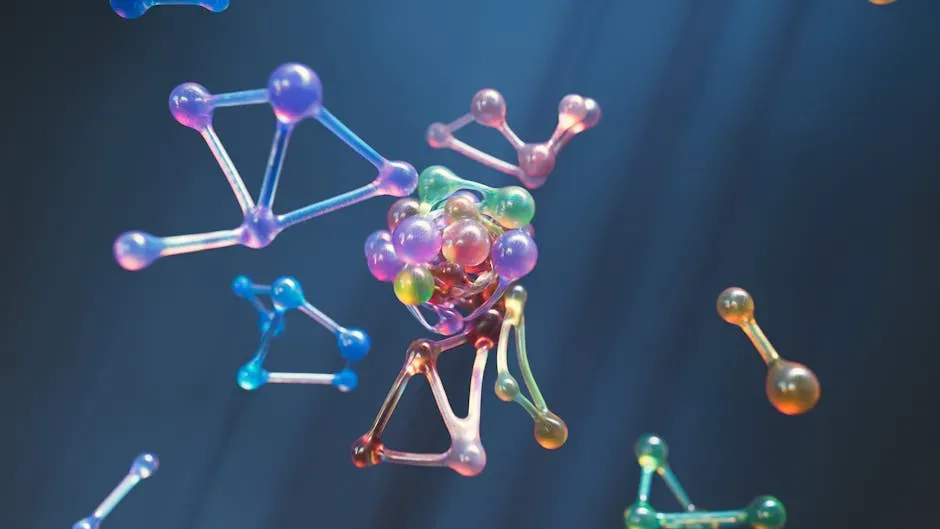
Chemistry as we know it is built on the ways electrons arrange themselves around atomic nuclei made of protons and neutrons. Change the masses or charges of these particles enough, and the periodic table – the grand catalog of possible elements – might collapse to just a handful, or explode into something unrecognizably different. In some hypothetical universes, stable nuclei heavier than hydrogen might not exist at all, so every “atom” would be nearly identical and simple.
On the flip side, there could be universes where different particles are stable, giving rise to weird analogues of atoms with bizarre bonding rules. Maybe what passes for “molecules” there would not form long, flexible chains, the kind that support complex biochemistry in our universe. If you erase that flexibility, you might erase the possibility of DNA‑like information carriers and the rich complexity we associate with life. The universe could still be intricate on a physics level, but chemically barren in ways we’d find deeply alien.
Weird Time: Faster, Slower, or Not in a Straight Line

Time seems obvious to us: it flows forward, one second after another, giving us a clear sense of past, present, and future. But the laws of physics we know often treat time more like another dimension in an equation, and many of those equations don’t actually prefer forward over backward. If you imagine universes where the “arrow of time” is weaker, reversed, or fragmented, everyday experiences like memory, cause and effect, and aging could look totally different – or not exist at all in the way we understand them.
Some speculative models consider regions where time might loop or branch in complex ways. A universe with multiple time dimensions, or with time that behaves like a spatial direction you can move around freely, would probably not allow stable, predictable processes like evolution or long‑term structure. Our expectation that causes lead to effects in a consistent order is a kind of cosmic luxury; change the rules of time, and the very idea of a life story might dissolve.
Would Anything Like Life be Possible At All?

When you strip the question down, what people really care about is whether other universes could host something we’d recognize as life – or at least as complex, adaptive structures. Life in our universe relies on a long chain of coincidences: long‑lived stars, rich chemistry, energy flowing in controlled ways, and physical laws that let small differences get amplified instead of washed out. Break any major link in that chain, and life as we know it vanishes from the menu.
However, that doesn’t automatically mean no form of complexity could arise under different laws. Maybe there are universes where information is stored in patterns of fields instead of molecules, or where stable structures emerge from completely different building blocks. The honest answer is that we have no solid evidence either way; we’re guessing from a single data point. Still, when physicists play with the constants on paper, they usually find that conditions that allow anything resembling our kind of life are surprisingly narrow.
The Anthropic Angle: Why Our Universe Looks “Just Right”

There’s a controversial but influential idea called the anthropic principle, which basically says: of course we find ourselves in a universe with laws that permit observers, because in universes that do not allow observers, nobody is there to wonder about it. If there really is a multiverse with many different law sets, then we shouldn’t be shocked that ours seems oddly well‑tuned for stars, chemistry, and life. It’s similar to why you never wake up in a hotel room that has no bed; the rooms without beds don’t host sleeping guests.
Some physicists are wary of leaning too hard on anthropic reasoning because it can feel like giving up on deeper explanations. Others argue it might be an unavoidable part of the story if there truly is a vast landscape of universes. For now, it’s a tool for thinking, not a final answer. But it does highlight an unsettling possibility: the laws of physics might not be uniquely elegant truths, but just the local conditions of our particular cosmic neighborhood.
Can We Ever Test or Observe Other Universes?

Here’s the hard part: by definition, other universes with different laws might be completely causally disconnected from ours. If no signal can ever pass between them and us, then they’re beyond the reach of telescopes, particle colliders, and every measurement we know how to make. That makes many multiverse ideas feel more philosophical than scientific, which understandably frustrates people who want clear, testable predictions.
That said, some models suggest faint fingerprints. For example, if our universe is just one bubble in a larger inflating space, collisions between bubbles might, in principle, leave subtle patterns in the cosmic microwave background. So far, nothing like that has been convincingly seen. Other theories hint that the values of our constants might be statistically typical of a bigger ensemble, though that’s tough to turn into a clean experiment. For the moment, other universes remain a serious idea living right on the edge of what science can meaningfully probe.
Why Thinking About Other Laws Changes How We See Our Own
Even if we never confirm another universe, asking how things could be different sharpens our sense of what’s truly fundamental. When you imagine dialing constants up and down, or breaking and rearranging the laws, you notice which features our universe can’t seem to live without: stable structures, a reliable arrow of time, room for complexity to grow. It’s like taking apart an engine not because you plan to build a different car, but because you want to understand why this one runs at all.
On a more personal level, there’s something humbling and strangely comforting about the possibility that our entire cosmic rulebook might be just one page in a much larger manual. It makes our existence feel both fragile and uniquely precious. We’re the result of laws that, as far as we can tell, could have been otherwise. The fact that those laws allow beings who can care, wonder, and argue about them might be one of the oddest outcomes of physics in any universe.
Conclusion: Living With One Universe And Many Possibilities
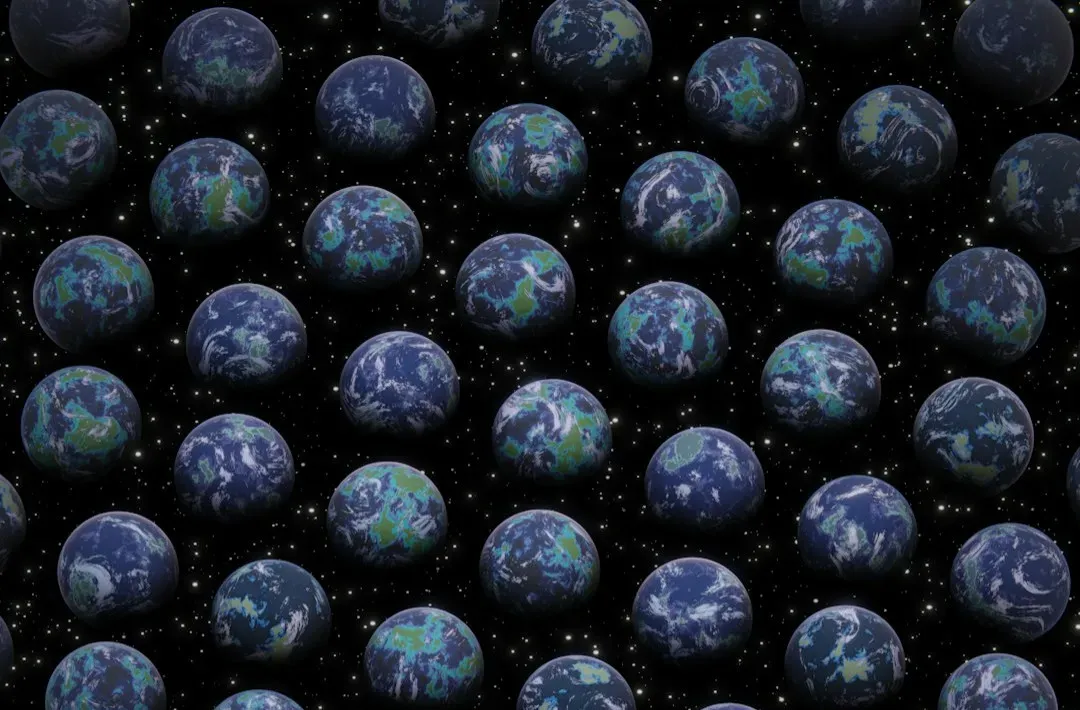
We don’t know if there are other universes, and we’re even less sure whether they follow laws wildly different from ours. What we do know is that the laws we see seem to walk a tightrope between chaos and sterility, leaving just enough room for stars, chemistry, and living minds. That alone makes the question more than a late‑night thought experiment; it’s a way of asking why reality turned out so surprisingly hospitable to complexity.
For now, we’re stuck with one universe and one set of laws, trying to reverse‑engineer them from our tiny vantage point on a small planet. Maybe someday our theories will force us to accept that ours is only one of many possible cosmic stories; maybe they’ll point instead to a single, inevitable way that reality has to be. Until then, wondering how physics might work elsewhere is really a way of looking more closely at home. If you could peek into a universe with different laws for just one minute, what would you hope to see?