
Solar Storms Pose Growing Risks to Modern Infrastructure (Image Credits: Upload.wikimedia.org)
Researchers unveiled a pioneering AI tool that promises to extend critical space weather predictions from mere hours to several weeks.
Solar Storms Pose Growing Risks to Modern Infrastructure
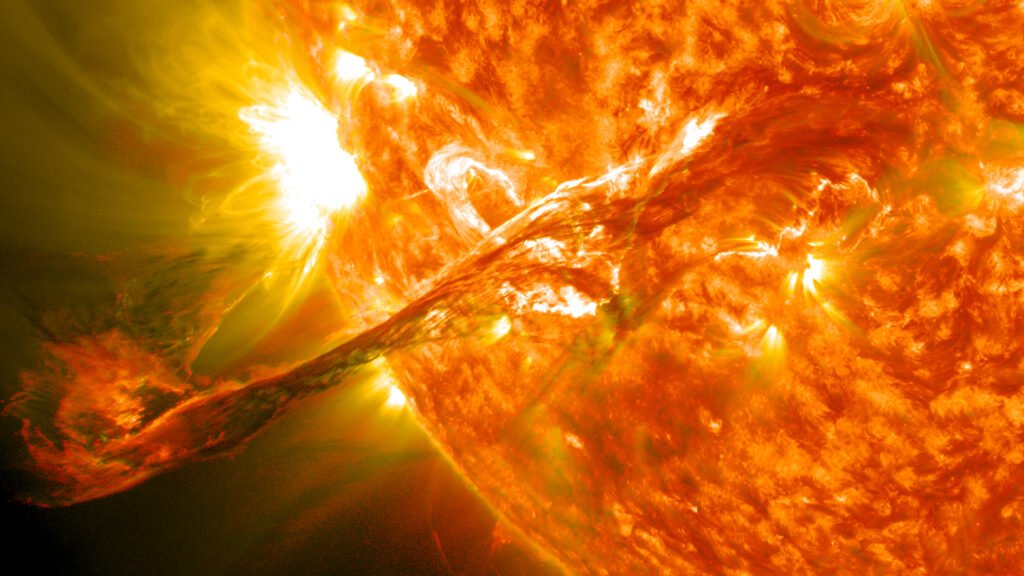
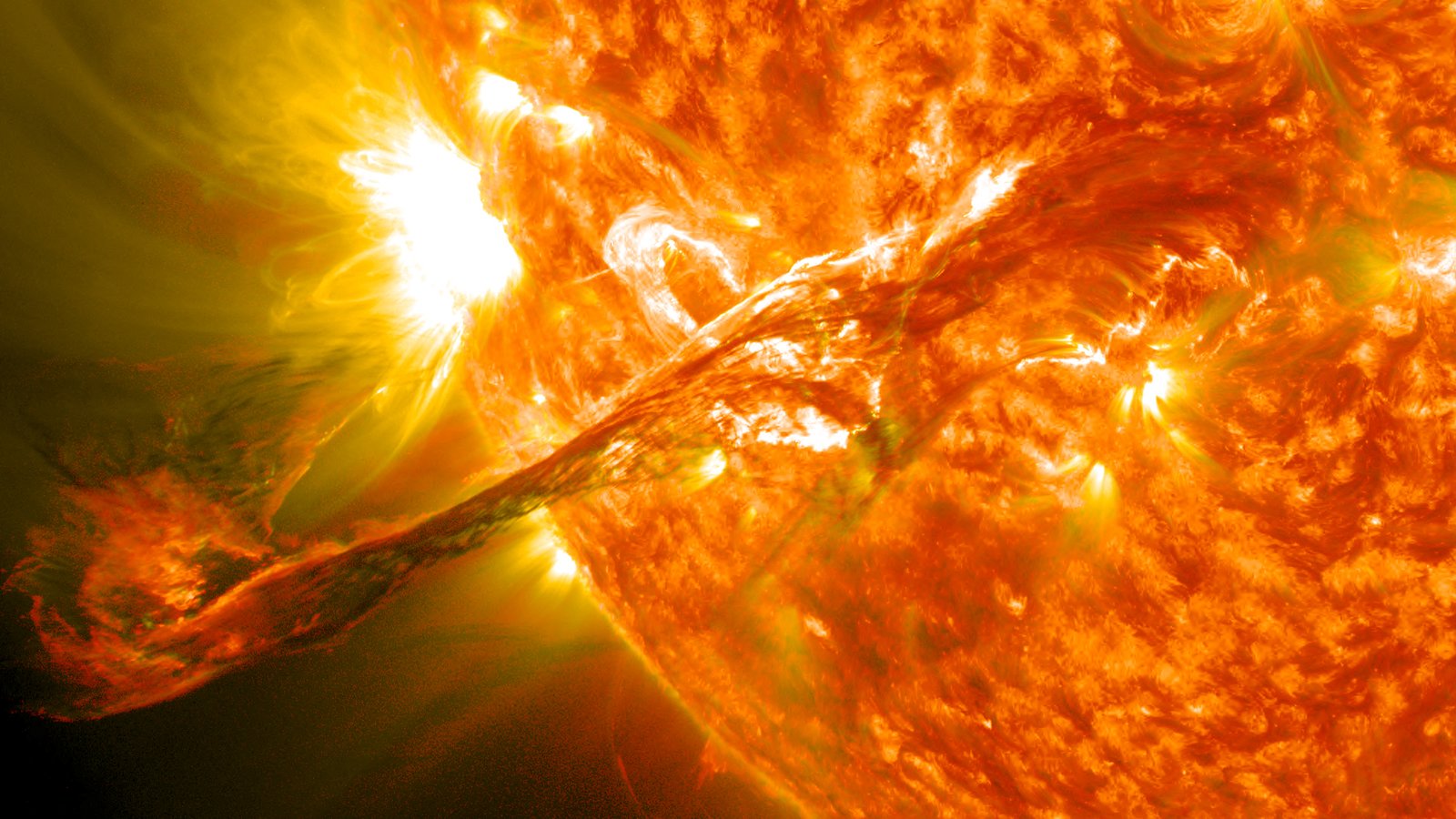
Solar active regions on the Sun’s surface harbor tangled magnetic fields responsible for explosive events like flares and coronal mass ejections. These phenomena unleash charged particles that can cripple GPS signals, overload power grids, damage satellites, and endanger astronauts in space. Current forecasting methods detect threats only hours before impact, leaving little time for protective measures. A new collaboration between Southwest Research Institute and the National Science Foundation’s National Center for Atmospheric Research addresses this gap head-on.[1][2]
The team recognized that active regions do not appear randomly. Instead, they cluster along vast, warped magnetic structures known as toroidal bands deep within the Sun. Decoding these patterns offers a pathway to earlier warnings. This insight forms the foundation of their breakthrough approach.
PINNBARDS: Bridging Surface Observations and Subsurface Dynamics
The innovation centers on PINNBARDS, a Physics-Informed Neural Network-Based Active Regions Distribution Simulator. This framework integrates observations from the Solar Dynamics Observatory’s Helioseismic and Magnetic Imager with advanced machine learning and physical models of solar magnetohydrodynamics. By inverting surface magnetic patterns, PINNBARDS reconstructs hidden states in the tachocline, the Sun’s thin transition layer between its stable interior and turbulent outer convection zone.[1]
Lead researchers Dr. Mausumi Dikpati of NSF-NCAR and Dr. Subhamoy Chatterjee of SwRI demonstrated the tool’s potential using data from February 14, 2024. The model accurately mapped bulges and depressions in toroidal bands, aligning magnetic vectors with observed solar hemispheres. “The reconstructed subsurface states from PINNBARDS provide initial conditions for forward simulations of solar magnetic evolution, opening the door to predicting where and when large, flare-producing active regions are likely to emerge weeks in advance,” Dikpati stated.[2]
From Data to Predictions: A Step-by-Step Process
PINNBARDS processes global magnetograms to derive velocity fields and magnetic configurations beneath the surface. These outputs serve as starting points for simulating future active region emergence. Latitude and longitude predictions prove crucial, as they determine whether solar eruptions will impact Earth-facing regions.
- Surface data input: Magnetic measurements from SDO/HMI.
- Neural network inversion: Reconstructs tachocline states using physics constraints.
- Forward modeling: Projects active region locations weeks ahead.
- Output: Probability maps for flare-prone zones.
Simulations ran on the Derecho supercomputer at NSF NCAR-Wyoming Supercomputer Center, validating the approach with historical observations.[2] This method surpasses traditional tools reliant on short-term, small-scale signatures.
Real-World Safeguards and Broader Impacts
Extended forecasts enable proactive defenses against space weather disruptions. Power operators could preempt blackouts, satellite firms might reposition assets, and space agencies could shield missions. Funding from NASA’s Heliophysics Guest Investigator program and the COFFIES DRIVE Center underscores the effort’s strategic importance.
| Forecast Horizon | Current Capability | PINNBARDS Potential |
|---|---|---|
| Lead Time | Hours | Weeks |
| Key Inputs | Surface signatures | Global subsurface dynamics |
| Risk Mitigation | Reactive | Proactive |
“One of COFFIES aims is to predict where and when the Sun will produce its next big, flare-generating active region,” noted Stanford’s Todd Hoeksema.[2]
Key Takeaways:
- PINNBARDS links Sun’s surface to tachocline for unprecedented forecast range.
- Demonstrated accuracy with SDO data reconstructions.
- Paves way for protecting tech infrastructure and space operations.
This first-of-its-kind tool marks a pivotal advance in heliophysics, blending AI precision with solar physics fundamentals. As reliance on space technologies grows, such innovations become essential. What steps should industries take to prepare for enhanced space weather alerts? Share your thoughts in the comments.