
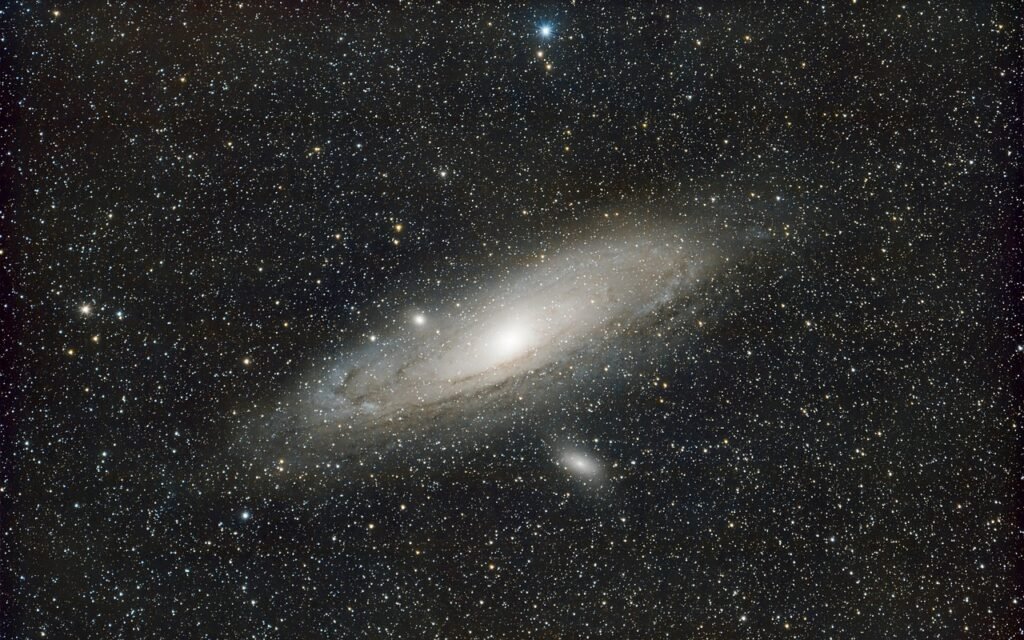


Unlocking Infrared Mysteries (Image Credits: Pixabay)
Astronomers have gained a clearer view of the turbulent core of the Circinus Galaxy, where a supermassive black hole drives dramatic cosmic processes just 13 million light-years from Earth.
Unlocking Infrared Mysteries
The James Webb Space Telescope recently provided astronomers with detailed infrared observations that illuminate the inner workings of the Circinus Galaxy’s nucleus. This nearby Seyfert galaxy hosts an active supermassive black hole, one of the closest such systems to our Milky Way. For years, scientists suspected that powerful outflows of superheated gas dominated the infrared emissions near the black hole. Webb’s advanced instruments confirmed this while revealing finer details about the surrounding environment.
These outflows, streams of matter ejected at high speeds, shape the galaxy’s structure and evolution. Researchers analyzed data showing how the black hole accretes material and expels it, influencing star formation across vast distances. The observations marked a significant advancement, as previous telescopes struggled to penetrate the dense dust obscuring the core.
The Black Hole’s Enduring Grip
At the heart of Circinus lies a supermassive black hole that continues to exert profound influence on its host galaxy. This central engine powers an active galactic nucleus, where intense radiation and jets of particles emerge from the accretion disk. The black hole’s activity has persisted for millions of years, altering the interstellar medium and potentially suppressing or triggering new stars.
Webb’s infrared gaze detected the strongest emissions originating from regions perilously close to the event horizon. Scientists noted that these emissions arise primarily from the outflows rather than the disk itself, challenging earlier models. The galaxy’s proximity allows for repeated studies, offering a natural laboratory for understanding similar processes in more distant universes.
Outflows: Engines of Change
Superheated matter streams, or outflows, represent the primary source of infrared light in the Circinus core, as revealed by Webb’s precise measurements. These ejections reach velocities that rival the escape speed from the black hole’s grasp, carrying away energy and angular momentum. Such dynamics prevent the unchecked growth of the black hole while redistributing resources throughout the galaxy.
The observations highlighted a complex interplay between inflow and outflow, with dust and gas forming a torus around the nucleus. This structure absorbs visible light but allows infrared to escape, enabling Webb to map the region in unprecedented detail. Key factors in these outflows include magnetic fields and radiation pressure, which accelerate particles to extreme temperatures.
Broader Implications for Cosmic Evolution
The Circinus Galaxy serves as a prime example of how supermassive black holes regulate galactic development. By expelling material, the black hole clears paths for future starbirth or quenches it in overfed regions. These findings from Webb align with theories on feedback mechanisms that maintain balance in galaxies.
Astronomers now plan follow-up observations to track changes in the outflows over time. Complementary data from other telescopes, like Hubble, provide a multi-wavelength perspective that enriches the picture. Understanding Circinus could inform models of our own Milky Way’s past and future.
- Infrared emissions primarily stem from superheated outflows near the black hole.
- The galaxy’s active nucleus influences star formation 13 million light-years away.
- Webb’s tools pierced dust layers invisible to earlier observatories.
- Outflows regulate black hole growth and galactic structure.
- Future studies may reveal temporal variations in the core’s activity.
Key Takeaways
- Webb confirmed outflows as the dominant infrared source, reshaping views of black hole environs.
- Circinus offers insights into nearby active galaxies, mirroring distant cosmic events.
- These observations underscore black holes’ role in sculpting galaxy evolution.
The revelations from the Circinus Galaxy remind us of the intricate forces at play in the universe’s most enigmatic hearts, where destruction and creation coexist. As Webb continues to explore such realms, it promises deeper revelations about our cosmic neighborhood – what discoveries await next in these distant yet familiar skies? Share your thoughts in the comments.


