

A Massive Powerhouse 5 Billion Light-Years Away (Image Credits: Unsplash)
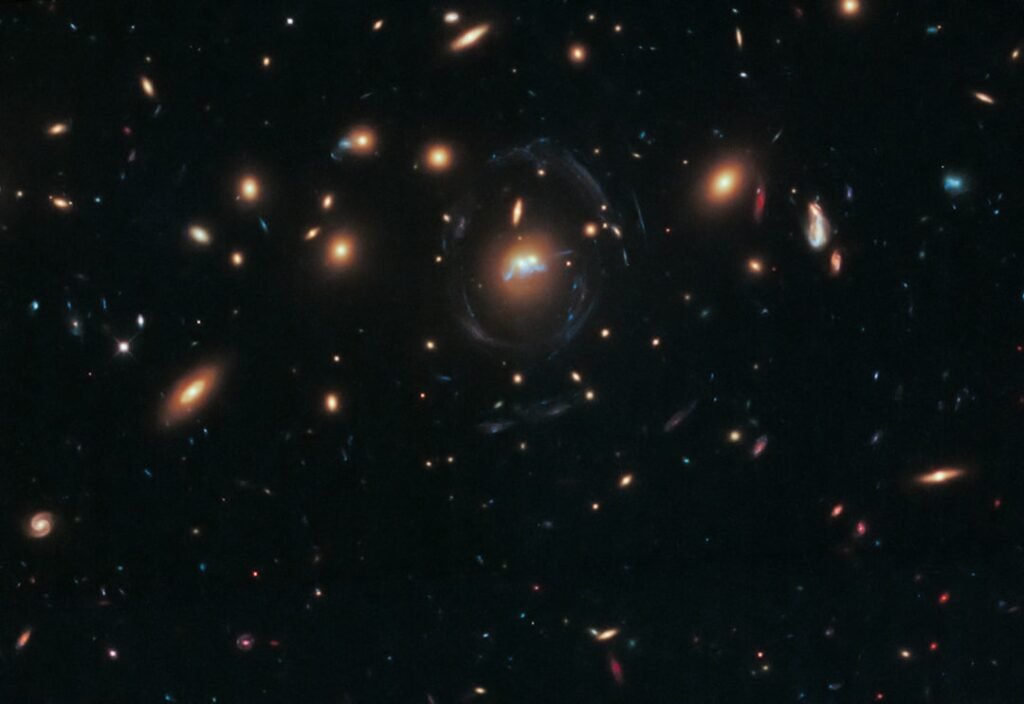
The James Webb Space Telescope has captured a mesmerizing image of the galaxy cluster MACS J1149.5+2223, revealing its powerful gravitational lensing that distorts and amplifies light from faraway objects.
A Massive Powerhouse 5 Billion Light-Years Away
Astronomers confirmed more than 300 galaxies within MACS J1149, with several hundred additional candidates identified The cluster resides approximately 5 billion light-years from Earth in the constellation Leo.
At its core, a dense group of elliptical galaxies exerts immense gravitational pull, binding the cluster together as its members move through space. This colossal self-gravity turns the cluster into a gravitational giant. Previous observations, including those from the Hubble Space Telescope’s Frontier Fields program, had already marked MACS J1149 as a prime target for deep-space studies.
Gravitational Lensing: Nature’s Magnifying Glass
The cluster’s enormous mass warps spacetime, bending light from background galaxies into dramatic arcs and peculiar shapes. Faint, distant objects appear stretched into narrow streaks or transformed into unusual forms, making the otherwise invisible visible.
Near the center, one background galaxy’s spiral arms contort into a striking pink, jellyfish-like appearance. This same galaxy hosted the most distant individual star ever detected, known as Icarus, and a supernova named Refsdal that appeared in multiple images due to the lensing effect. Such phenomena provide astronomers with rare windows into extreme cosmic events.
- Curved arcs from highly magnified galaxies.
- Distorted spirals resembling jellyfish.
- Multiple images of the same supernova.
- Streaks of light from faint early-universe objects.
- Rings and smears amplifying hidden light.
Webb’s Instruments Bring New Clarity
James Webb collected data for this view through the Canadian NIRISS Unbiased Cluster Survey, or CANUCS, led by principal investigator C. J. Willott. Instruments like the Near-Infrared Camera (NIRCam), Near-Infrared Imager and Slitless Spectrograph (NIRISS), and Near-Infrared Spectrograph (NIRSpec) captured intricate details invisible to earlier telescopes.
The resulting composite highlights a field crowded with tiny specks – mostly remote galaxies – against the ghostly central ellipticals. ESA selected this as Webb’s Picture of the Month, released on January 22, 2026. Compared to Hubble’s earlier images, Webb penetrates deeper into infrared wavelengths for sharper insights.
Probing the Dawn of the Universe
Gravitational lensing by MACS J1149 enables detailed study of low-mass galaxies from the universe’s infancy, their star formation, dust content, and chemistry. Researchers use the data to explore the epoch of reionization, when the first stars and galaxies ionized neutral hydrogen.
Recent findings from the cluster include a supermassive black hole actively feeding less than 600 million years after the Big Bang. These observations refine models of galaxy evolution and cluster dynamics. The CANUCS program continues to yield discoveries about mass distribution and environmental influences on star formation.
Key Takeaways
- MACS J1149 magnifies light from galaxies billions of light-years farther away.
- Webb’s infrared view reveals early-universe structures Hubble could not.
- Lensing uncovers rare events like the farthest known star and multiply-imaged supernovae.
MACS J1149 stands as a testament to how massive clusters serve as portals to the cosmos’s hidden depths, pushing the boundaries of astronomical discovery. As Webb continues its mission, such images promise even more revelations about our universe’s origins. What do you think about these gravitational wonders? Tell us in the comments.