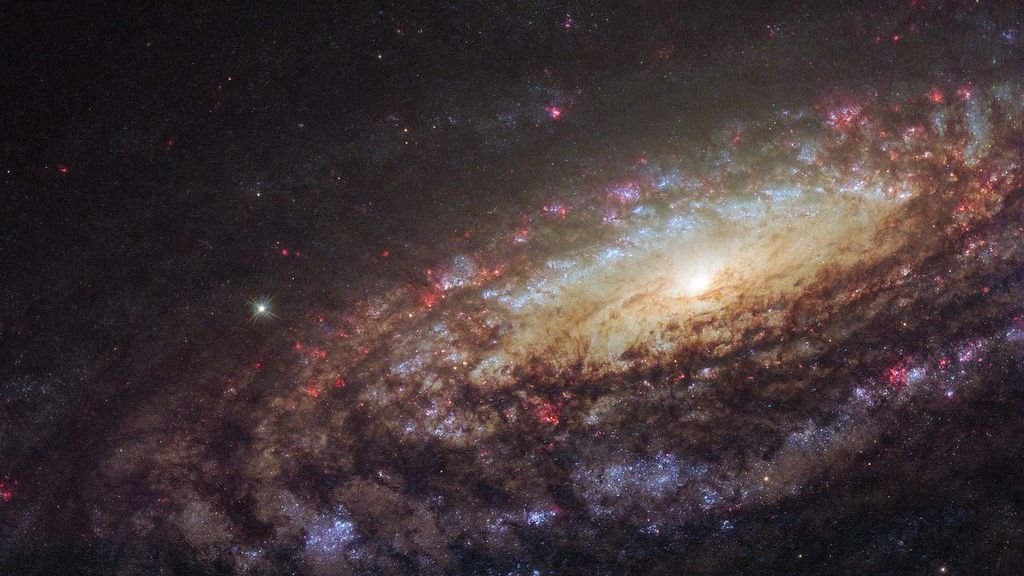


A Christmas Launch That Redefined Astronomy (Image Credits: Pixabay)
The James Webb Space Telescope marked its fourth launch anniversary with a mesmerizing visual journey that captures the awe-inspiring scope of its discoveries.
A Christmas Launch That Redefined Astronomy
Launched on Christmas Day in 2021 aboard an Ariane 5 rocket from Europe’s Spaceport in French Guiana, the James Webb Space Telescope quickly became a cornerstone of modern astronomy. This collaborative effort between NASA, ESA, and the Canadian Space Agency promised unprecedented views of the universe, and it delivered from the start. By July 2022, after unfolding its massive golden mirror in deep space, the telescope began its scientific operations, peering through cosmic dust to reveal hidden wonders.
Astronomers worldwide hailed the mission as a game-changer, allowing observations in infrared light that penetrate veils of gas and dust invisible to previous telescopes. The instrument’s position at the L2 Lagrange point, a million miles from Earth, ensured stable, cold conditions ideal for sensitive detections. Over four years, Webb has served thousands of scientists, transforming our understanding of star formation, galaxy evolution, and the early universe.
Embarking on a 43-Minute Cosmic Flight
The European Space Agency celebrated the milestone by releasing a 43-minute compilation video titled “Fly through Webb’s cosmic vistas,” which stitches together the telescope’s most iconic images into a seamless narrative of exploration. Viewers experience a simulated spaceship journey, starting close to home and venturing into the depths of space. The sequence begins with dives into the Milky Way’s vibrant nebulae, where infrared vision uncovers the birth of stars amid swirling clouds of gas and dust.
As the video progresses, it shifts to interstellar realms, showcasing interacting galaxies locked in gravitational dances and massive clusters bending light from distant objects. This virtual tour highlights Webb’s ability to capture intricate details, from the glowing filaments of star-forming regions to the faint glow of ancient galaxies. Released on the anniversary, the video invites everyone to appreciate the telescope’s role in bridging the near and the far cosmos.
Spotlighting Transformative Discoveries
Webb’s observations have illuminated previously unseen phenomena, such as the most distant supernova ever detected, which exploded when the universe was less than a billion years old. Scientists confirmed this event after an initial gamma-ray burst signal, using the telescope to isolate the explosion from its host galaxy. Such findings push back the timeline of cosmic events, offering clues about the universe’s violent youth.
Closer to home, images of gigantic molecular clouds near the Milky Way’s center reveal pink and purple expanses of gas, shrouded in mystery and teeming with potential for new star systems. The telescope’s mid-infrared capabilities expose structures that shape planetary formation, including disks around young stars that may harbor worlds like our own. These revelations not only stun but also drive ongoing research into the building blocks of the cosmos.
From Stellar Nurseries to Distant Galaxies
The anniversary video weaves in highlights from renowned sites observed by Webb, creating a tapestry of cosmic diversity. Key regions include:
- The Carina Nebula, a bustling star nursery where massive stars emerge from dense clouds.
- Southern Ring Nebula, showcasing a dying star’s final act as it ejects outer layers.
- Deep fields revealing thousands of galaxies in a single frame, some from the universe’s dawn.
- Galaxy clusters like those acting as natural lenses, magnifying light from behind them.
- Interacting pairs such as the Antennae Galaxies, illustrating mergers that fuel new stars.
Each segment builds on the last, emphasizing how Webb’s data connects local phenomena to universal scales. This approach makes complex astronomy accessible, fostering public fascination with space exploration.
Key Takeaways from Four Years of Webb:
- Infrared imaging pierces cosmic dust to reveal star births and deaths in vivid detail.
- Early universe glimpses, including ancient supernovae, refine models of cosmic evolution.
- Collaborative science yields thousands of peer-reviewed papers, advancing knowledge globally.
As the James Webb Space Telescope continues its mission, its anniversary video stands as a testament to human ingenuity and the endless allure of the stars, reminding us that the universe holds infinite stories yet to be told. What aspect of Webb’s discoveries excites you most? Share your thoughts in the comments.