

The Power of Gravitational Lensing (Image Credits: Pixabay)
Astronomers have harnessed subtle bends in the light from distant galaxies to chart the elusive forces shaping the cosmos, offering fresh insights into the invisible components that dominate existence.
The Power of Gravitational Lensing
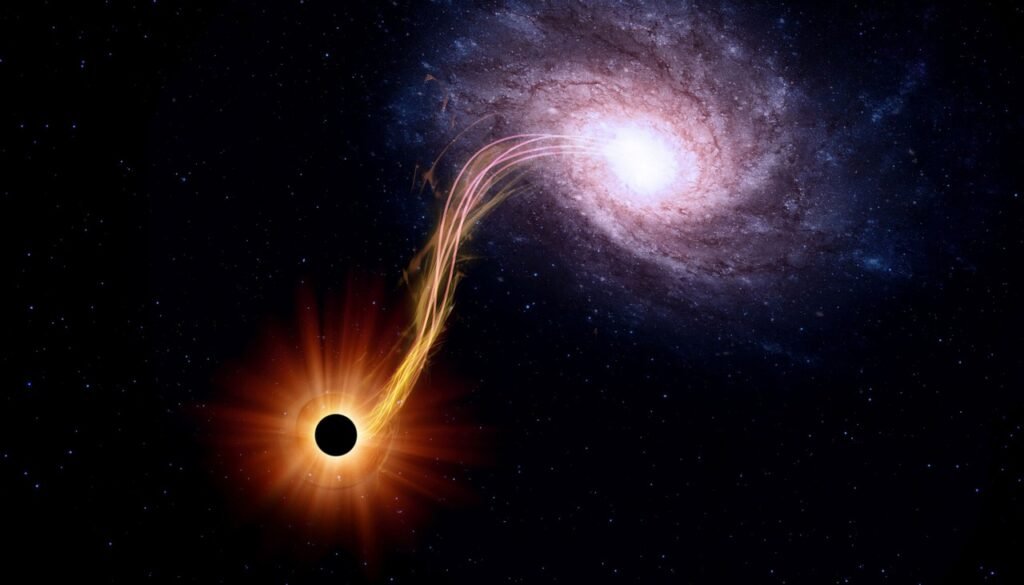
Gravitational lensing emerged as a pivotal tool in this endeavor, where massive structures bend spacetime and distort the appearance of background objects. Researchers analyzed faint shears in galaxy shapes, a phenomenon known as weak lensing, to infer the presence of unseen mass. This method allowed them to probe regions far beyond direct observation, revealing patterns invisible to the naked eye.
The technique relies on Einstein’s general relativity, which predicts that gravity warps light paths. In practice, teams sifted through vast datasets from sky surveys, identifying these minute distortions across millions of galaxies. Such analysis not only mapped gravitational influences but also highlighted how dark matter clusters influence cosmic evolution.
Unveiling Dark Matter’s Role
Dark matter, comprising about 27 percent of the universe, exerts gravitational pull without emitting or absorbing light, making it detectable only through its effects on visible matter. The recent survey demonstrated how these invisible halos around galaxies create the observed warps, confirming their distribution on large scales. Scientists found that dark matter’s scaffolding underpins the formation of galaxy clusters, aligning with long-held theoretical models.
By examining archival images from powerful telescopes, the study extended coverage to one of the broadest sky patches yet surveyed. This approach yielded a detailed map showing dark matter’s filamentary structure, the cosmic web that connects galaxies across voids. The findings reinforced the standard cosmological framework, where dark matter drives the universe’s large-scale architecture.
Probing Dark Energy’s Influence
Dark energy, responsible for roughly 68 percent of the universe’s energy content, accelerates cosmic expansion and counters gravity’s pull. Through weak lensing data, researchers measured how this force interacts with matter distributions, providing clues to its uniform yet mysterious nature. The survey’s results indicated consistent expansion rates, supporting the Lambda-CDM model that has guided cosmology for decades.
Challenges arose in isolating dark energy’s signal amid noise from galactic dust and intrinsic alignments, yet advanced statistical methods prevailed. The project integrated data from multiple observatories, enhancing precision and reducing uncertainties. Ultimately, these measurements affirmed that dark energy remains a dominant, steady force throughout cosmic history.
Implications for Future Discoveries
The success of this mapping effort underscores the value of repurposing existing telescope archives for new science. It paves the way for upcoming missions like the Vera C. Rubin Observatory, which will expand such surveys exponentially. Astronomers anticipate even finer resolutions that could detect deviations from the standard model, potentially revealing new physics.
Beyond confirmation, the study highlighted tensions in current data, such as discrepancies in expansion rates observed elsewhere. Resolving these could reshape our understanding of the universe’s fate, whether it continues expanding indefinitely or faces a different end.
- Weak lensing detects dark matter through galaxy shape distortions.
- Archival data from large sky surveys enabled broad coverage.
- Results align with the standard cosmological model.
- Future telescopes promise deeper insights into cosmic structure.
- Dark energy’s role in acceleration remains consistently supported.
Key Takeaways
- Over 95 percent of the universe consists of dark matter and dark energy, mapped via gravitational effects.
- The survey covered vast sky regions, using subtle galaxy warps for unprecedented detail.
- Findings bolster the Lambda-CDM model while hinting at areas for further exploration.
This groundbreaking work reminds us that the universe’s greatest secrets often hide in plain sight, waiting for the right tools to reveal them. As we peer deeper into the cosmic veil, what new enigmas might these warped galaxies unveil next? Share your thoughts in the comments below.
Hi, I’m Andrew, and I come from India. Experienced content specialist with a passion for writing. My forte includes health and wellness, Travel, Animals, and Nature. A nature nomad, I am obsessed with mountains and love high-altitude trekking. I have been on several Himalayan treks in India including the Everest Base Camp in Nepal, a profound experience.