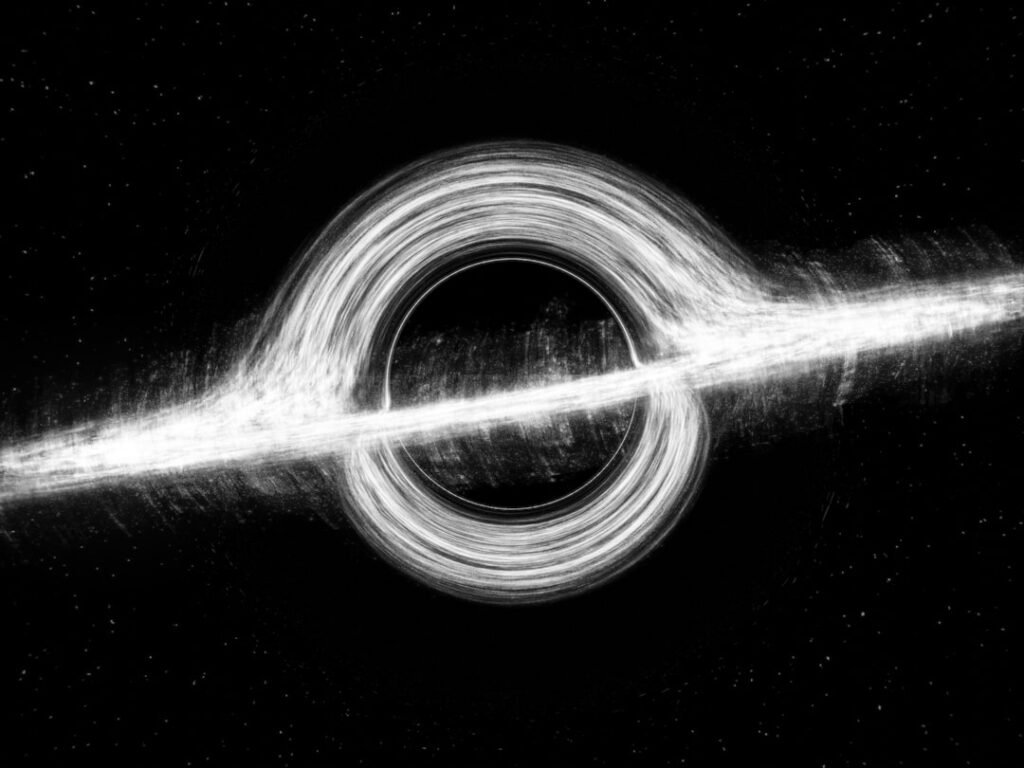


A Cosmic Disappearance Caught in Archival Data (Image Credits: Unsplash)
Andromeda Galaxy — A massive supergiant star faded dramatically from view without the explosive supernova astronomers expected, marking the clearest observation of a direct plunge into a black hole.[1][2]
A Cosmic Disappearance Caught in Archival Data
The star, known as M31-2014-DS1, stood out as one of the brightest in its region before it began to change. Researchers uncovered its story through years of overlooked data from NASA’s NEOWISE mission. Infrared observations captured the star brightening gradually starting in 2014, a process that lasted about three years.[3]
Then came the fade. By 2017, the star dimmed sharply in optical light, dropping by a factor of more than 10,000 and becoming undetectable. Near-infrared and total light followed suit, falling by over a factor of 10 through 2022. Ground-based telescopes like Keck’s NIRES instrument confirmed the disappearance across wavelengths, ruling out mere dust obscuration or variability.[2]
Lead researcher Kishalay De called it the most surprising discovery of his career. “The evidence of the disappearance of the star was lying in public archival data and nobody noticed for years until we picked it out,” he stated.[1]
Tracing the Infrared Afterglow
The lingering mid-infrared glow from a shell of dust and gas provided crucial clues. This faint signal, predicted in 1970s models of failed supernovae, persisted as the primary remnant. NASA’s NEOWISE tracked it from 2009 to 2023, revealing a dust shell about 110 astronomical units across, heated to around 870 Kelvin.[4]
Follow-up spectra from Keck showed the material’s properties matched expectations for ejected outer layers. No signs of an explosion appeared. Instead, the pattern suggested the star’s core imploded entirely, leaving about 98 percent of its mass — roughly five solar masses — to form a black hole.[3]
- 2014: Mid-infrared brightening begins.
- 2016-2017: Optical fading accelerates.
- 2019-2023: Star undetectable in most wavelengths.
- Present: Faint infrared from debris shell.[5]
The Mechanics of a Failed Explosion
M31-2014-DS1 began life with about 13 times the sun’s mass but shed much through powerful winds, ending as a hydrogen-poor yellow supergiant around five solar masses. Nuclear fusion ceased, and the core collapsed under gravity. Neutrinos drove a shock wave outward, but it failed to eject the envelope.[4]
Chaotic interactions among gravity, gas pressure, and shocks caused most material to fall back. Convection delayed the infall, prolonging the glow as gas orbited the newborn black hole. Only a small fraction, about 0.1 to 0.28 solar masses, escaped as a dust-forming shell.[1]
| Typical Supernova | Direct Collapse (M31-2014-DS1) |
|---|---|
| Explosive ejection of outer layers | Slow fade and disappearance |
| Brilliant visible flash | Infrared glow from dust |
| Neutron star or light black hole | ~5 solar mass black hole |
Reshaping Views on Stellar Deaths
This event, detailed in a February 12, 2026, Science paper, echoes a 2010 candidate in NGC 6946 but offers far superior data due to Andromeda’s proximity.[4] It challenges the assumption that stars around five solar masses always explode. “Stars with this mass have long been assumed to always explode as supernovae,” De noted. “The fact that it didn’t suggests that stars with the same mass may or may not successfully explode.”[3]
Such quiet collapses could explain many unseen black holes. Future surveys with telescopes like James Webb may spot more, refining models of how these cosmic giants end their lives.[5]
Key Takeaways
- Direct collapse skips supernova, forming black holes silently.
- Infrared data reveals hidden stellar deaths.
- Massive stars’ fates depend on internal chaos.
This rare glimpse into a star’s unheralded end underscores the universe’s hidden dramas. As the debris glow fades over decades, it leaves a benchmark for black hole origins. What do you think this means for our cosmic neighborhood? Tell us in the comments.