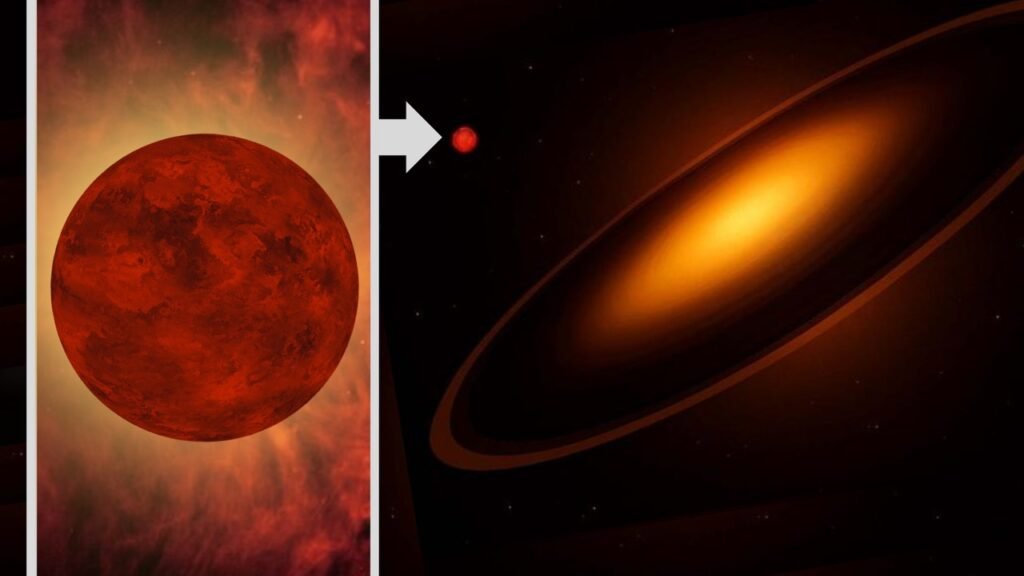


Unprecedented Fadeout Captivates Astronomers (Image Credits: Cdn.mos.cms.futurecdn.net)
A remote star known as ASASSN-24fw faded dramatically late in 2024, dropping 97 percent in brightness and remaining dim for nearly nine months in one of the longest such events on record.[1][2]
Unprecedented Fadeout Captivates Astronomers
The star, situated 3,200 light-years away in the Monoceros constellation, had appeared stable for decades prior to the incident. Observations revealed the dimming began gradually and persisted for around 200 days, far exceeding typical eclipse durations of days or weeks.[1]
This extreme blackout puzzled researchers, as it required a precise alignment between the star and an obscuring object. The event stood out for its rarity and intensity, prompting detailed modeling to uncover the cause. ASASSN-24fw, roughly twice the sun’s size and over a billion years old, showed signs of a nearby circumstellar environment, hinting at past planetary collisions.[1]
Leading Theory Points to Ringed Brown Dwarf
International astronomers concluded the dimming resulted from a brown dwarf – a “failed star” too light to sustain fusion but heavier than any planet – encircled by a vast ring system. The rings, likened to Saturn’s but far larger, span about 0.17 astronomical units, reaching halfway to Mercury’s orbit from the sun.[1][2]
Lead author Dr. Sarang Shah, a post-doctoral researcher at India’s Inter-University Centre for Astronomy and Astrophysics, stated, “Various models made by our group show that the most likely explanation for the dimming is a brown dwarf – an object heavier than a planet but lighter than a star – surrounded by a vast and dense ring system.”[1] The companion’s mass exceeds three times Jupiter’s, with the opaque “saucer” of rings blocking nearly all light during transit.
Historical data suggested prior dimmings around 1937 and 1982, implying an orbital period of 42 to 44 years for the object.[2]
Super-Jupiter as Viable Alternative
While the brown dwarf scenario fits best, scientists also considered a super-Jupiter – a gas giant bridging planets and brown dwarfs. Such a world, with similarly enormous rings roughly 25 million kilometers across and 16 times wider than the star itself, could produce the observed effect.[2]
Dr. Jonathan Marshall, affiliated with Academia Sinica in Taiwan, noted, “Large ring systems are expected around massive objects, but they are very difficult to observe directly to determine their characteristics. This rare event allows us to study such a complex system in remarkable detail.”[1] Distinguishing between the two remains challenging without further spectra.
Bonus Finds Enrich the Discovery
During analysis, the team serendipitously detected a red dwarf star near ASASSN-24fw, adding context to the system. The primary star’s debris disk, unusual for its age, suggests dynamic planetary history.
- Dimming depth: 95-97 percent.
- Event length: Nearly 200 days.
- Rings extent: 0.17 AU.
- Object mass: >3 Jupiter masses.
- Orbital cycle: 42-44 years.
- Unexpected neighbor: Red dwarf companion.
Glimpse into Distant Planetary Systems
The findings, detailed in Monthly Notices of the Royal Astronomical Society, open doors to studying ring formation around substellar objects. Future observations with telescopes like the Very Large Telescope and James Webb Space Telescope could reveal compositions and temperatures, refining models of planetary evolution.
Researchers anticipate another dimming in about four decades, offering a chance for deeper insights. This event underscores the universe’s hidden complexities, where rare alignments unveil worlds beyond imagination.[1]
Key Takeaways
- A brown dwarf’s massive rings likely caused one of the longest stellar dimmings ever recorded.
- The system harbors a red dwarf companion and debris suggestive of violent history.
- Next eclipse expected in 42-44 years, promising more revelations.
Such discoveries remind us how much remains unknown about exoplanetary architectures. What do you think caused the dimming – brown dwarf or super-planet? Tell us in the comments.