
Decades of Data Forge a New Benchmark (Image Credits: Upload.wikimedia.org)
Astronomers recently unveiled the most accurate direct measurement of the Universe’s current expansion rate, sharpening a longstanding puzzle in cosmology. The result, derived from a massive international collaboration, shows the cosmos expanding faster than models based on its early history anticipate. This confirmation strengthens the Hubble tension, a discrepancy that now demands serious consideration of flaws in our standard understanding of the Universe.[1][2]
Decades of Data Forge a New Benchmark
Researchers from the H0 Distance Network (H0DN) Collaboration combined observations spanning decades into a unified framework. This effort yielded a Hubble constant value of 73.50 ± 0.81 kilometers per second per megaparsec, with precision just over 1 percent. The study appeared on April 10, 2026, in Astronomy & Astrophysics.[1]
The collaboration originated at the International Space Science Institute Breakthrough Workshop titled “What’s under the H0od?” in Bern, Switzerland, in March 2025. NSF NOIRLab contributed key data from its Cerro Tololo Inter-American Observatory in Chile and Kitt Peak National Observatory in Arizona. John Blakeslee, Director of Research and Science Services at NSF NOIRLab, participated in the work. Such coordination across ground- and space-based telescopes marked a pivotal advance in reliability.[2]
Two Paths to the Same Cosmic Riddle
Local measurements track distances to nearby stars and galaxies, revealing an expansion rate around 73 kilometers per second per megaparsec. Early-Universe probes, like the cosmic microwave background, predict a slower pace of about 67 or 68 kilometers per second per megaparsec. Independent studies repeatedly surfaced this gap, too wide to attribute to chance.[1]
The H0DN team constructed a “distance network” to link methods and test for flaws. Consistency held even when excluding any single technique. “This work effectively rules out explanations of the Hubble tension that rely on a single overlooked error in local distance measurements,” the authors stated.[1]
Building the Cosmic Distance Ladder
Astronomers calibrated distances rung by rung, starting from well-known markers. Cepheid variable stars provided a foundation, as their pulsations correlate with brightness. Red giant stars offered another anchor with their predictable luminosity. Type Ia supernovae served as standard candles due to uniform peak brightness.
- Cepheid variable stars: Pulsate predictably, enabling distance estimates from apparent brightness.
- Red giant stars: Emit light at known levels, aiding nearby galaxy mapping.
- Type Ia supernovae: Explode with consistent energy, measuring farther reaches.
- Galaxy types: Certain clusters refine the ladder at cosmic scales.
Overlaps between these approaches allowed cross-verification. The network’s resilience underscored the measurement’s strength. “This isn’t just a new value of the Hubble constant,” the collaboration noted. “It’s a community-built framework that brings decades of independent distance measurements together, transparently and accessibly.”[1]
Challenging the Standard Cosmological Model
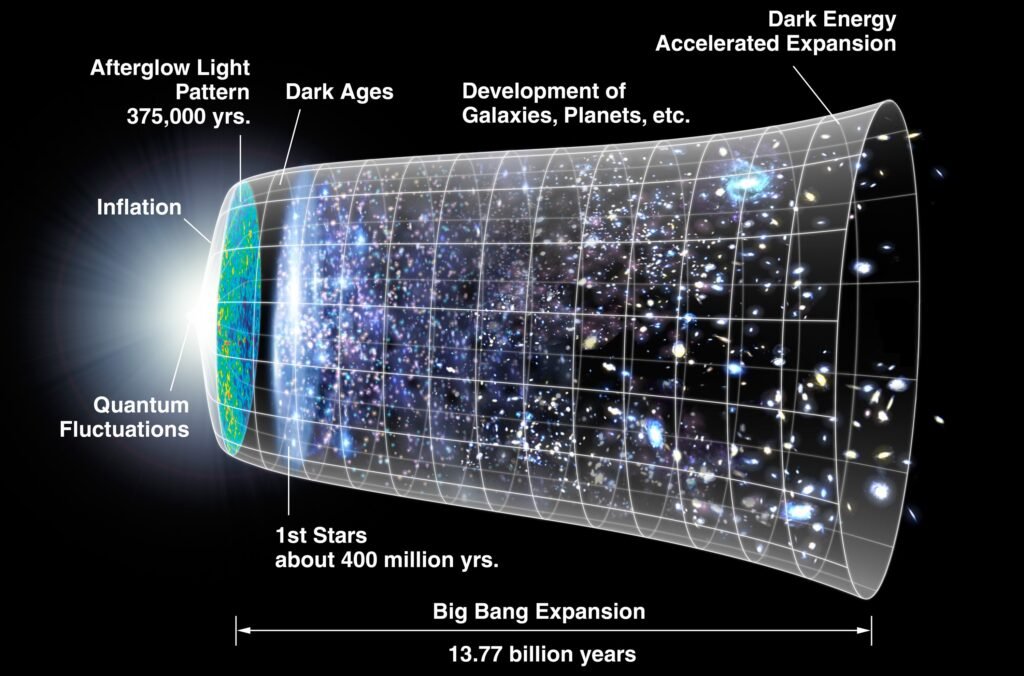
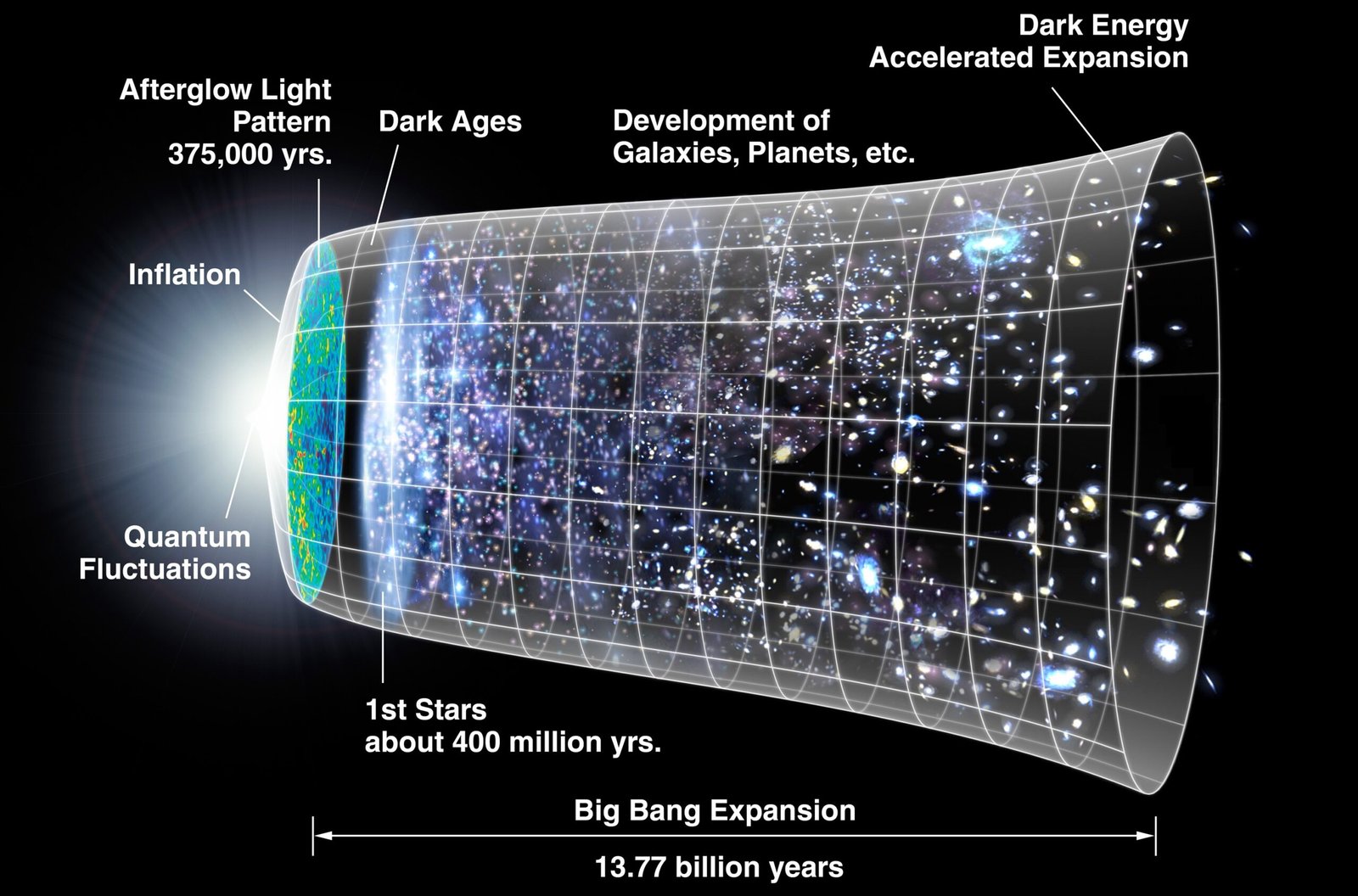
The standard model traces the Universe’s evolution from the Big Bang, incorporating dark energy, dark matter, and ordinary matter. Early-Universe data fit this framework neatly but clash with local observations. A real tension might reveal missing elements, such as evolving dark energy or novel particles.
Gravity’s role at vast scales could also require adjustment. The growing evidence tilts toward physics beyond current theory. “If the tension is real, as the growing body of evidence suggests, it may point to new physics beyond the standard cosmological model,” the researchers concluded.[1]
Key Takeaways
- New measurement pins Hubble constant at 73.50 ± 0.81 km/s/Mpc, achieving over 1% precision.[2]
- Multiple techniques rule out simple measurement errors as the tension’s cause.
- Discrepancy with early-Universe predictions hints at gaps in cosmological theory.
Future telescopes promise sharper data to test these ideas further. The distance network stands ready for integration with incoming observations. This framework invites global refinement.
The Hubble tension endures as cosmology’s most pressing enigma, urging a reevaluation of cosmic fundamentals. As precision climbs, the path to resolution – or revolution – clarifies. What do you think this means for our understanding of the Universe? Tell us in the comments.