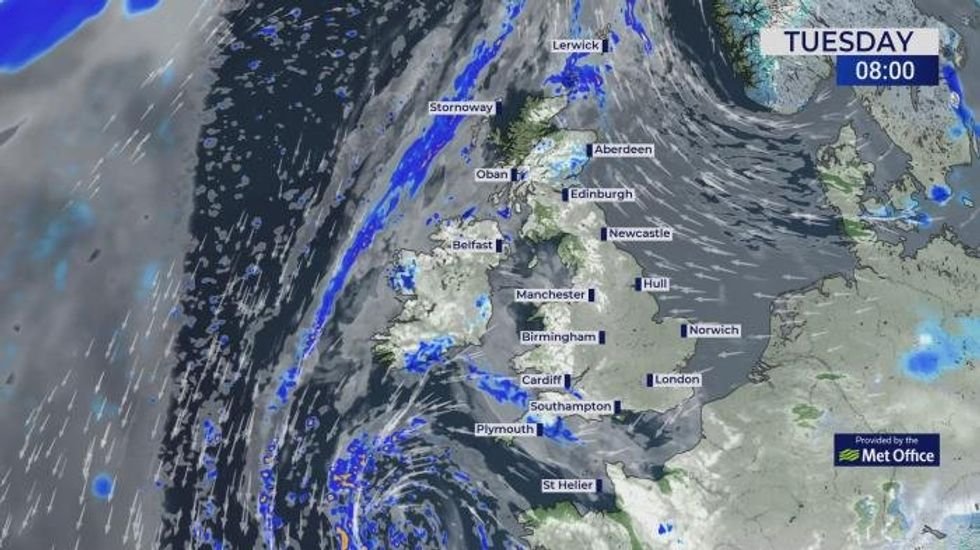

A Record on the Horizon (Image Credits: Gbnews.com)
United Kingdom – The nation faces the prospect of etching 2025 into the history books as its warmest year ever recorded.
A Record on the Horizon
Provisional figures from the Met Office revealed that the UK’s mean annual temperature through December 21 reached 10.05C, edging out the previous benchmark of 10.03C from 2022.
This development marked only the second instance in which the country’s yearly average crossed the 10C mark, underscoring a dramatic shift in climate patterns.
Forecasters emphasized that while the data pointed strongly toward a new high, a anticipated cold spell over the holiday period introduced a measure of uncertainty.
Confirmation awaited the full compilation of December’s observations, yet the trajectory suggested 2025 would join an elite trio alongside 2022 and 2023 as among the hottest years since records began in 1884.
Senior Met Office scientist Mike Kendon captured the moment’s gravity, stating that at this stage, it appeared more likely than not that 2025 would secure the top spot.
Decades of Accelerating Warmth
Temperature logs dating back to the late 19th century illustrated a clear upward trajectory, with the UK’s annual average rising by about 1C over the last four decades alone.
Notably, every one of the ten warmest years occurred within the past two decades, a stark concentration that highlighted the pace of change.
Four of the five hottest years now fell within the most recent half-decade, reflecting how recent periods dominated the historical leaderboard.
Since 2000, the nation set new annual records on six occasions – in 2002, 2003, 2006, 2014, and 2022 – with 2025 potentially extending that streak.
These milestones not only surpassed prior highs but also built upon one another, each new peak higher than the last amid steadily intensifying conditions.
Voices from the Climate Frontlines
Experts weighed in on the implications, framing the data as both a milestone and a warning.
Mike Kendon described the era as one of extraordinary transformations, unprecedented in the observational archives of the 19th century onward.
Climate scientist Professor Friederike Otto called the outcome devastating yet utterly unsurprising, noting that the 10C average masked extremes like soaring summer heats that had become routine.
She explained that such averages concealed the reality of much higher peaks during warmer months, temperatures once deemed impossible but now commonplace.
Bob Ward, policy director at the London School of Economics, stressed the urgency for action, viewing the record as compelling proof of climate change’s reach and the imperative to achieve net zero emissions swiftly.
These perspectives converged on a shared message: the data demanded immediate policy responses to curb further escalation.
Implications for the Future
Looking ahead, the Met Office anticipated that this record might not endure long, given the persistent warming observed across recent decades.
A brief chill was forecast to sweep the country from Christmas through the new year, potentially tightening the race but unlikely to derail the overall trend.
Broader patterns showed summer 2025 already confirmed as the hottest on record, with provisional means exceeding prior highs by notable margins.
Stakeholders across sectors prepared for cascading effects, from agriculture to energy demands, as elevated baselines reshaped seasonal norms.
The concentration of extreme years in recent times signaled a future where such records could become annual expectations rather than rarities.
- 1884: Start of reliable UK temperature records.
- 2000s: Six new annual highs established, beginning a pattern of escalation.
- 2022: Previous record holder at 10.03C.
- 2023: Ranked second warmest, reinforcing recent dominance.
- 2025: Current leader at 10.05C through late December.
Key Takeaways
- 2025’s provisional average of 10.05C positions it ahead of 2022’s record.
- All top 10 warmest years have unfolded in the last 20 years.
- Experts urge accelerated net zero efforts to mitigate ongoing warming.
As Britain navigates this pivotal climate juncture, the 2025 data serves as a clarion call for sustained environmental stewardship, reminding all that collective action today shapes tomorrow’s weather legacy. What steps do you believe the UK should prioritize next? Share your thoughts in the comments.
Jan loves Wildlife and Animals and is one of the founders of Animals Around The Globe. He holds an MSc in Finance & Economics and is a passionate PADI Open Water Diver. His favorite animals are Mountain Gorillas, Tigers, and Great White Sharks. He lived in South Africa, Germany, the USA, Ireland, Italy, China, and Australia. Before AATG, Jan worked for Google, Axel Springer, BMW and others.