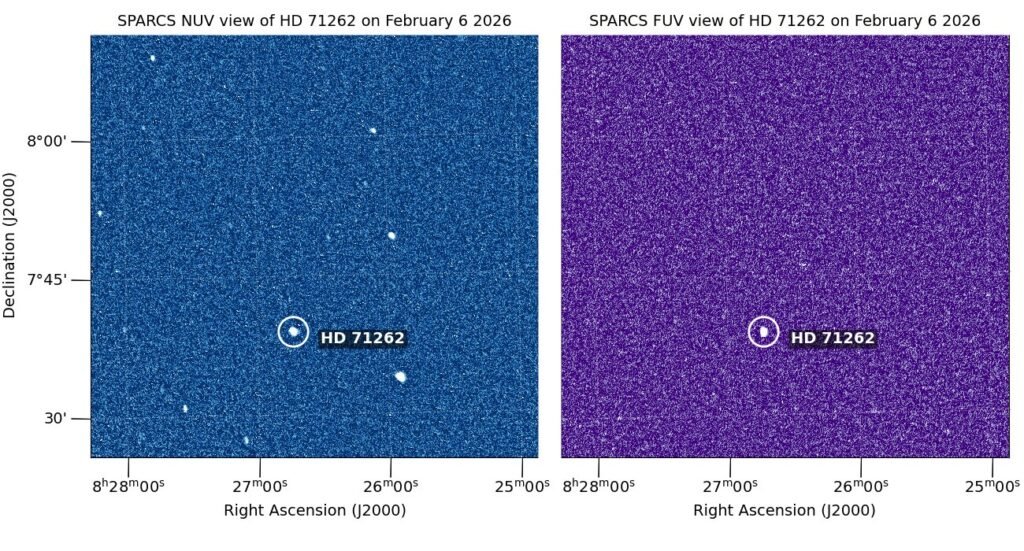
First Images From the Mission (Image Credits: NASA/JPL-Caltech/ASU)
The search for planets beyond our solar system has transformed astronomy over the past few decades. Since the first confirmed detection of an exoplanet orbiting a Sun-like star in the 1990s, scientists have discovered thousands of worlds scattered across our galaxy. Yet capturing direct images of these distant planets remains one of the most difficult challenges in modern astronomy.
Now a small spacecraft developed by NASA has taken an important step toward solving that challenge. The mission’s compact telescope has delivered its first images of stars and potential planetary systems, demonstrating how tiny space observatories could help scientists directly observe distant exoplanets in the future.
A Tiny Telescope With a Big Mission
The spacecraft responsible for the new images is a compact space telescope designed to test innovative technologies for studying planets around other stars. Despite its small size, the spacecraft carries sophisticated instruments capable of observing ultraviolet light from distant stars.
These observations are essential because ultraviolet radiation plays a major role in shaping the atmospheres of exoplanets. By studying how stars emit this high-energy light, scientists can better understand whether nearby planets could maintain atmospheres—and potentially support conditions suitable for life.
The spacecraft’s first images represent an important technical milestone, confirming that the instrument is operating successfully in space.
First Images From the Mission
The initial images captured by the telescope show stars observed in early February 2026. While the photographs may appear modest compared with dramatic images from larger observatories, they demonstrate that the spacecraft’s detectors and optics are functioning as planned.
These early observations serve as calibration data that allow engineers to fine-tune the telescope’s performance. By carefully analyzing the images, mission scientists can adjust the instruments to maximize sensitivity and accuracy for future observations.
In essence, these first pictures are proof that the spacecraft is ready to begin its primary scientific mission.
Why Ultraviolet Light Matters for Exoplanets
When astronomers search for habitable planets, they often focus on a star’s visible light and infrared emissions. However, ultraviolet radiation is equally important because it can significantly alter a planet’s atmosphere.
High-energy ultraviolet light can strip away atmospheric gases or trigger chemical reactions that shape planetary climates. By measuring a star’s ultraviolet output, scientists can determine how harsh its radiation environment might be for orbiting planets.
Understanding these effects is crucial for evaluating whether a distant world might retain water, oxygen, or other life-supporting molecules.
A New Approach to Exoplanet Exploration
Traditional space telescopes designed for exoplanet research are typically large and expensive missions that require years of development. This new spacecraft represents a different approach: smaller, more affordable satellites that can still produce valuable scientific data.
Miniaturized missions like this one allow space agencies to test new technologies more rapidly and at lower cost. They also make it possible to deploy multiple spacecraft that work together to study different aspects of planetary systems.
By demonstrating that compact satellites can perform complex observations, the mission could open the door to future fleets of small telescopes exploring the galaxy.
Building on Decades of Exoplanet Discoveries
Astronomers have discovered thousands of exoplanets using techniques such as the transit method and radial velocity measurements. These methods detect planets indirectly by observing how they influence the light or motion of their host stars.
However, directly imaging exoplanets remains extremely difficult because stars are vastly brighter than the planets orbiting them. Even the largest telescopes struggle to separate the faint glow of a planet from the blinding light of its star.
Technologies tested by this new spacecraft could eventually help overcome these challenges and enable clearer views of alien worlds.
Preparing for the Next Generation of Space Telescopes
The mission also plays a role in preparing for future flagship observatories that aim to study potentially habitable planets in detail.
Data collected by the spacecraft will help scientists refine models of how stellar radiation affects planetary atmospheres. These insights will guide the design of next-generation telescopes that may search for biosignatures—chemical signs of life—in distant planetary systems.
In this way, even a small spacecraft can contribute to one of humanity’s most ambitious scientific goals.
Conclusion: Small Spacecraft May Lead the Search for Alien Worlds
The first images from this tiny spacecraft may not yet reveal distant planets in breathtaking detail, but they represent something equally significant: a new strategy for exploring the cosmos.
For decades, astronomical discovery has been driven by increasingly large and expensive telescopes. But missions like this suggest that smaller spacecraft could play an equally important role, working alongside larger observatories to gather crucial data about distant stars and planets.
In the long run, the search for life beyond Earth will likely depend on a combination of technologies—giant telescopes peering deep into space and nimble, specialized satellites testing innovative ideas. If this tiny spacecraft continues to perform as expected, it may prove that the path to discovering alien worlds does not always require enormous instruments. Sometimes, the biggest breakthroughs begin with the smallest explorers.