
Think about this for a second. The universe carries wounds from its birth, invisible threads weaving through the cosmos that might just hold the secret to bending time itself. Not in some Hollywood fantasy way where someone jumps into a glowing portal, but through actual mathematical solutions that Einstein himself would recognize.
These cosmic scars are embedded in the fabric of space-time, and physicists call them cosmic strings. They’re relics from when the universe was barely a fraction of a second old. Let’s be real, the idea sounds absolutely wild at first. Scientists floating around discussing ancient scars that could theoretically enable time travel feels like science fiction. Yet here we are in 2026, and this isn’t fantasy anymore.
What Exactly Are These Cosmic Scars?
In the moments before the Big Bang, our universe was a hot, dense, and extremely high-energy place, but that all changed when the universe exploded roughly 14 billion years ago. Imagine the most intense transition imaginable. Rapid inflation divided a single “super” force into the four fundamental forces we know today: gravity, electromagnetic force, weak nuclear interaction, and strong nuclear interaction.
Picture water freezing into ice, with tiny cracks forming along the surface as it solidifies. These cosmic strings are believed to be relics from the formation of the early universe, scars that were left behind during a cosmic phase transition, forming like cracks that form as water freezes. Cosmic strings, if they exist, are thought to be incredibly slender, either stretching infinitely or looping back on themselves, yet a cosmic string’s mass could rival tens of thousands of stars.
The Connection Between Cosmic Strings and Time Machines

This is where things get truly fascinating. In 1991, Princeton physicist J. Richard Gott proposed how two infinite, parallel cosmic strings passing each other could warp space-time to create a path in time called a closed time-like curve. Think about that. Two cosmic threads flying past each other at near light speed, distorting the very structure of reality around them.
Essentially, this is a loop in time that returns a time traveler to their point of origin before the moment they left it. What is particularly intriguing about Gott’s theory is that this kind of time loop is an accepted solution to Einstein’s theories of general relativity. It’s not just random speculation. The math actually works, at least on paper.
Why Einstein’s Theories Support This Mind-Bending Possibility

These theories tell us that massive objects can distort space-time, which allows for the possibility that one could take a shortcut through time by condensing space. Honestly, general relativity keeps surprising us with what it permits. We’ve known for over a century that gravity bends space and time, but the implications continue to unfold in unexpected ways.
Closed time-like curves also explain how wormholes theoretically work. The universe doesn’t seem to explicitly forbid time travel, at least not according to our best current understanding of physics. Even if wormholes are physically implausible, it is significant that they fit in with the general theory of relativity, and it’s very curious that we can come so close to ruling out the possibility of time travel, yet we just can’t do it.
The Practical Problems With Cosmic String Time Travel
Here’s the thing though. The math behind a theoretical cosmic-string superhighway is sound, but that doesn’t necessarily mean we’re any closer to realizing this model of time travel, partly because the near-light-speed travel required is incredibly difficult, and according to Einstein’s relativity, the faster an object goes, the more energy it requires to continue accelerating, with no method yet that can produce the massive amounts of energy necessary.
There’s another massive hurdle. The infinite nature of Gott’s strings is a non-starter, because nobody can make something which is infinitely long. It’s hard to say for sure, but building a time machine based on cosmic strings would require manipulating objects that might not even be physically possible to create or control. We’re talking about structures with the mass of thousands of stars compressed into threads thinner than atoms.
Are We Close to Actually Finding These Cosmic Strings?
Before we can start daydreaming of real-life time machines, there’s a big task scientists need to check off their to-do list: actually discovering cosmic strings, though their discovery may be closer than ever before thanks to the North American Nanohertz Observatory for Gravitational Waves (NANOGrav), which detects low-frequency gravitational waves by measuring signals produced by pulsars. Think of pulsars as cosmic lighthouses, spinning rapidly and sending out perfectly timed radio pulses.
So far, scientists have observed gravitational waves that originate from the behavior of black holes, but in 2020, the group observed a signal that diverged from this pattern, which doesn’t look all that much like the signal expected from black holes, though the signal looks perfectly fine to be from cosmic superstrings. NANOGrav has recently reported strong evidence for a stochastic common-spectrum process affecting pulsar timing residuals, which admits an interpretation in terms of a stochastic gravitational-wave background emitted by a cosmic-string network in the early Universe.
The Danger of Encountering a Cosmic String
Let’s talk about what would happen if Earth actually crossed paths with one of these things. If we actually encountered one, which is unlikely, it might be unpleasant, as a cosmic string travelling close to the speed of light and hitting Earth head-on would cut the planet in half, just like a wire cutting through a ball of clay. Terrifying, right?
One half would then immediately slam back into the other, and in the best-case scenario, we could experience the equivalent of a magnitude 7 earthquake, though it could produce a seismic event of up to around magnitude 12.6, considerably bigger than the largest earthquake in history. Thankfully, the odds of this happening are astronomically low. Space is vast, and cosmic strings, if they exist, are probably rare.
What This Really Means for Understanding Our Universe
To most physicists, the alluring thing about cosmic strings isn’t their potential for time travel, but the fact that they may help uncover the secrets of the Universe on the most fundamental scales. If the existence of cosmic strings is confirmed, it would be huge, as they could help uncover the Holy Grail of physics: a theory of everything.
Today, scientists believe cosmic strings could unlock the mysteries of our early universe and could even warp space-time to create a path in time called a closed time-like curve. I think that’s what makes this so compelling. Whether or not we ever build a time machine, the quest to understand these cosmic scars pushes us toward answering the deepest questions about reality itself. Where did we come from? What are the true laws governing space and time? What happened in those first fractions of a second after the Big Bang?
Conclusion: The Future of Cosmic String Research
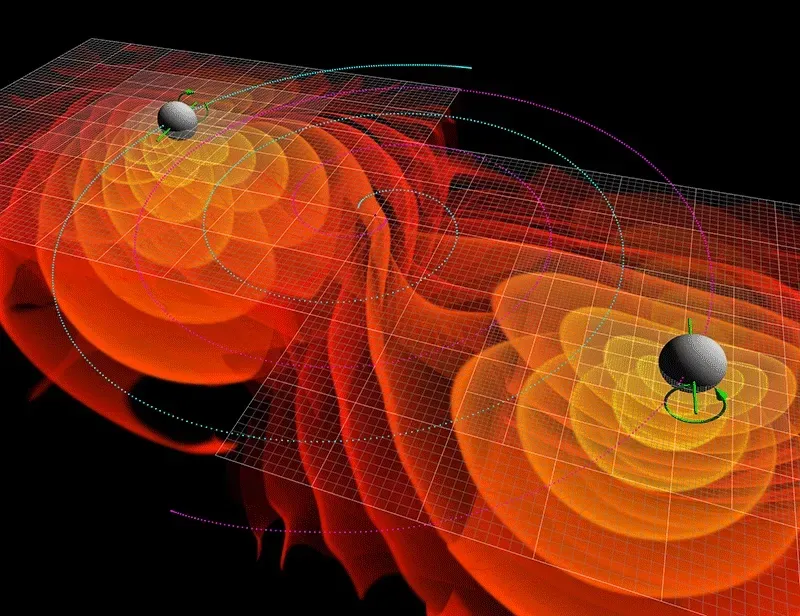
We don’t know how to time travel using cosmic strings yet, but future observations could teach us more about what they can do. We’re living in a remarkable moment for physics. Gravitational wave detectors are becoming more sensitive. Pulsar timing arrays are gathering years of data. Each observation brings us closer to either confirming or ruling out the existence of these cosmic relics.
If cosmic strings are real, they’re windows into physics beyond anything we currently understand. If they’re not, well, that tells us something important too. Either way, the search continues, driven by curiosity and the tantalizing possibility that the universe’s oldest scars might reveal its deepest secrets.
What do you think about the possibility of cosmic strings being out there right now? Could you imagine if scientists definitively detected one tomorrow?