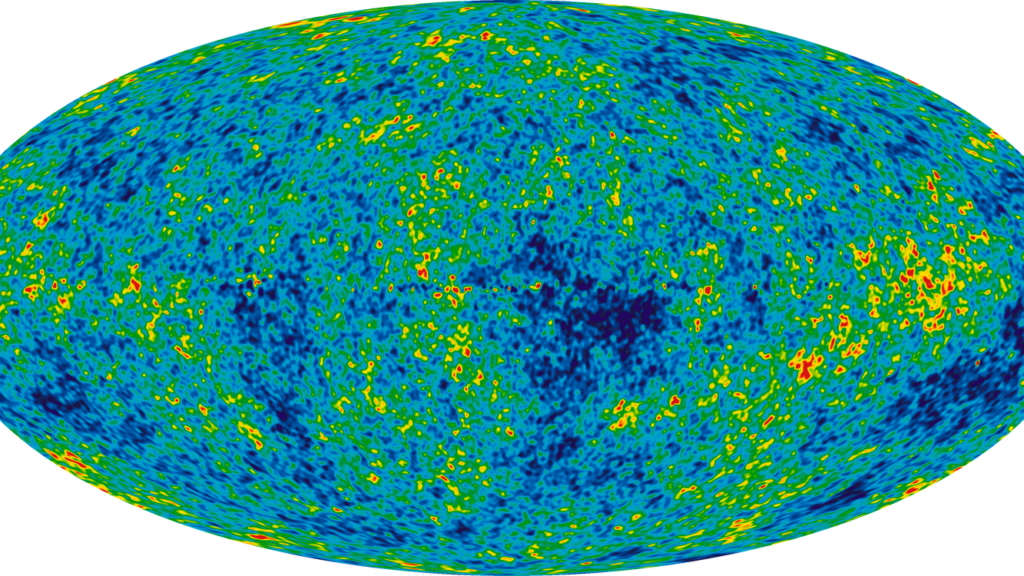

Imagine standing in a silent room and still hearing the faintest whisper from a party that ended billions of years ago. That’s basically what astronomers do when they study the cosmic microwave background, or CMB. It’s not just abstract science; it’s a literal picture of the baby universe, frozen in time and stretched across the sky.
When I first saw a CMB map, it honestly looked like a colorful weather forecast, not a snapshot of the beginning of everything. But buried in that mottled pattern of tiny temperature differences is a story about how space, time, matter, and even you and I came to exist. The more you stare at this ancient light, the more it feels like the universe left us a diary entry from its infancy – written in a language we’re just now learning to read.
The Faint Glow That Fills the Entire Sky
Here’s the shocking part: the night sky isn’t actually dark. Every direction you look, there’s a faint glow of microwave light gently washing over us. This glow is the cosmic microwave background, radiation that has been traveling for about thirteen and a half billion years, ever since the universe was only a few hundred thousand years old.
The CMB isn’t something you can see with your eyes, but old television static used to contain a tiny bit of it – real ancient light literally flickering on living room screens. Modern satellites like COBE, WMAP, and Planck have mapped this glow in exquisite detail, showing a nearly uniform temperature with tiny hot and cold spots only millionths of a degree apart. Those tiny variations, as unexciting as they look, are the seeds of everything: galaxies, stars, planets, and eventually life.
A Snapshot of the Universe as a Baby
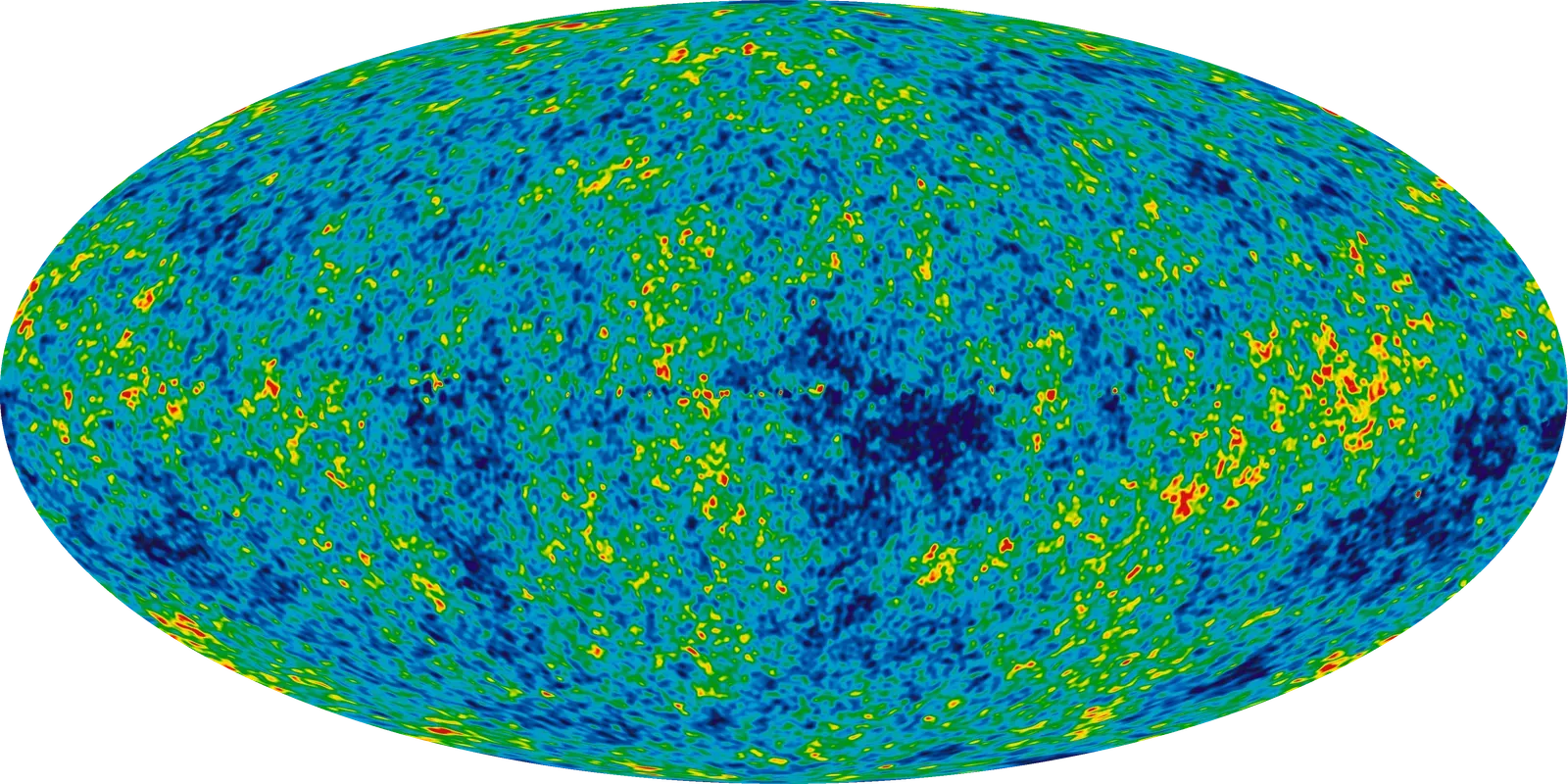
The CMB is basically the universe’s baby picture, taken when it was roughly about three hundred and eighty thousand years old. Before that time, the universe was a hot, dense plasma where light couldn’t travel freely because it kept bouncing off charged particles. It was more like an opaque fog than the transparent space we know today.
As the universe expanded and cooled, protons and electrons finally combined into neutral atoms, letting light move freely for the first time. That moment is called recombination, and the CMB is the afterglow of that cosmic “fog lifting.” When we detect the CMB, we’re seeing back in time to that surface, like looking at the glowing skin of a giant cosmic bubble from the inside.
How the CMB Proved the Big Bang Really Happened
For decades, scientists argued about whether the universe had a definite beginning or existed forever in a steady state. The discovery of the CMB in the 1960s instantly tipped the balance. A leftover glow from a hot, dense past is exactly what the Big Bang model predicted and something the steady-state idea couldn’t easily explain.
The CMB isn’t just there; it has the right properties. Its temperature matches predictions from Big Bang calculations, and its light has a nearly perfect thermal spectrum, like the glow from a very uniform, warm object. That kind of spectrum is hard to fake with any other process. The moment astronomers confirmed this, the Big Bang went from an interesting theory to the main story of how our universe began.
The Universe Is Shockingly Uniform… but Not Perfectly
One of the strangest things about the CMB is how incredibly uniform it is. The same patch of sky on opposite sides of the universe has nearly the same temperature, even though there hasn’t been enough time for light to travel between them and “even things out” in a simple way. That deep uniformity screams that something dramatic happened early on to smooth everything.
Yet the CMB isn’t perfectly smooth, and that’s just as important. The tiny temperature fluctuations – slightly hotter here, slightly colder there – are like small dents in an otherwise smooth surface. Those dents mark regions where matter was a little denser or a little thinner, which later grew, under gravity, into galaxies and clusters. Without those tiny imperfections, the universe might still be an almost featureless fog instead of a place with stars, planets, and people worrying about existential questions.
The Fingerprints of Cosmic Inflation
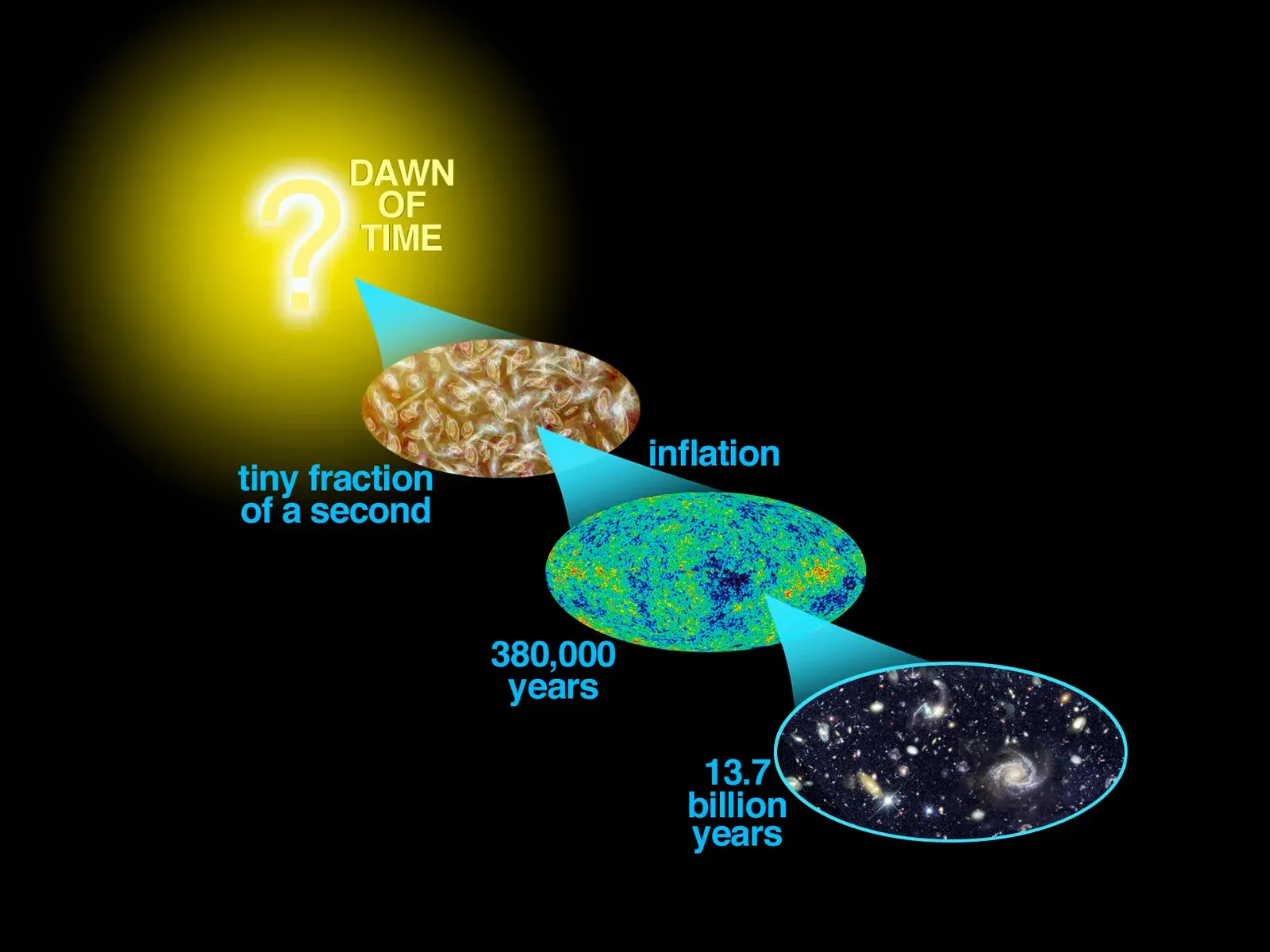
The CMB carries subtle patterns that hint at something wild: a period of extremely rapid expansion called inflation, right after the universe began. Inflation helps explain why distant parts of the universe look so similar and why space on large scales seems so flat. It’s like the universe inflated from something tiny to enormous almost instantly, smoothing out most irregularities.
The idea of inflation started as a bold theoretical fix, but the detailed structure of the CMB – how fluctuations change with scale – matches what inflation predicts surprisingly well. Maps from experiments like Planck show a pattern of hot and cold spots that align with the idea that quantum fluctuations were stretched across the universe during this early growth spurt. We haven’t nailed down every detail, but the CMB is one of the strongest reasons inflation is taken seriously rather than dismissed as a sci‑fi plot.
Weighing the Universe with Temperature Ripples
Those colorful CMB maps aren’t just pretty; they’re a measuring tool. By studying how big the hot and cold patches are and how often they appear at different scales, cosmologists can infer the contents of the universe. It sounds almost magical, but it’s really just physics: the density of matter, dark matter, and dark energy all affect how sound waves moved through the early plasma.
When scientists analyze these patterns, they can tell how much of the universe is made of normal matter, how much is dark matter, and how much is in the form of dark energy driving cosmic acceleration. The CMB suggests that normal matter is only a small fraction, dark matter adds a lot more, and dark energy dominates the total. In a way, the CMB lets us “weigh” the entire cosmos just by listening to its frozen echo of ancient sound waves.
Clues About Dark Matter and Dark Energy
Dark matter and dark energy are two of the most unsettling concepts in modern physics, and the CMB is one of the main reasons we’re confident they’re real, even if we don’t yet know exactly what they are. The way tiny fluctuations grew into large structures depends strongly on how much unseen mass was present. The CMB patterns show that gravity was pulling harder than visible matter alone could account for, pointing to dark matter.
Dark energy leaves its imprint more indirectly. When researchers compare the age and geometry implied by the CMB with how fast the universe is expanding today, they find a mismatch that dark energy neatly explains. It acts like a kind of smooth, repulsive component that accelerates cosmic expansion. The CMB does not tell us its true nature, but it tells us that if we ignore dark energy, the numbers stop lining up, like trying to balance a budget with a missing, very large expense.
When the Numbers Don’t Quite Agree: The Hubble Tension
In the last few years, an intriguing tension has emerged: if you use the CMB to infer how fast the universe should be expanding today, you get one value; if you measure that speed directly using nearby galaxies and supernovae, you get a higher value. The disagreement is not enormous, but it’s persistent and larger than you’d expect from simple measurement errors.
This mismatch, often called the Hubble tension, has turned the CMB into the center of a quiet scientific drama. Either something subtle is off in our measurements, or our current cosmological model is missing a piece – maybe an extra kind of radiation, a twist in dark energy, or entirely new physics in the early universe. No one has a fully convincing solution yet, and that uncertainty is both frustrating and incredibly exciting; the CMB might be hinting that our neat picture of the cosmos still has some cracks.
Polarization: A New Layer of Hidden Information
Temperature maps were just the beginning. The CMB is also polarized, meaning its light waves tend to vibrate more in certain directions than others, thanks to the way they scattered in the early universe. Measuring that polarization reveals extra layers of information about cosmic history and the motion of matter back then.
Scientists are especially interested in a particular polarization pattern that could come from gravitational waves produced during inflation. If we see a clear, unambiguous signal of this kind, it would be like finding a direct fossil trace of the universe’s earliest moments, far before recombination. A previous claim of such a detection turned out to be mostly dust in our own galaxy, which was a humbling reminder that nature doesn’t give up its secrets easily. Even so, next‑generation experiments on the ground, on balloons, and perhaps in space are chasing that signal with renewed caution and determination.
The Future: Sharper Maps, Deeper Mysteries
It’s tempting to think we’ve squeezed everything we can out of the CMB, but that’s far from true. Future experiments are aiming for sharper resolution, better polarization measurements, and more precise control of foreground noise like galactic dust. Each incremental improvement lets us test the standard cosmological model more harshly and look for tiny deviations that might point to new physics.
At some point, there will be a fundamental limit: we only have one universe, one CMB sky, and only so many photons we can measure. But we’re not at that wall yet. As instruments improve, the CMB will keep acting as a cosmic truth detector, confirming some ideas and killing others. There’s something humbling about that – our deepest theories of reality are being judged by a faint glow left behind when the universe was still learning how to be transparent.
Conclusion: Listening to a Whisper from the Beginning
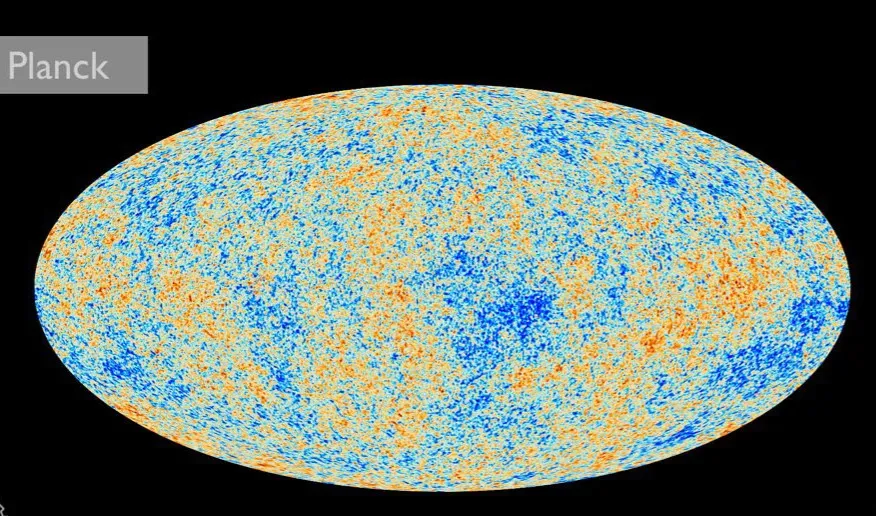
The cosmic microwave background is easy to overlook because it sounds abstract and technical, but it’s one of the most intimate things we’ve ever discovered about the universe. It’s a fossil light, a whisper from a time when there were no stars, no galaxies, and certainly no humans, yet it carries the blueprint of everything that would follow. Every small patch of color in those maps represents a tiny imbalance that gravity patiently amplified into the grand cosmic web we see now.
To me, the most moving part is this: by decoding this ancient glow, a species that only recently learned to make fire has begun to understand the first instants of all space and time. That’s a staggering leap, and it comes from paying attention to a nearly invisible background hum that most of us never notice. The universe did not have to leave us such a clear trail, but it did, and we’re just getting better at reading it. When you look up at the night sky, does it feel different knowing that, beneath the darkness, a thirteen‑billion‑year‑old echo is still quietly shining?