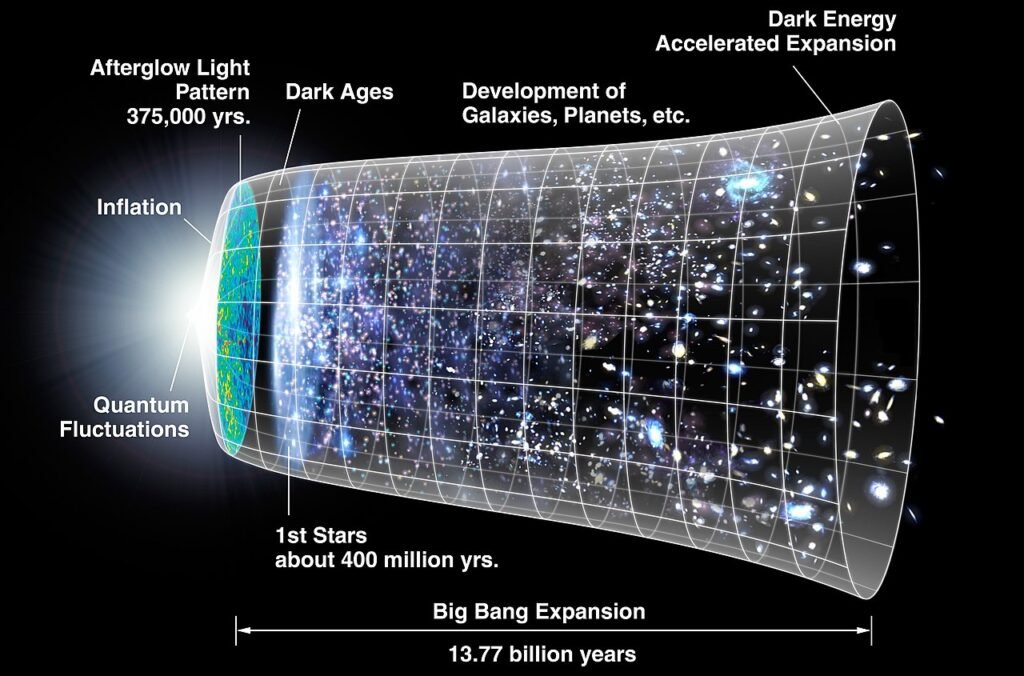

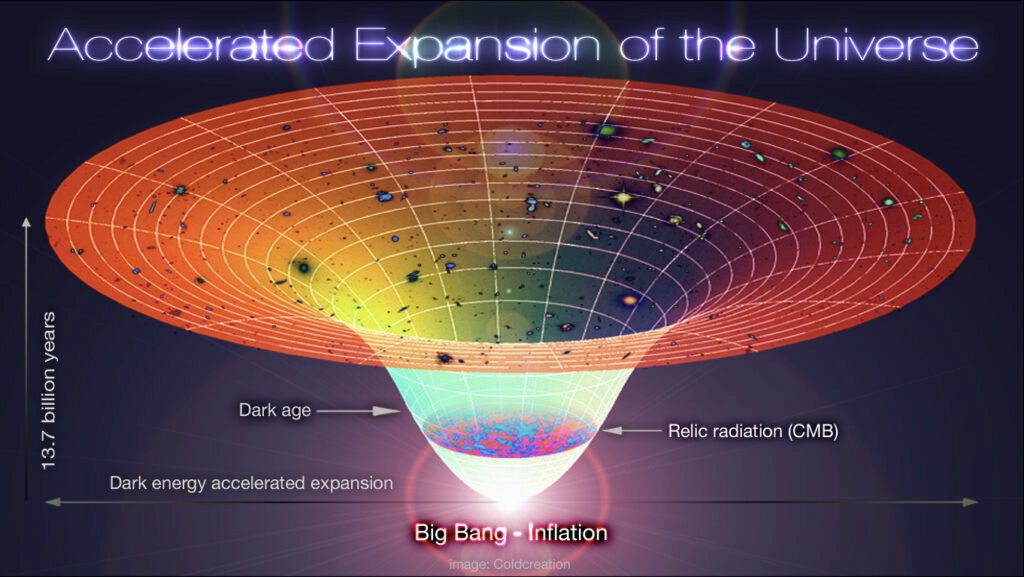
Imagine blowing up a balloon, and then discovering, to your complete shock, that the balloon is not only getting bigger but inflating faster and faster with each passing second, with no sign of ever stopping. Now make that balloon the entire universe. That is roughly the situation scientists found themselves in during the late 1990s, and the shockwaves from that moment are still reverberating through physics today.
What you are about to read is a story about cosmic mystery on the grandest scale imaginable. It is a story involving Nobel Prizes, invisible forces, squabbling measurements, and technologies so powerful they can map billions of galaxies at once. Strap in, because the universe has a few surprises it hasn’t finished revealing yet. Let’s dive in.
The Discovery That Upended Everything We Thought We Knew
Before 1998, if you had asked any physicist what gravity was doing to the expansion of the universe, they would have told you: slowing it down. That was the working assumption. Two teams of astronomers and physicists independently made the same stark discovery – not only is the universe expanding like a vast inflating balloon, but its expansion is actually speeding up. At the time, many scientists expected the gravitational pull of galaxies to slow down the expansion. Nobody saw the opposite coming.
First identified through observations of Type Ia supernovae by independent teams led by Saul Perlmutter, Brian Schmidt, and Adam Riess, the discovery revealed that the universe’s expansion, which began with the Big Bang approximately 13.8 billion years ago, began accelerating about 9 billion years later. Honestly, it is hard to overstate how destabilizing that was for cosmology. It was like expecting a rolling boulder to slow at the bottom of a hill and watching it speed up instead.
How Exploding Stars Became the Universe’s Greatest Messengers
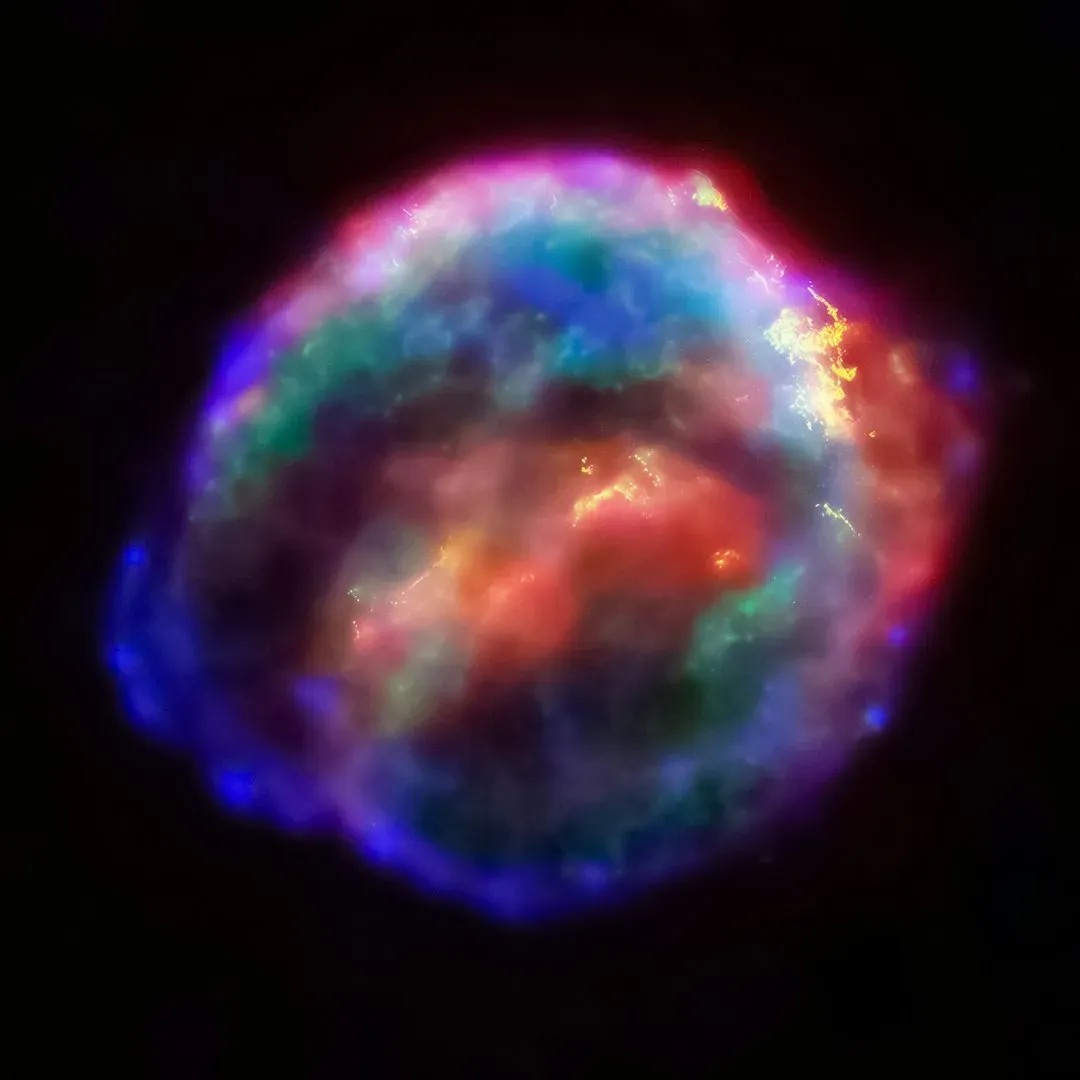
Here is the thing about Type Ia supernovae: they are remarkably consistent. This technique requires data from Type Ia supernovae, which occur when an extremely dense dead star known as a white dwarf reaches a critical mass and explodes. Since the critical mass is nearly the same for all white dwarfs, all Type Ia supernovae have approximately the same actual brightness, and any remaining variations can be calibrated out. So when astrophysicists compare the apparent brightnesses of two Type Ia supernovae as seen from Earth, they can determine their relative distances. Think of them as cosmic lightbulbs with a known wattage.
All in all, the two research teams found over 50 distant supernovae whose light was weaker than expected – this was a sign that the expansion of the universe was accelerating. The potential pitfalls had been numerous, and the scientists found reassurance in the fact that both groups had reached the same astonishing conclusion. When two rival teams racing each other both reach the same jaw-dropping answer, you know something real has been discovered. This revolutionary discovery was recognized with the Nobel Prize in Physics in 2011.
Dark Energy: The Name We Give to Our Own Ignorance
Since the early 20th century, scientists have gathered convincing evidence that the universe is expanding, and that this expansion is accelerating. The force responsible for this acceleration is called dark energy, a mysterious property of spacetime thought to push galaxies apart. Let’s be real, though – calling it “dark energy” is essentially admitting we have no idea what it is. We gave a name to a gap in our knowledge and ran with it.
To explain these observations, scientists proposed a new kind of energy responsible for driving the universe’s accelerated expansion: dark energy. Astrophysicists now believe dark energy makes up about 70% of the mass-energy density of the universe. Yet we still know very little about it. Seventy percent of everything, and we can’t see it, touch it, or directly detect it. That is a deeply uncomfortable position for a species that prides itself on scientific understanding.
The Standard Model of Cosmology and Its Uneasy Foundations
For decades, the prevailing cosmological model, known as Lambda Cold Dark Matter (ΛCDM), has assumed that dark energy remains constant throughout cosmic history. This simple but powerful assumption has been the foundation of modern cosmology. Yet it leaves one key question unresolved: what if dark energy changes over time instead of remaining fixed? It is a remarkably fragile foundation for the most comprehensive theory of everything humanity has ever built.
The cosmological constant is a fixed value associated with dark energy, believed to drive the accelerating expansion of the universe. The second key component is cold dark matter, thought to comprise around 85% of all matter in the universe despite never being directly observed. Third is ordinary matter, which we can detect through astronomical observations. Although the model’s predictions have held firm against decades of scrutiny, this picture has recently come under increasing pressure. Pressure, to put it mildly, is an understatement.
The Hubble Tension: When Two Measurements of the Same Thing Disagree
Imagine measuring the length of a table from both ends and getting two different numbers that stubbornly refuse to agree. That is precisely what has been happening with the Hubble constant, the number that tells you how fast the universe is expanding. The well-known Hubble tension is a persistent roughly 5-sigma discrepancy between early and late universe determinations of the Hubble constant, challenging the foundations of our baseline cosmological paradigm. A 5-sigma discrepancy in science is not noise – it is practically a siren.
This persistent challenge to the standard cosmological model is called the “Hubble tension,” referring to the well-established discrepancy between measurements of the present-day expansion rate. The estimate based on the Cosmic Microwave Background, for example, sits in stark tension with the distance-ladder measurements. Even as these observational methods have improved, the discrepancy between them has remained stubbornly persistent. If the tension cannot be explained by measurement error, it implies that the standard model of cosmology is broken or incomplete, which would require new physics, such as new particles, modified gravity, or a more complex understanding of dark energy.
Is Dark Energy Actually Changing? The Evidence Mounts
For a long time, the assumption was that dark energy was fixed, stable, and perfectly constant. Now that assumption is looking shakier by the month. Recent observations from the Dark Energy Spectroscopic Instrument (DESI) have provided intriguing evidence suggesting that dark energy may not be a simple cosmological constant. Data from DESI in 2024 and 2025 provided evidence that dark energy may not be a constant, and the results hinted at a dynamic form of dark energy. If true, this would shatter decades of assumption like glass.
The corrected supernova data and the BAO+CMB-only results both indicate that dark energy weakens and evolves significantly with time. More importantly, when the corrected supernova data were combined with BAO and CMB results, the standard ΛCDM model was ruled out with overwhelming significance. If dark energy is truly weakening over time, it throws a wrench into the standard cosmological model, the backbone of our understanding of the universe. It might mean that the future of the cosmos is far different than we have imagined, and that Einstein’s famous equations will need serious revisiting.
Could the Universe Actually Be Slowing Down Already?
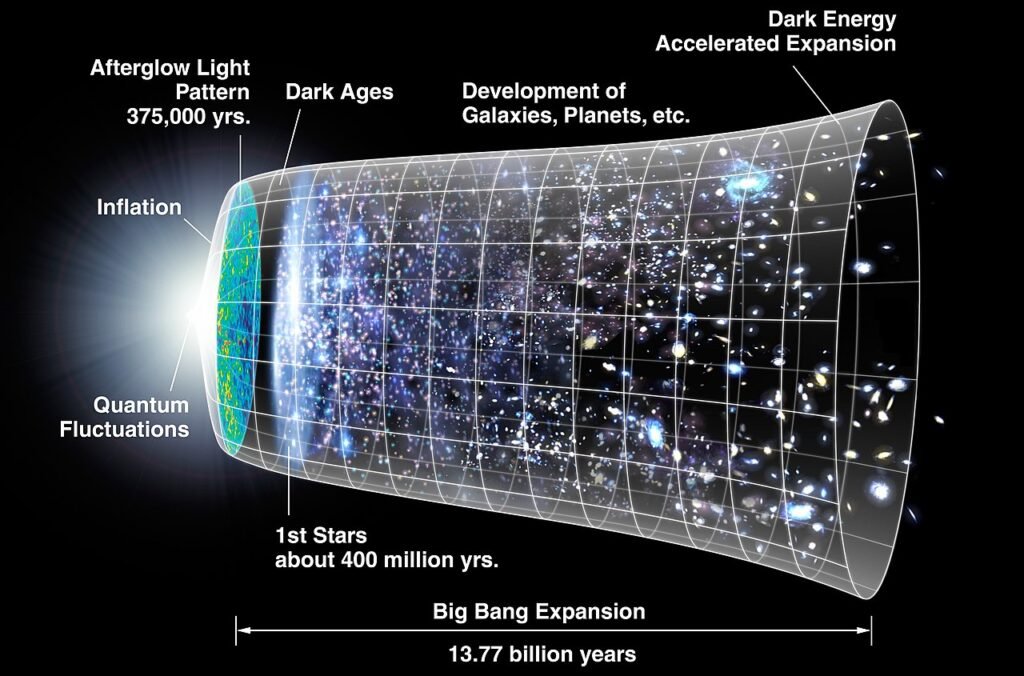
Here is where things get genuinely surprising. While many researchers focused on how dark energy might be evolving over time, a separate bombshell arrived in late 2025. The universe’s expansion may actually have started to slow rather than accelerating at an ever-increasing rate as previously thought, a new study suggests. Findings published in Monthly Notices of the Royal Astronomical Society cast doubt on the long-standing theory that a mysterious force known as dark energy is driving distant galaxies away increasingly faster. Instead, they show no evidence of an accelerating universe.
If the results are confirmed, it could open an entirely new chapter in scientists’ quest to uncover the true nature of dark energy, resolve the Hubble tension, and understand the past and future of the universe. And the potential end game? It may be more dramatic than the quiet freeze cosmologists once imagined. New data from major dark-energy observatories suggest the universe may not expand forever after all. A Cornell physicist calculates that the cosmos is heading toward a dramatic reversal: after reaching its maximum size in about 11 billion years, it could begin collapsing, ultimately ending in a “big crunch” roughly 20 billion years from now. Now that is a storyline nobody expected.
The New Instruments That Could Finally Give Us Answers
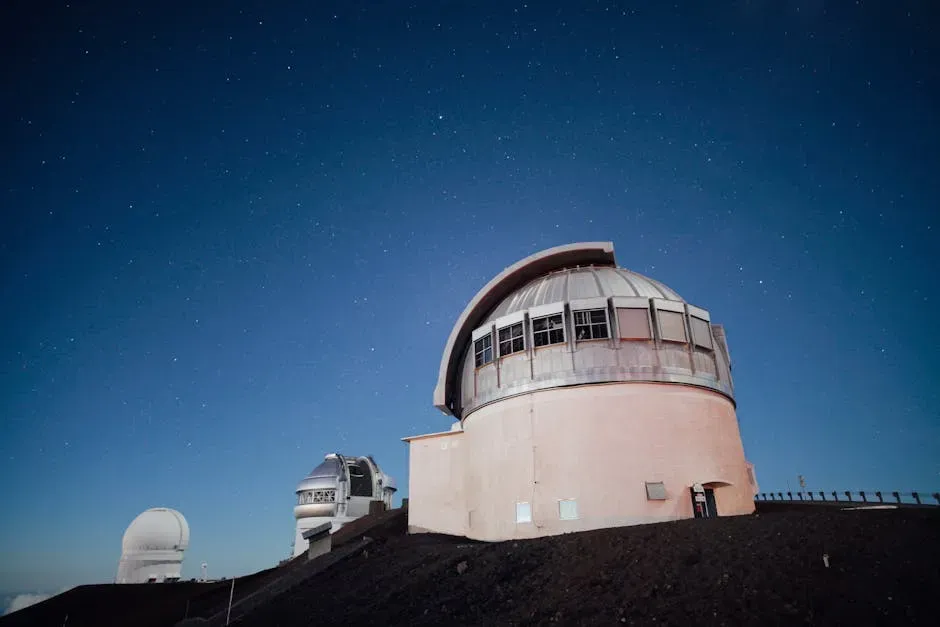
Science never stands still, and the tools being deployed to crack these mysteries are nothing short of extraordinary. The revelation comes from the Dark Energy Spectroscopic Instrument, or DESI, perched atop the Kitt Peak National Observatory in Arizona. DESI is a cutting-edge tool designed specifically to measure the universe’s expansion and probe the elusive dark energy. Scientists from over 70 institutions around the world are collaborating on this ambitious project. Over the past three years, DESI has collected data from 15 million galaxies and quasars, offering one of the most detailed looks at cosmic expansion ever attempted.
Meanwhile, a new observatory is joining the quest and raising the ambitions of the entire field. Rubin’s innovative 8.4-meter telescope has the largest digital camera ever built, which feeds a powerful data processing system. The Vera C. Rubin Observatory has begun its primary mission, the Legacy Survey of Space and Time, in which it will ceaselessly scan the sky nightly for 10 years to precisely capture every visible change. The result will be an ultrawide, ultra-high-definition time-lapse record of the universe. Over its 10-year Legacy Survey of Space and Time, Rubin could change our understanding of how and when the universe formed. It’s hard to say for sure what it will find, but the scientific community is holding its breath.
Conclusion: A Universe Still Full of Surprises
You might think that after more than a century of modern cosmology, we would have the universe mostly figured out. The story of cosmic expansion tells a very different tale. Why the universe is expanding faster and faster remains one of the biggest open questions in physics, and current theories cannot fully explain this accelerating growth. Every new instrument, every fresh dataset, seems to push the mystery a little deeper rather than resolving it cleanly.
What makes this all so compelling is not just the scale of the unknown, but the pace at which our understanding is shifting. We went from confident belief in a decelerating cosmos to Nobel-winning proof of acceleration, and now we are grappling with evidence that even that acceleration may be evolving or decelerating again. A team of cosmologists in China has introduced a mathematical framework that investigates two of the deepest mysteries in cosmology at the same time, with work that could pave the way for vital corrections to the current ΛCDM model alongside a long-awaited resolution to the Hubble tension. The race is very much still on.
The universe, it turns out, does not care much for human expectations. It expands on its own terms, by its own rules, and it has been doing so for nearly 14 billion years without asking our opinion. Perhaps that is the most humbling and thrilling realization of all: we are passengers on a cosmic journey whose destination we are only beginning to understand. What does it make you think about how much we really know? Drop your thoughts in the comments below.