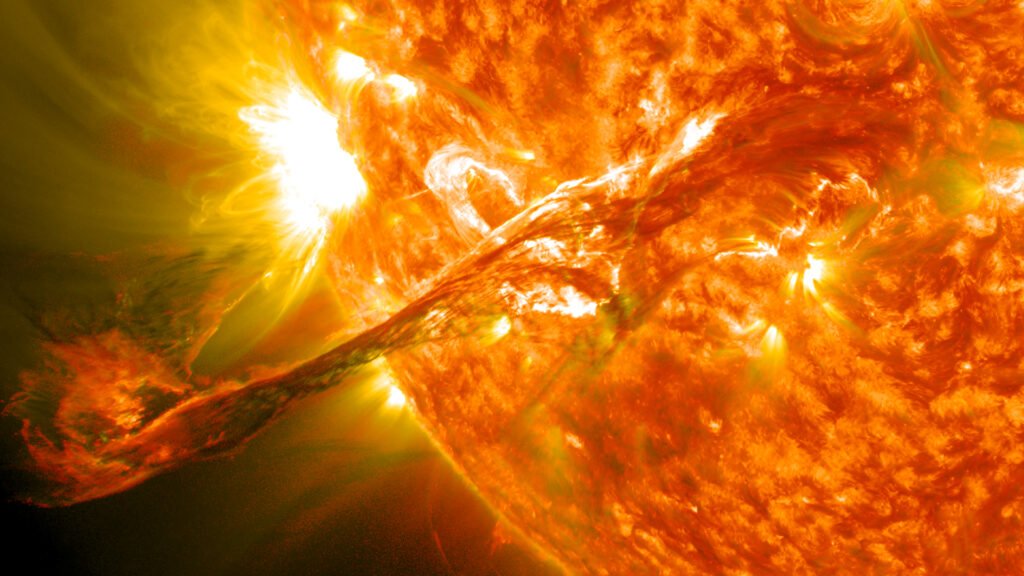

If you’ve ever watched a sunrise and felt, for a split second, that the Sun was more than just a ball of gas, you’re not crazy. In a very real sense, the Sun is alive with activity: it pulses, flares, breathes in cycles, and its moods ripple across every corner of Earth. We feel it in our power grids, in airplane routes, in satellite signals, even in the tiny particles our bodies are exposed to when we fly or live at high latitudes.
What’s truly wild is how much we still don’t fully control, even with all our technology. As we move deeper into a world dependent on space-based infrastructure and interconnected systems, the Sun’s cycles are becoming less of a background curiosity and more like a powerful neighbor whose habits we urgently need to understand. Once you see how tightly our lives are bound to its rhythms, it’s very hard to ever look at daylight the same way again.
The Sun’s 11-Year Mood Swing: Understanding the Solar Cycle
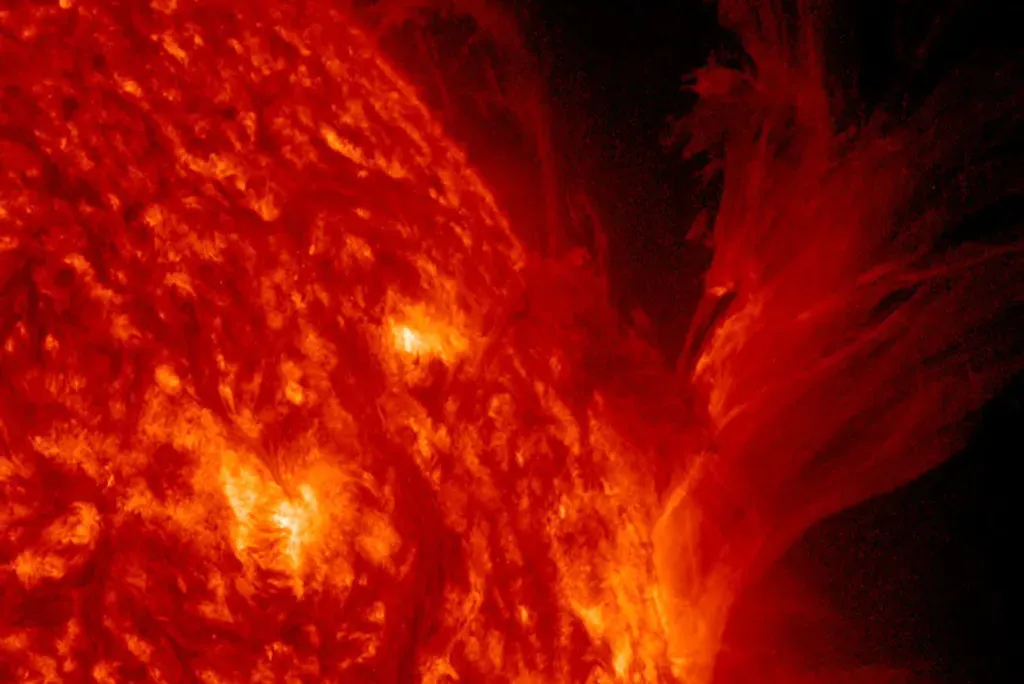
Every roughly eleven years, the Sun swings from quiet and relatively calm to restless and explosive, then back again. Scientists call this the solar cycle, and it’s tracked mainly by counting sunspots, which are darker, cooler patches on the solar surface where intense magnetic fields poke through. During solar maximum, the Sun boils with activity: more sunspots, more solar flares, more outbursts of energetic particles hurled into space.
In the quieter phase, solar minimum, sunspots practically vanish and the Sun looks deceptively smooth and steady. But even then, its magnetic field is shifting and reorganizing, building up to the next peak. Right now, in the mid-2020s, we’re in a particularly active part of the cycle, and predictions suggest this maximum is stronger than many experts originally expected. That means more stunning auroras for some of us – and more headaches for the systems we rely on.
Solar Flares and Storms: When the Sun Throws a Punch
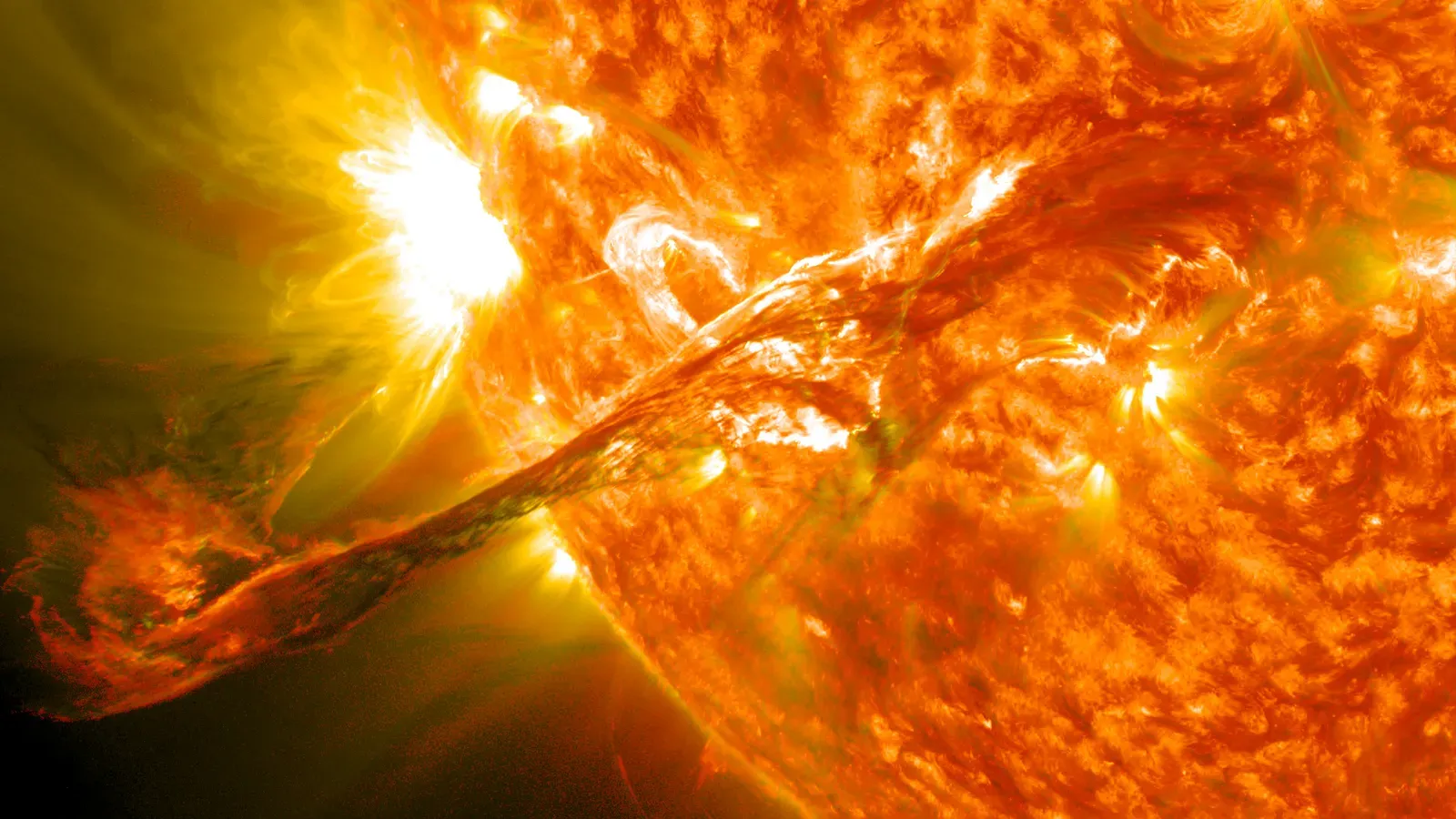
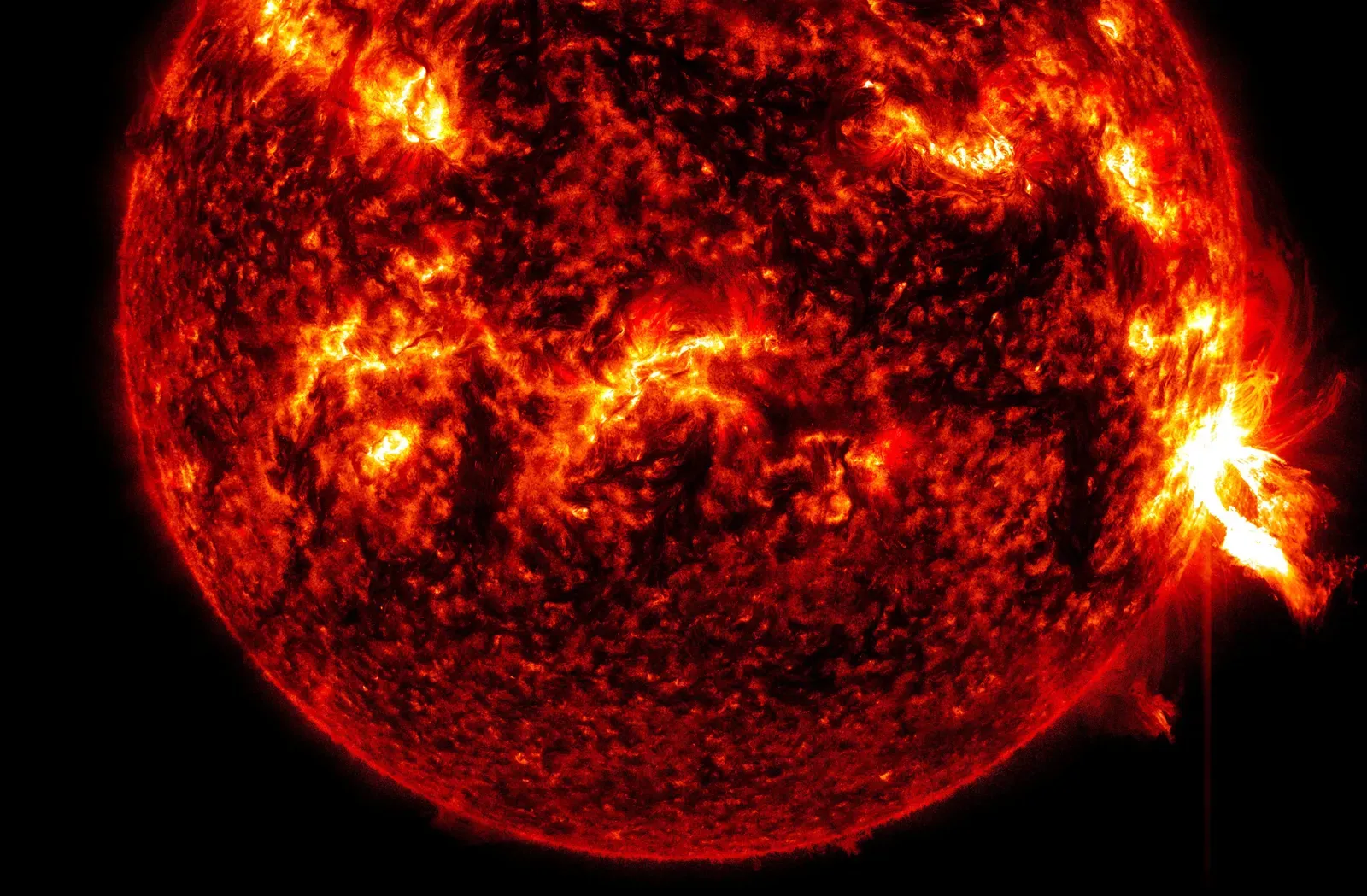
Also available on NASA’s Image and Video Library as GSFC_20171208_Archive_e001662, CC BY 2.0)
Think of solar flares as massive bursts of light and energy, like a cosmic lightning flash on the solar surface. Sometimes they come with coronal mass ejections – gigantic clouds of magnetized plasma launched into space. When one of these is aimed at Earth and arrives a couple of days later, we get what’s known as a geomagnetic storm, a sort of magnetic tide crashing into our planet’s protective shield. Most of the time, Earth’s magnetic field takes the hit and converts that energy into beautiful auroras.
But when the storm is strong enough, it can cause real trouble. Fluctuations in Earth’s magnetic field can induce currents in long conductors like power lines and pipelines, stress transformers, and interrupt communications. The famous outage in Quebec in 1989, which left millions without power, was triggered by a geomagnetic storm. That was a warning shot. Our world is far more electrified and connected now, so a similar storm today could be much more disruptive.
Power Grids, Pipelines, and Planes: How Solar Cycles Hit Modern Life
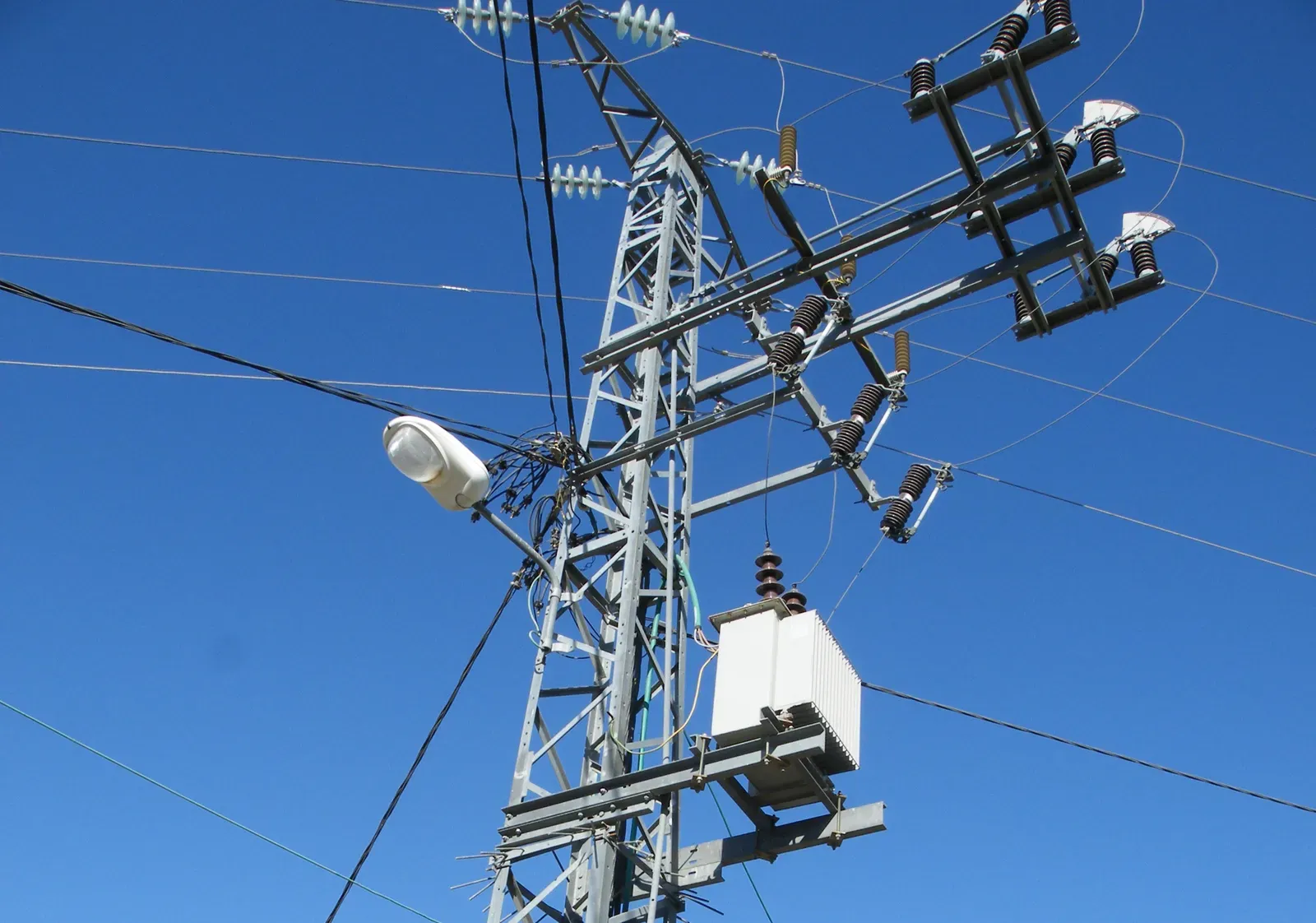
It’s easy to imagine solar activity as something that only matters to astronauts and space engineers, but that’s not the case. Power grid operators now keep an eye on space weather forecasts almost the way coastal cities watch hurricane updates. Strong geomagnetic storms can drive unexpected currents through high-voltage lines, overheating transformers and forcing emergency shutdowns to protect critical components. Even moderate storms can nudge already stressed systems closer to their breaking point.
Long pipelines can also feel this invisible squeeze, with induced currents affecting corrosion rates and monitoring sensors. Aviation routes over polar regions are sometimes shifted, because solar storms can disrupt high-frequency radio communications and increase radiation exposure at cruising altitudes. I remember the first time I flew on a transpolar route and later discovered that airlines actively watch solar reports just to decide whether to reroute; it quietly blew my mind how a flare 150 million kilometers away could change my flight path.
Satellites, GPS, and the Invisible Infrastructure Above Us
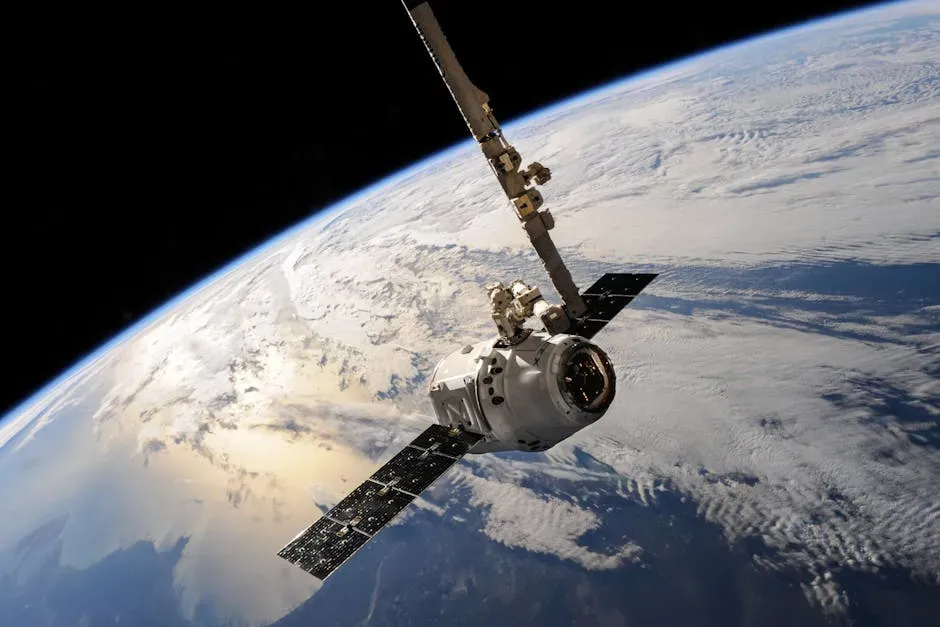
Our modern lives secretly rest on a fragile shell of satellites orbiting high above the planet, and those satellites sit right in the line of fire when the Sun gets rowdy. Charged particles from solar storms can build up static in satellite electronics, interfere with onboard systems, and in extreme cases cause total failures. Denser upper atmosphere during strong solar activity can also increase drag on satellites in low Earth orbit, slowly tugging them down and altering their paths.
GPS signals, which already have to thread through layers of atmosphere, can be scrambled or delayed by disturbances in the ionosphere – a region of charged particles around Earth that responds dramatically to solar activity. That matters for far more than just finding a coffee shop; precision timing and positioning from GPS underpins banking transactions, shipping logistics, and even some power grid controls. When solar storms distort the ionosphere, that invisible backbone of timing and navigation gets shaky in ways most of us never notice directly.
Auroras, Atmospheres, and Subtle Climate Links
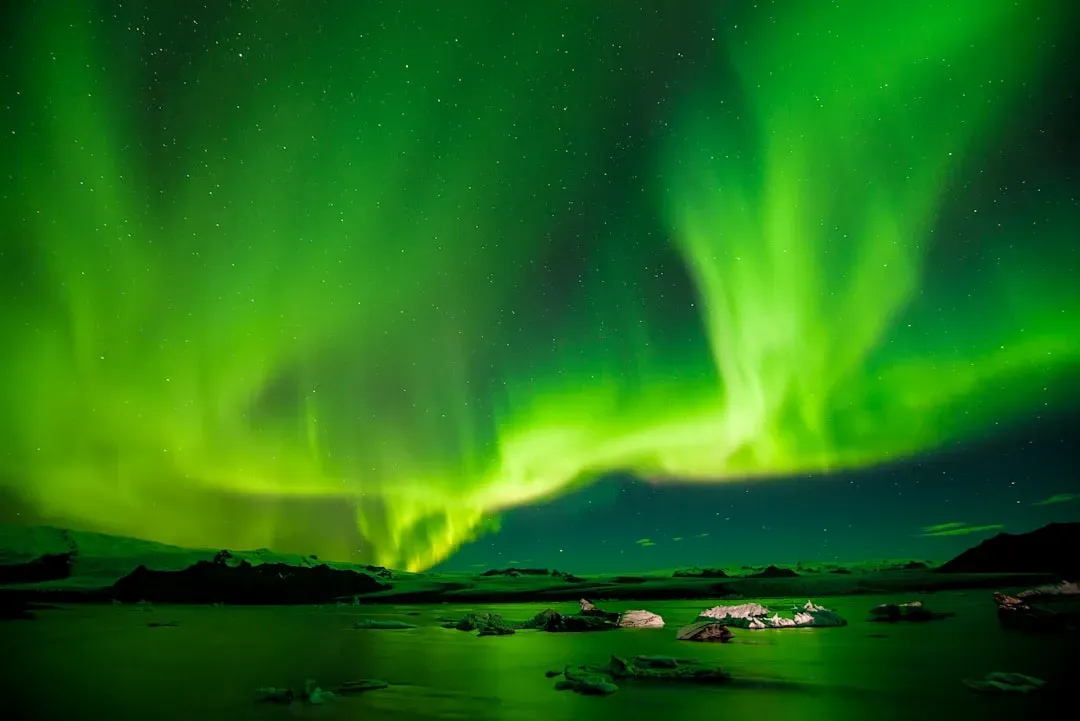
The most visible and enchanting sign that the Sun is interacting with Earth is the aurora, those shimmering curtains of light near the poles. They’re created when energetic particles from the Sun spiral along Earth’s magnetic field lines and collide with atoms in the upper atmosphere. During solar maximum, auroras often become brighter and visible much farther from the poles than usual, lighting up skies over places that rarely see them. For those who witness them, they can feel almost unreal, like the sky is breathing.
Deeper down, the story gets more subtle. Researchers are still untangling how solar cycles might influence climate over decades, especially by changing the distribution of energy in the upper atmosphere and slightly nudging atmospheric circulation patterns. The key point: the Sun does vary, but those variations are small compared to the warming driven by human greenhouse gas emissions. It’s tempting to blame everything on solar cycles, but the evidence simply doesn’t support that; the Sun is part of the picture, not an excuse to look away from what we’re doing down here.
Space Weather Forecasting: Learning to Read the Sun’s Temperament
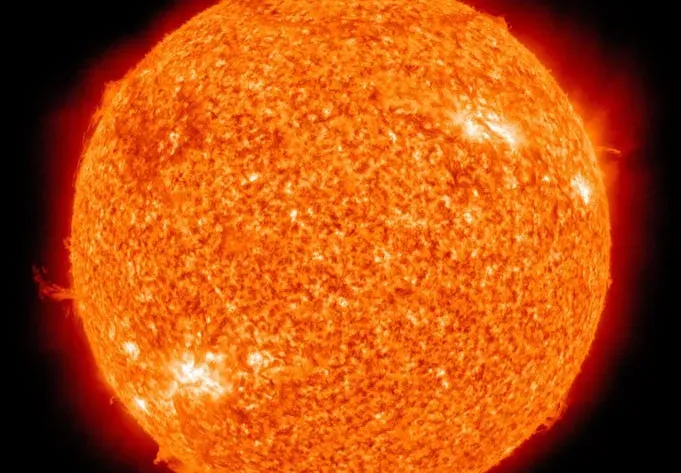
Over the past few decades, humanity has gone from barely noticing solar storms to actively trying to forecast them days in advance. Agencies around the world now monitor the Sun in multiple wavelengths, track sunspots, measure solar wind, and use spacecraft parked between Earth and the Sun as early-warning sentinels. When a coronal mass ejection is spotted heading our way, alerts go out to satellite operators, airlines, and grid managers so they can switch to safer modes, reroute flights, or adjust system loads.
This is still an evolving science, full of uncertainty and guesswork, more like predicting volcanic eruptions than tomorrow’s rain. But we’re getting better, especially with new solar observatories and data-driven models that can simulate how an incoming storm will interact with Earth’s magnetic shield. I like to think of it as learning to read the Sun’s moods: we can’t stop a tantrum, but we can at least brace ourselves, protect what’s most fragile, and ride it out with fewer nasty surprises.
Living with a Living Star: Risk, Wonder, and Responsibility
There’s something humbling in realizing that every text you send, every satellite image you see, and every international bank transfer depends on the stability of a star that’s constantly churning and erupting. We live downstream of a living engine of fusion, wrapped in a magnetic cocoon that turns most of its fury into light shows and subtle atmospheric changes. The same star that warms your face on a winter morning can, in a bad storm, push our technology to the brink.
That mix of risk and wonder is a reminder that progress doesn’t make us separate from nature; it ties us to it even more. As we build bigger networks, launch more satellites, and dream about moon bases and Mars missions, respecting the Sun’s cycles becomes less optional and more like basic survival planning. The Sun may not be alive in the way we are, but its rhythms shape the rules we live under. Next time you step outside and squint into that blinding disk, will you see just light – or a restless neighbor whose moods quietly touch everything you do?