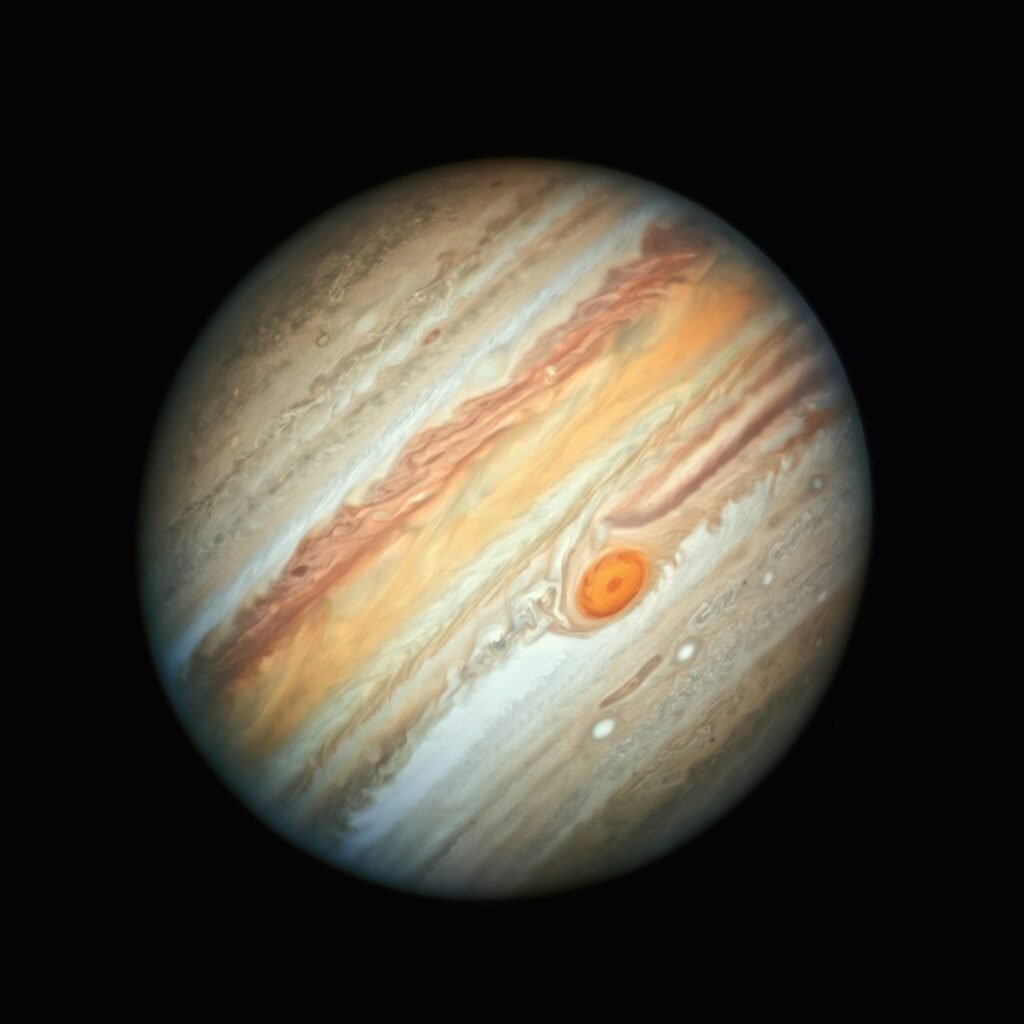

Picture yourself staring up at the night sky, spotting Jupiter glowing like a bright jewel among the stars. Yet hidden beneath that serene twinkle lies one of the most violent and persistent storms in our solar system. While hurricanes on Earth barely last a week, Jupiter hosts a tempest that has been raging for centuries. This colossal weather system, known as the Great Red Spot, challenges everything we thought we knew about planetary storms.
The Great Red Spot was first reliably observed in September 1831, though a similar spot was noted from 1665 to 1713. Recent research from 2024 suggests these may not be the same storm, but even the conservative estimate makes this tempest at least two centuries old. When 17th-century astronomers first turned their telescopes to Jupiter, they noted a conspicuous reddish spot that remains present more than 300 years later.
A Storm Bigger Than Earth Itself
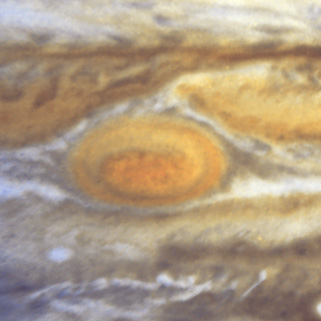
With a current diameter of approximately 10,250 miles, the Great Red Spot is about 1.3 times the width of Earth and one-sixth the diameter of Jupiter itself. To put this in perspective, you could fit our entire planet inside this storm with plenty of room to spare. At its widest point historically, the storm once measured about 25,000 miles across, wide enough to fit three Earths side by side.
The storm rotates counterclockwise with wind speeds reaching up to 400 to 500 kilometers per hour. To understand just how extreme this is, Earth’s most powerful hurricanes like Hurricane Katrina reached peak winds of around 175 miles per hour. The Great Red Spot makes our worst storms look like gentle breezes.
What makes this storm truly remarkable isn’t just its size but its incredible stability. The Red Spot is the largest known storm in the Solar System, and unlike terrestrial hurricanes that dissipate quickly, this Jovian monster has maintained its basic structure for generations.
The Mystery of Its Longevity
So what keeps this storm alive when Earth’s hurricanes die out so quickly? The answer lies in Jupiter’s unique nature. The long lifetime of the Red Spot may be due to the fact that Jupiter is mainly a gaseous planet, possibly having liquid layers but lacking a solid surface which would dissipate the storm’s energy.
Think of it this way: when a hurricane hits land on Earth, it’s like a spinning top hitting sandpaper. The friction brings it to a grinding halt. Jupiter’s Great Red Spot, however, spins freely in an endless ocean of gas with nothing to slow it down. A significant factor in its longevity is that Jupiter, as a gas planet, has no surface, and thus there is no friction to slow the storm.
The storm may well be equivalent to a gigantic hurricane powered by condensation of water, ammonia, or both at lower levels in Jupiter’s atmosphere, or it may draw its energy from smaller eddies that merge with it. Recent studies have shown that the Great Red Spot actually feeds on smaller storms, absorbing them like a cosmic vacuum cleaner to maintain its strength.
The Puzzle of Its Red Color
Despite decades of study, scientists still can’t definitively explain why the Great Red Spot appears red. The source of the red coloration is unknown, with suggestions ranging from compounds of sulfur and phosphorus to organic material, any of which could be produced by lightning discharges or high-altitude photochemical reactions.
Studies predict Jupiter’s upper atmosphere has clouds consisting of ammonia, ammonium hydrosulfide, and water, but scientists don’t know exactly how or even whether these chemicals react to give colors like those in the Great Red Spot. These compounds make up only a really tiny portion of the atmosphere, making it incredibly hard to figure out exactly what creates the colors we see.
Interestingly, the spot’s color can vary; some years it appears deep red, other times it fades to a pale salmon or even beige. Since 2014, it has been taking on a ruddy orange color that is slowly intensifying. This color-changing behavior adds another layer of mystery to an already puzzling phenomenon.
A Storm Under Pressure
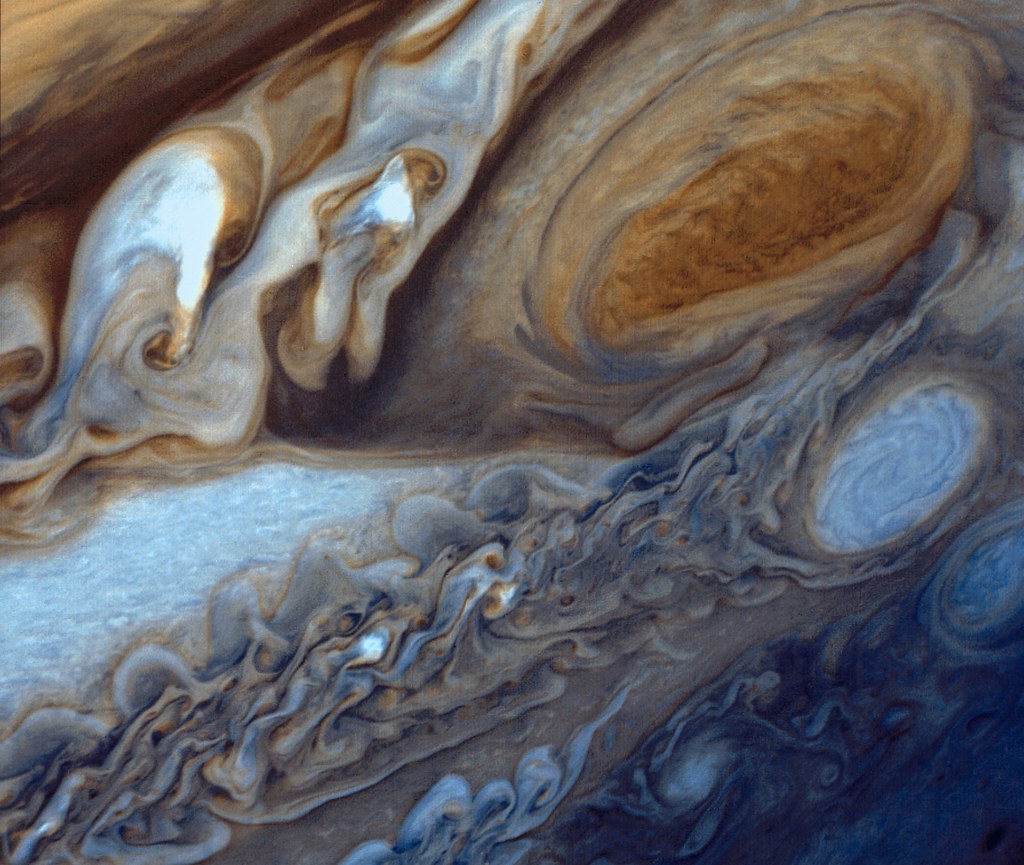
Unlike a low-pressure hurricane in the Caribbean Sea, the Red Spot rotates counterclockwise in the southern hemisphere, showing that it is a high-pressure system. This makes it what scientists call an anticyclone, the opposite of the familiar cyclones we experience on Earth.
The Great Red Spot is an anticyclone, a large circulation of winds that rotates around a central area of high pressure along Jupiter’s southern midlatitude cloud belt. This high-pressure center acts like the eye of the storm, creating a relatively calm region surrounded by the churning chaos of the outer winds.
Recent observations have revealed something fascinating: the storm isn’t as stable as it appears. New observations captured by the Hubble Space Telescope show that the 190-year-old storm wiggles like gelatin and shape-shifts like a squeezed stress ball over 90 days. As it accelerates and decelerates, the storm pushes against the windy jet streams to the north and south of it, similar to a sandwich where the slices of bread are forced to bulge out when there’s too much filling in the middle.
The Shrinking Giant
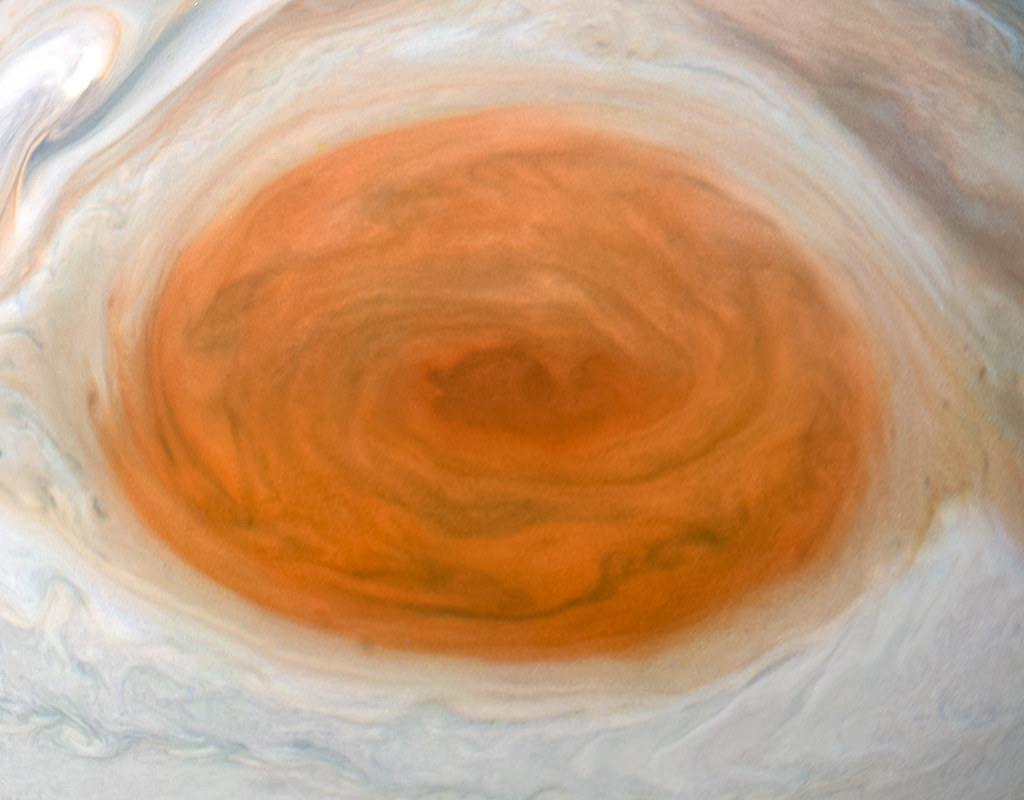
One of the most intriguing aspects of the Great Red Spot is that it’s been steadily shrinking. In the 21st century, the major diameter has been observed to be shrinking, with its length in 2004 about half that of a century earlier when it reached 40,000 kilometers.
The Great Red Spot has reduced from its original 19th-century estimate of 25,500 miles across to 10,250 miles in diameter, shrinking by an average of 580 miles per year. At the present rate of reduction, it will become circular by 2040.
This shrinkage raises uncomfortable questions about the storm’s future. The cause of the Great Red Spot’s shrinking remains unknown; it could be that the weather patterns that sustain it have simply lost steam after potentially several hundred years. A shriveling spot may not be able to fuel enough thunderstorm activity to sustain itself.
Feeding on Smaller Storms
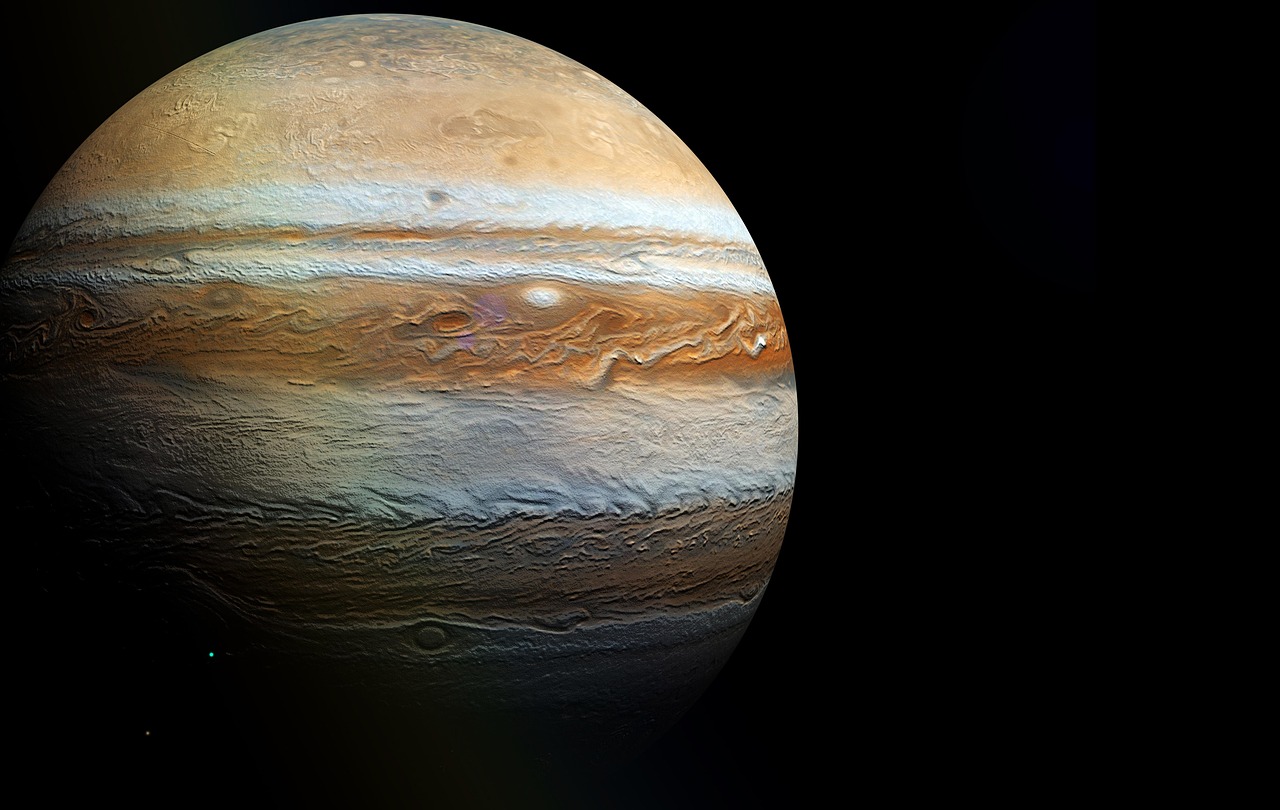
Recent research has revealed a fascinating aspect of how the Great Red Spot maintains itself. Bigger storms like the Great Red Spot gobble up smaller neighbors. Think of it as a cosmic version of the playground bully, but instead of taking lunch money, it’s absorbing entire weather systems.
A ring of thunderstorms forms around the planet at this latitude and eventually gets sucked into and essentially feeds the Great Red Spot, which may help seed these storms as it’s so big that it obstructs gas flow, creating a low-pressure region ripe for thunderstorm formation.
This feeding mechanism might be crucial to the storm’s survival. Recent simulations suggest that the presence of other storms strengthened the Great Red Spot, causing it to grow larger, with researchers finding that feeding the spot a diet of smaller storms could modulate its size. It’s like the storm needs to constantly eat to maintain its massive proportions.
The relationship between the Great Red Spot and smaller storms reveals a complex ecosystem of weather patterns on Jupiter that we’re only beginning to understand. This discovery has important implications for understanding not just Jupiter’s weather, but storm systems throughout the universe.
Scientific Discoveries and Modern Observations
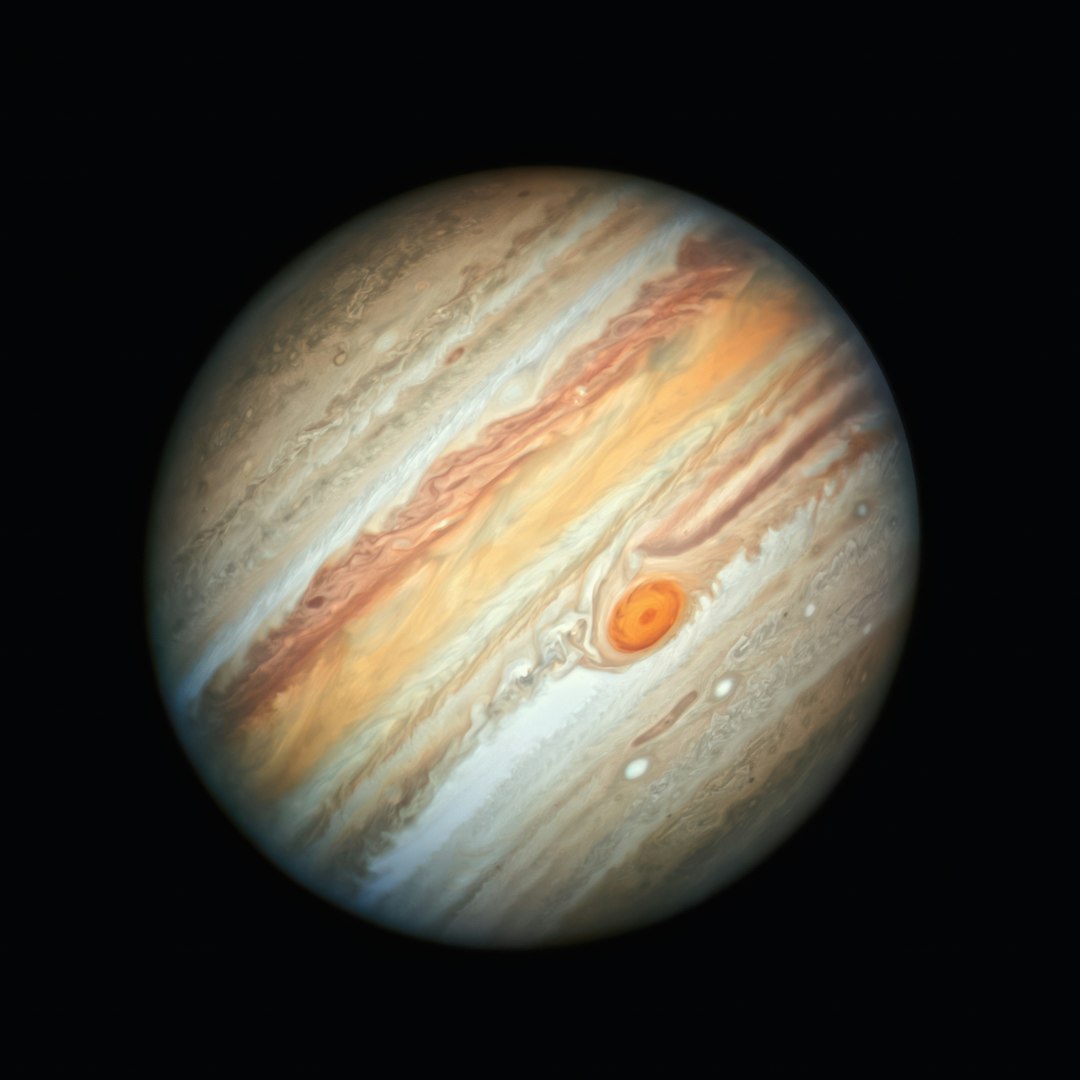
On 25 February 1979, when Voyager 1 was 9.2 million kilometers from Jupiter, it transmitted the first detailed image of the Great Red Spot with cloud details as small as 160 kilometers across visible. This marked the beginning of the modern era of Great Red Spot research.
The Juno spacecraft, which entered polar orbit around Jupiter in 2016, flew over the Great Red Spot on 11 July 2017, taking images from about 8,000 kilometers above the surface. These close-up observations have provided unprecedented detail about the storm’s structure and behavior.
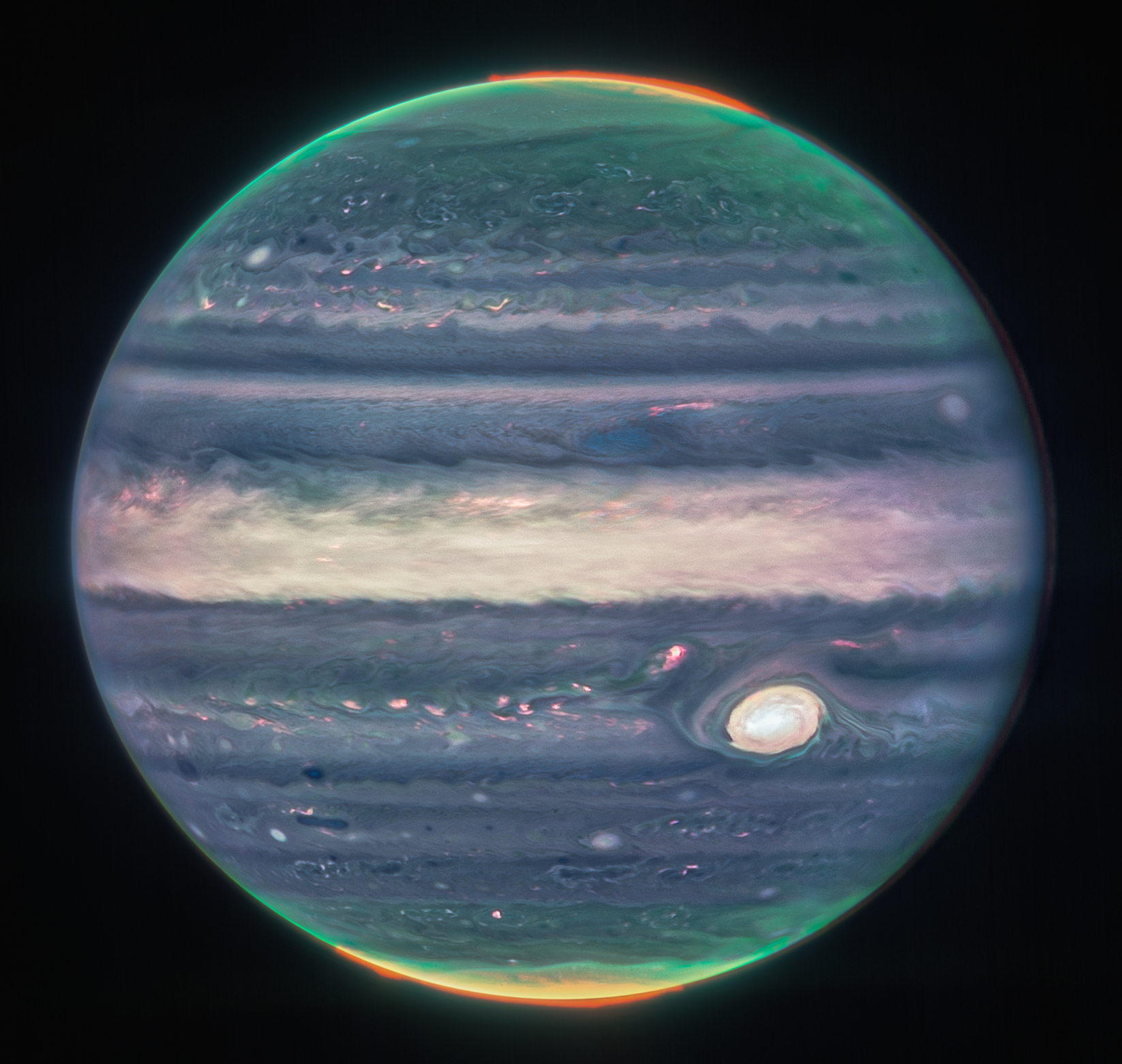
Hubble’s new observations collected over 90 days between December 2023 and March 2024 reveal that the storm is not as stable as it might look, with recent data showing it jiggling like a bowl of gelatin. The James Webb Space Telescope has revealed that the Great Red Spot is cold in the center, causing ammonia and water to condense and create thick clouds, while also detecting phosphine gas that could play a role in generating the mysterious red colors.
These modern observations continue to surprise scientists, proving that even after centuries of study, Jupiter’s Great Red Spot still holds many secrets waiting to be uncovered.
What Does the Future Hold?
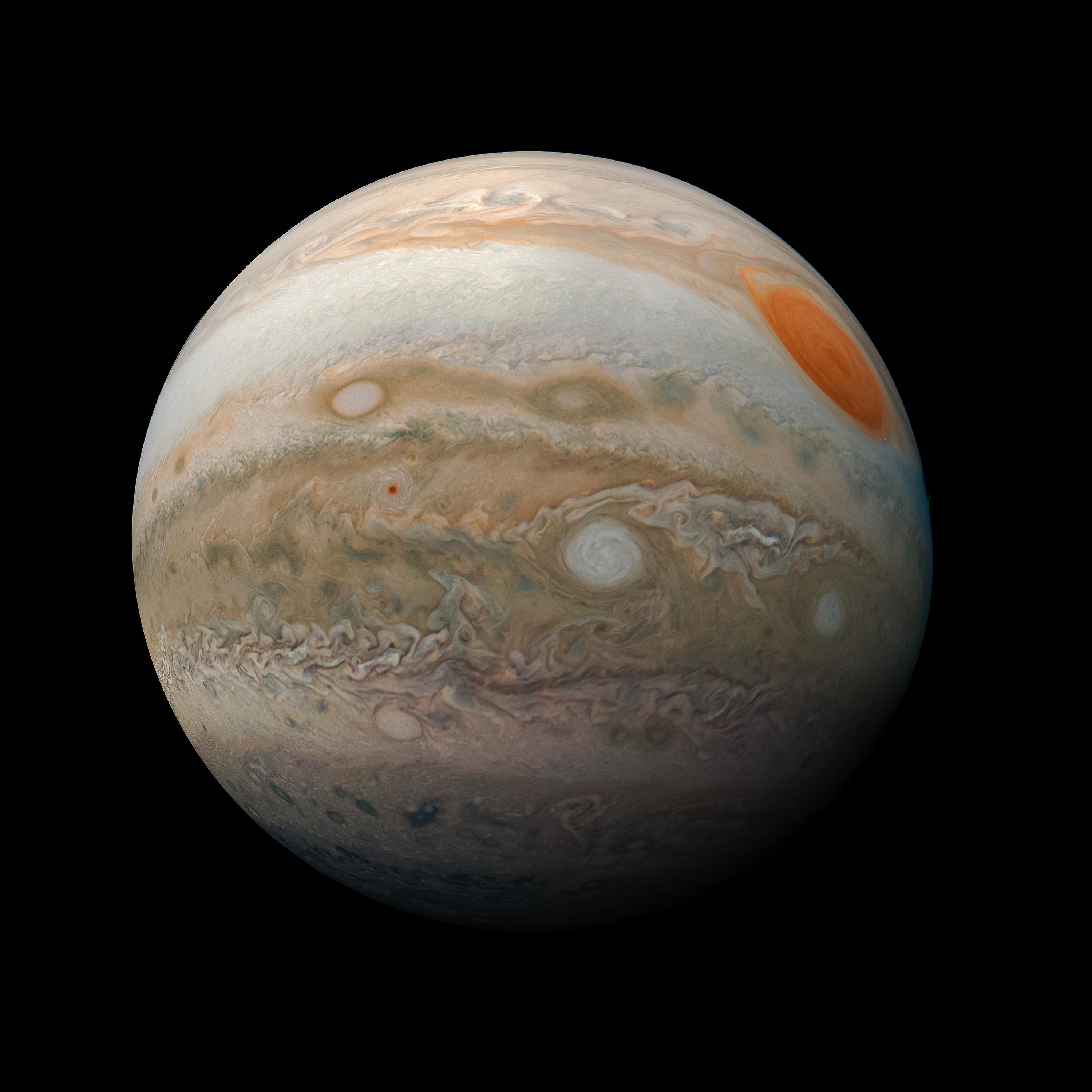
The Great Red Spot’s future remains one of astronomy’s most intriguing questions. It is not known how long the spot will last or whether the change is a result of periodic fluctuations. Given that the reasons for its size reduction are not well understood, some research suggests it could disappear within one or two decades, but it also may last much longer.
In 2019, the spot began flaking at its edges, with fragments spinning off and dissipating. This flaking behavior has scientists wondering if we’re witnessing the beginning of the end for this ancient storm, or just another phase in its complex evolution.
However, the storm’s remarkable resilience over centuries suggests it might surprise us yet again. Because researchers don’t fully understand how and why the spot is changing, it may last for much longer, possibly many centuries. The Great Red Spot has already defied expectations for hundreds of years, making any predictions about its demise highly speculative.
Whether this cosmic hurricane continues to rage for decades or centuries to come, it has already earned its place as one of the solar system’s most extraordinary and enduring phenomena. What do you think will happen to Jupiter’s Great Red Spot? Will this ancient storm finally fade away, or continue to surprise us for generations to come?