
There is a world hidden beneath the surface of everything you can see, touch, or measure. It does not follow your logic. It does not care about your intuitions. Particles vanish and reappear. Objects exist in two places at once. Time itself might run backwards. Honestly, if someone had described these things to you before science confirmed them, you would have dismissed the whole idea as fantasy. Yet here we are, in 2026, a year in which the quantum realm is no longer just the domain of theoretical physicists scribbling on chalkboards. It is crashing into the real world with unstoppable momentum.
You can imagine the tiniest building blocks of nature, things like electrons, atoms, and photons, and they all play by rules that defy common sense. In quantum physics, particles can be in two places at once, leap through energy barriers, or stay mysteriously linked across vast distances. These strange effects might sound like science fiction, but they really do happen at the atomic and subatomic scale. This article peels back the curtain on what the quantum realm actually is, why it matters more than ever, and what it means for the future of pretty much everything. Buckle up. This is going to bend your mind.
The Subatomic Foundation: What the Quantum Realm Actually Is
Let’s be real. When most people hear “quantum,” they picture something impossibly abstract. Something reserved for geniuses in lab coats. The truth, though, is that the quantum realm is simply the domain where the rules of nature operate at their most fundamental and strange level.
The macroscopic realm, which consists of everything from falling balls to orbiting planets, can be explained by the laws of classical mechanics. When nature reaches the smallest scales, however, stranger quantum rules kick in. Think of it this way: classical physics is like the rules of a familiar board game. Quantum physics is what happens when you zoom in so far that the game board itself dissolves into something entirely different.
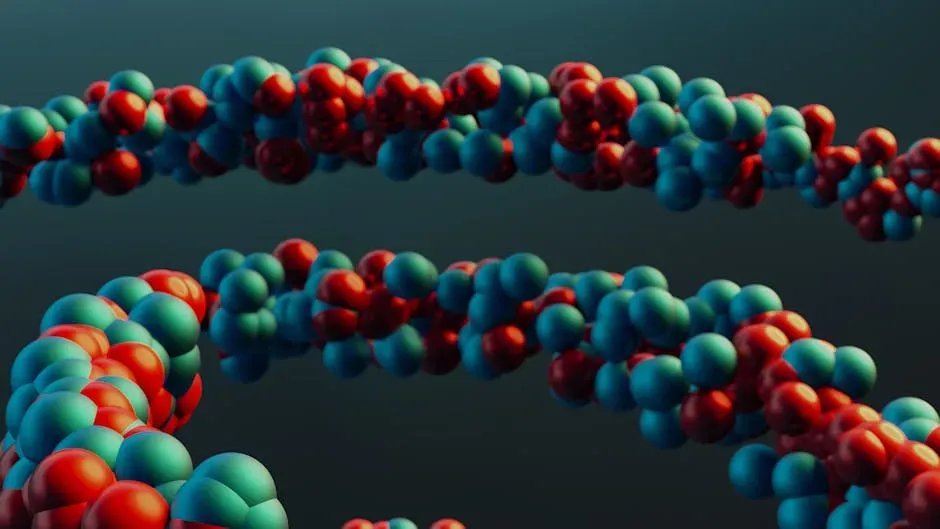
Atoms are the building blocks of matter, but the building blocks of atoms go even deeper. For more than a century, we have known that each atom is composed of electrons surrounding a heavy nucleus, bound together by the electromagnetic force. The nucleus is composed of protons and neutrons, which are themselves composed of quarks, bound together by the strong force. That layered reality is where the quantum realm lives, and it is far stranger than you might expect.
All known subatomic phenomena can be described by particles and their interactions, an amazing new concept in modern science. When you look deeper, you see a rich landscape of quantum effects that rule the subatomic realm. The electron appears indivisible, yet its properties are affected by a quantum dance among all subatomic particles. It is that dance, messy and probabilistic and beautiful, that forms the heartbeat of all matter.
Superposition: The Art of Being Everywhere at Once
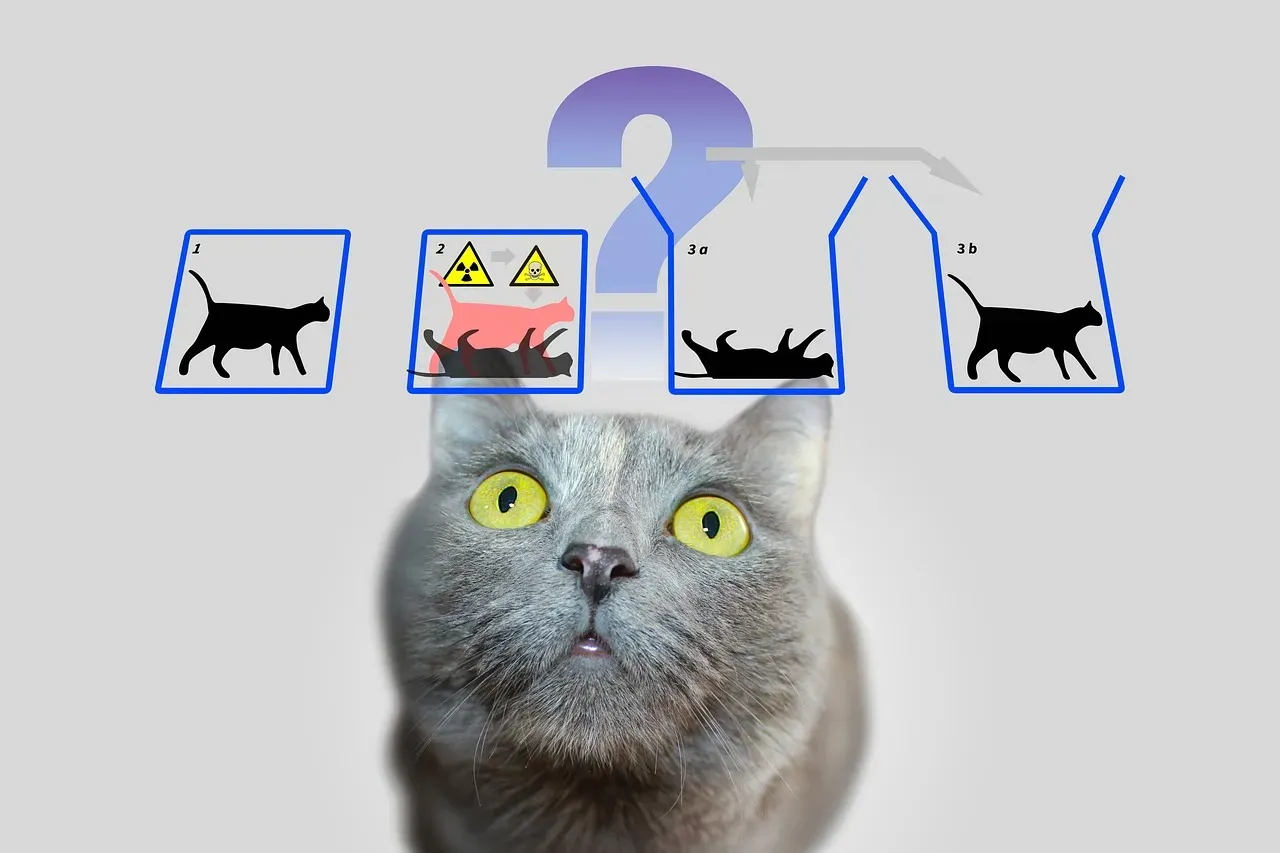
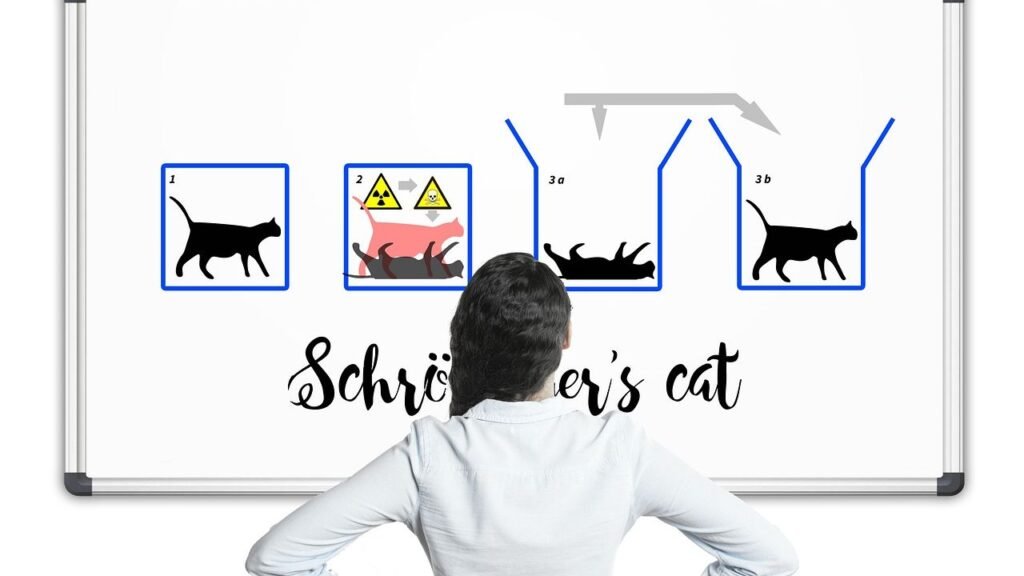
Here is the thing that tends to short-circuit people’s brains. In the quantum world, you do not get to say a particle “is” in any one place or state until you actually look at it. Before observation, it exists in a superposition of all possible states simultaneously. It is not hiding. It is genuinely everywhere at once.
In quantum physics, superposition means a particle can exist in multiple states at once until it is observed. For example, an electron does not have a fixed location but exists in a cloud of possibilities. This is not poetry or metaphor. It is measurable, reproducible, and verified in labs around the planet.
Electrons or photons sent through two slits form an interference pattern, as if each particle went through both slits simultaneously. If you observe which slit a particle goes through, the superposition collapses, and the pattern disappears. This shows that quantum particles behave like waves and only settle into one state when measured. Your act of looking, quite literally, changes what is there. That is not a quirk. That is the rule.
Molecules with masses exceeding ten thousand, composed of over 810 atoms, have successfully been superposed, and metal clusters with masses over 170,000 units and containing more than 7,000 atoms have also been demonstrated in quantum superposition. So this is not only happening with tiny, invisible particles. Superposition is scaling up in ways that are genuinely mind-bending, and scientists are only beginning to explore the boundaries of how large a superposed object can actually get.
Quantum Entanglement: The Spookiest Connection in the Universe
If superposition sounds wild, quantum entanglement will make your head spin even faster. Two particles become entangled, and from that moment on, they share a connection that no distance can break. Measure one, and the other instantly “knows” what result you got. Across the room. Across the planet. Across the galaxy, theoretically.
Quantum entanglement describes a strange and powerful connection between quantum objects that remains intact even across vast distances. When two particles, such as photons or electrons, are entangled, their states are linked in such a way that the state of one instantly determines the state of the other, no matter how far apart they are. Einstein famously called this “spooky action at a distance,” and he hated it. He was wrong to dismiss it, though, because it is very real.
Scientists have demonstrated that quantum entanglement is not just a theoretical prediction. It is a measurable, real-world phenomenon with profound implications for quantum information science, opening the door to practical quantum technologies. What was once dismissed as “spooky action” is now one of the most validated phenomena in modern physics, forming the backbone of technologies like quantum cryptography, quantum networks, and teleportation protocols.
Quantum cryptography uses entanglement to create ultra-secure communication, where any interference breaks the link and reveals tampering. Quantum computing uses entangled qubits to process many possibilities at once, enabling much faster calculations than classical computers. The practical power of entanglement is not a future promise. It is being deployed right now in laboratories and early-stage commercial networks across the world.
Quantum Tunneling: How Particles Walk Through Walls
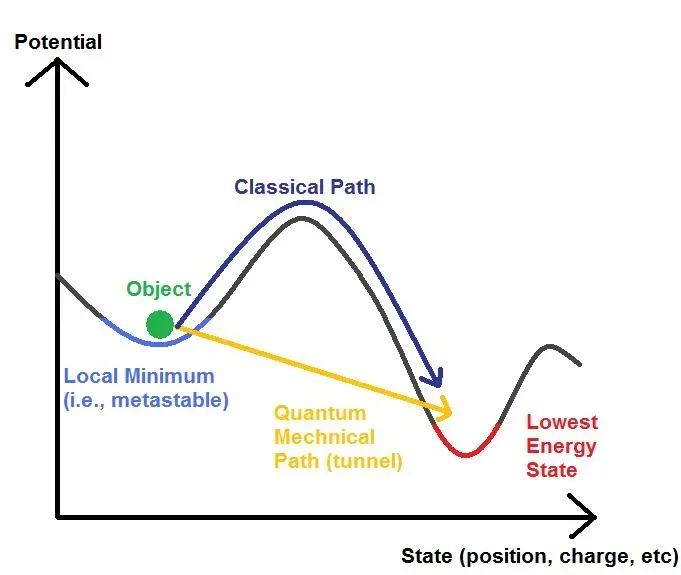
I know it sounds crazy, but particles regularly pass through barriers they have no business crossing. In classical physics, if you do not have enough energy to climb over a wall, you simply do not get over it. End of story. In the quantum realm, that wall is more of a suggestion than a rule.
In classical physics, a particle cannot cross a barrier higher than its energy. Quantum physics, however, treats particles as waves that extend into classically forbidden regions. Even if a barrier is too high for a particle to cross conventionally, there is a finite probability that its wavefunction will “leak” through to the other side. This is quantum tunneling, and the implications are enormous.
Tunneling explains radioactive decay, where alpha particles trapped inside an atomic nucleus escape through potential barriers. It also makes nuclear fusion possible in the Sun, where protons would otherwise lack the energy to overcome their mutual repulsion. In other words, the fact that our sun shines at all is a quantum tunneling event happening billions of times per second. Without it, there would be no sunlight. No warmth. No life.
The 2025 Nobel Prize in Physics was awarded jointly to John Clarke of UC Berkeley, Michel H. Devoret of Yale University, and John M. Martinis of UC Santa Barbara for the discovery of macroscopic quantum mechanical tunneling and energy quantization in an electric circuit. This landmark recognition celebrates one of the most consequential discoveries in modern physics, demonstrating that quantum mechanical phenomena, previously observed only at microscopic scales, can be demonstrated and controlled in macroscopic electrical circuits visible to the naked eye. That is a jaw-dropping milestone. The quantum and classical worlds are not as separate as we once believed.
The Uncertainty Principle: Nature’s Fundamental Fuzziness
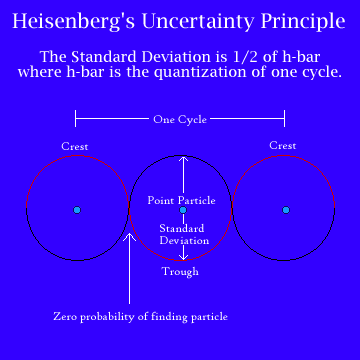
Werner Heisenberg gave us something that still unsettles even seasoned physicists to this day. There are certain pairs of properties in nature, like position and momentum, that you fundamentally cannot know with perfect precision at the same time. Not because our instruments are bad. Because nature itself refuses to allow it.
Heisenberg’s uncertainty principle states that the more precisely you pinpoint the position of a particle, the less precisely you can know its momentum at the same time, and vice versa. Picture trying to take a perfectly sharp photograph of a hummingbird in flight. The faster it moves, the blurrier it gets. The quantum world works like this except the fuzziness is not a limitation of your camera. It is baked into reality itself.
Researchers have now reimagined Heisenberg’s uncertainty principle, engineering a trade-off that allows more precise measurement of both position and momentum. Using quantum computing tools like grid states and trapped ions, they demonstrated sensing precision that goes beyond classical limits. This is not breaking Heisenberg’s rule so much as cleverly working around it, like squeezing a balloon rather than popping it.
Such advances could revolutionize navigation, medicine, and physics as a whole. Scientists have experimentally reshaped quantum uncertainty, achieving precision once thought impossible under Heisenberg’s principle. This breakthrough could fuel ultra-sensitive sensors for navigation, medicine, and astronomy. The deeper we understand uncertainty, the more powerfully we can work with it. That is the profound irony at the heart of quantum science.
When Time Gets Weird: Quantum Physics and the Arrow of Time

If you thought superposition and tunneling were strange, brace yourself. Quantum mechanics is now challenging something you probably never expected anyone to question: the direction of time. Not philosophically. Physically.
Researchers from the University of Surrey have uncovered evidence that in the strange world of quantum physics, time could theoretically run both forward and backward. Their study reveals that certain quantum systems, when interacting with a vast environment, still obey time-reversible laws, even under assumptions that typically favor a one-way arrow of time. This challenges the everyday experience of time as an irreversible forward march.
It is a mind-bending insight that could shake the foundations of physics and our understanding of reality itself. Scientists found that in certain quantum systems, time behaves symmetrically. It could flow backward just as easily as forward. Honestly, this is the kind of finding that makes you stare at the ceiling at two in the morning wondering what “forward” even means anymore.
Researchers at the University of Basel are pushing thermodynamic rules into the strange realm of quantum physics, where the line between useful energy and random motion becomes blurry. What this suggests is that the entire framework of thermodynamics, the science that says time only flows one way and entropy always increases, may have a quantum loophole hiding in plain sight. The investigation is still very much ongoing, but it is one of the most exciting frontiers in all of physics right now.
The Quantum Future: Computing, Sensing, and a Revolution in Technology
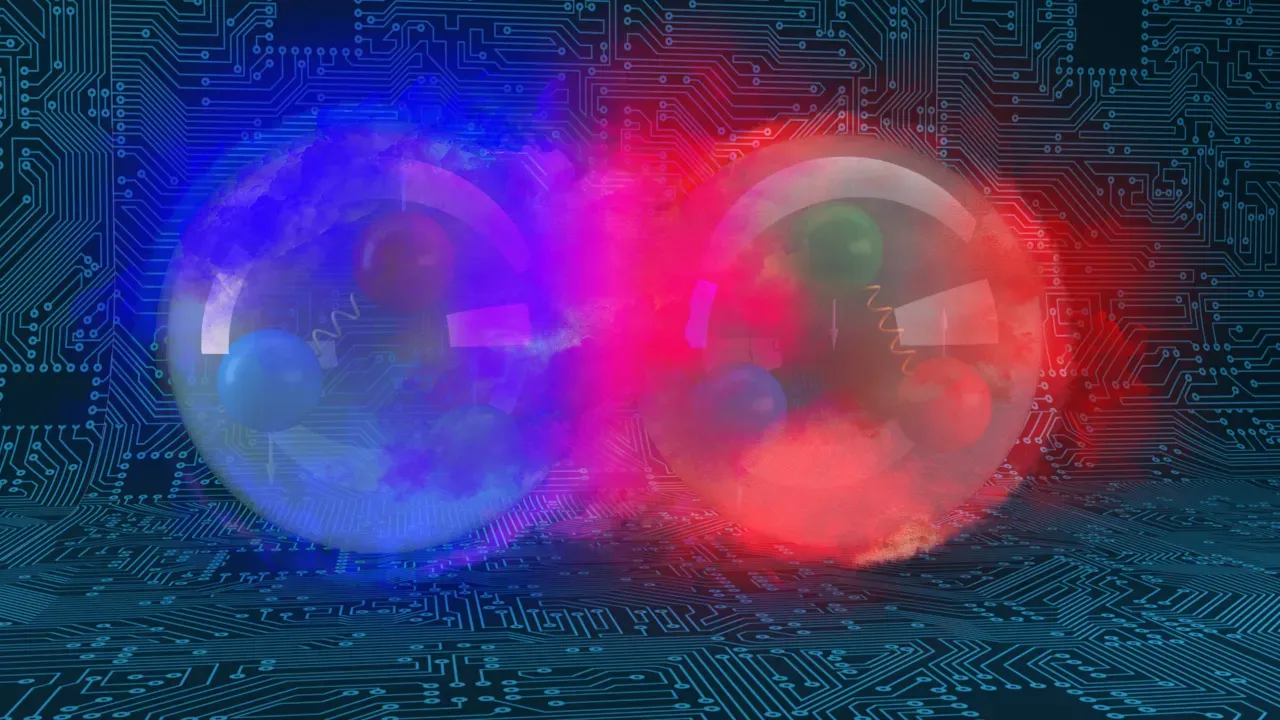
All of this extraordinary physics is not just sitting in academic journals. It is being engineered into actual machines and systems that will reshape how you live, communicate, and solve problems. The quantum revolution is not coming. It has already begun.
Quantum computers hold the promise of solving problems that classical computers cannot, including those in cryptography, chemistry, financial modeling, and more. Where classical computers use binary bits to carry information, quantum computers use qubits, which exist in states of one and zero at the same time. Think of a classical computer as a flashlight that can only point in one direction at a time. A quantum computer is more like a lamp that illuminates every direction simultaneously.
Fujitsu and RIKEN announced a 256-qubit superconducting quantum computer in April 2025 and plan a 1,000-qubit machine by 2026. IBM aims for quantum circuits with up to 7,500 gates by 2026 and quantum-centric supercomputers with thousands of logical qubits by 2033. The hardware race is accelerating at a pace that would have seemed impossible just a decade ago.
Quantum computing could accelerate discovery in areas where complexity overwhelms classical computation, such as simulating the behavior of molecules for drug discovery, solving optimization problems in logistics or supply chains, creating new superconducting materials, improving weather forecasts, and developing ultra-secure communication protocols. The applications stretch across virtually every industry you can think of. It is hard to say for sure exactly when quantum advantage becomes routine, but the trajectory is clear and the momentum is real.
Conclusion
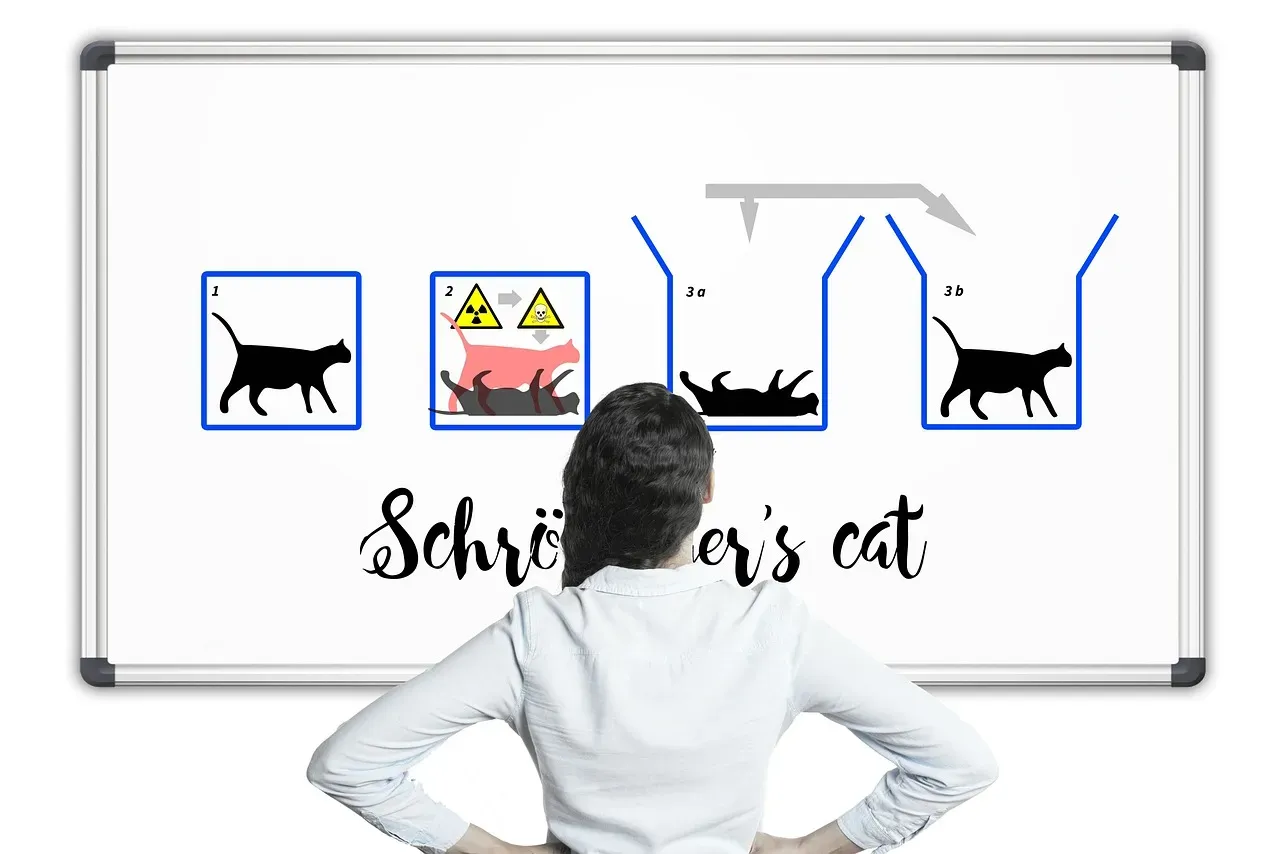
The quantum realm is not a distant frontier. It is the foundation of everything you see, everything you touch, and every technology you rely on daily. Your smartphone exists because of quantum tunneling. The GPS signal guiding you through traffic depends on quantum precision. The universe’s very structure is stitched together by entanglement and probability waves you will never directly see.
What is most remarkable about all of this is how young our understanding still is. We have confirmed that time can run backwards in certain quantum systems. We have tunneled particles through barriers that classical physics says are impenetrable. We have pushed Heisenberg’s uncertainty principle to its limits and found clever ways to work around it. Yet the deeper scientists look, the more mystery seems to unfold. The quantum world is not getting simpler as we learn more. It is getting richer, stranger, and more astonishing with every discovery.
Perhaps the most humbling thought is this: the rules governing the smallest things in existence are rewriting how we understand reality at the largest scales. The quantum realm is not just a corner of physics. It is the hidden operating system of the universe itself. So the next time you flick on a light switch or tap your phone screen, pause for just a second. Somewhere in there, particles are tunneling, superposing, and entangling. What would you have guessed the universe was made of, if no one had ever told you?