
You think you understand reality. You wake up, go about your day, and trust that the world operates in a logical, predictable way. Then quantum physics shows up and completely flips the script. The delayed choice quantum eraser experiment isn’t just another weird science story – it’s a mind-bending demonstration that challenges our most fundamental assumptions about cause and effect, observation, and the very fabric of reality itself.
What makes this experiment so unsettling is that it seems to suggest the future can influence the past. I know that sounds like science fiction nonsense, but stick with me here. This isn’t about time travel or fictional paradoxes. It’s about something far stranger happening right at the quantum level, and honestly, once you understand what’s going on, you might never look at the universe the same way again.
What Actually Happens in This Experiment
The delayed choice quantum eraser builds on the famous double-slit experiment, where particles like photons behave as both waves and particles depending on whether you’re watching them. In this more elaborate setup, scientists fire photons through a double-slit apparatus, but they add a clever twist using special crystals that split each photon into two entangled partners.
One photon from each pair heads toward a detector screen where it creates an interference pattern – that telltale sign of wave-like behavior. The other photon, its entangled twin, gets sent down a different path where scientists can choose to either measure which slit it came from or erase that information entirely. Here’s where things get weird: the choice to measure or erase happens after the first photon has already hit the detector.
The Part That Breaks Your Brain
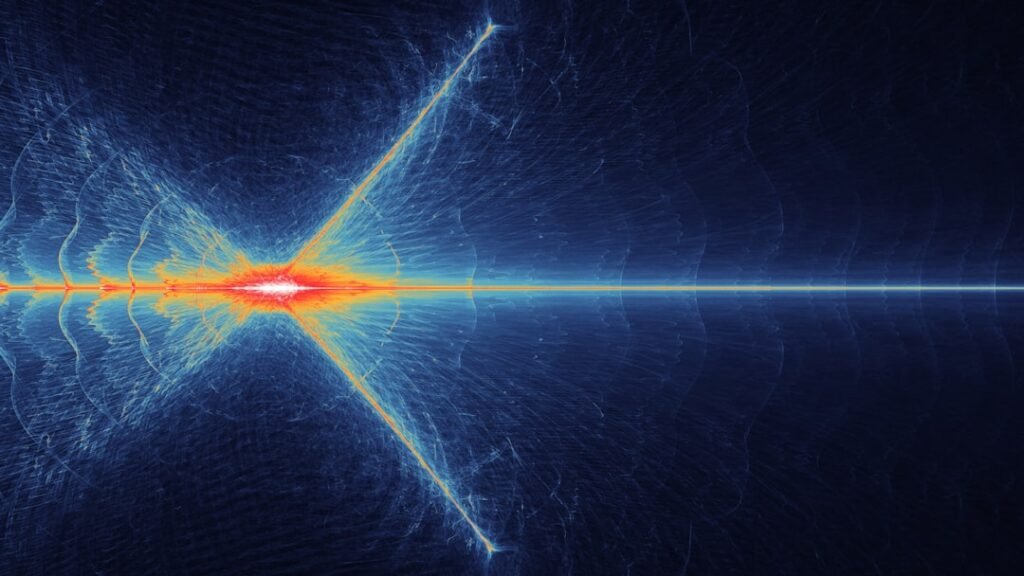
When researchers look at all the data from the detector screen initially, they see a random blob with no interference pattern. Nothing special there. But when they sort the data based on what happened to the second photon – the one measured later – distinct patterns emerge. If the second photon’s path information was erased, the corresponding first photons show interference patterns. If the path was measured, no interference appears.
Let’s be real: this seems to suggest that a measurement made in the present affects data that was recorded in the past. The photons hit the screen before anyone decided what to do with their entangled partners, yet the pattern correlates perfectly with a choice that hasn’t been made yet. It’s enough to make your head spin, and frankly, it should.
Why Time Doesn’t Actually Flow Backwards
Before you start thinking we’ve discovered actual time travel, here’s the thing physicists want you to understand: no information actually travels backward in time. The key word here is “correlation,” not causation. You can only see these patterns by comparing data from both measurements after everything has happened. There’s no way to use this setup to send messages to your past self or change historical events.
The interference pattern only becomes visible when you sort the detector data using information from the delayed measurement. Until you do that sorting, all you see is randomness. It’s like having a coded message that looks like gibberish until you apply the right key – except in this case, the key comes from a measurement that happens later. Still confusing, but not quite the same as actual backwards causation.
The Observer Effect Taken to Extremes
This experiment takes the observer effect – the idea that measuring quantum systems affects their behavior – and cranks it up to eleven. In standard quantum mechanics, you learn that observing a particle forces it to “choose” between being a wave or a particle. The quantum eraser shows that even the potential for future observation matters.
What blows my mind is that it’s not just the act of measuring that matters, but whether that measurement could theoretically reveal which-path information. If there’s any way, even in principle, to figure out which slit a photon went through, the interference pattern vanishes. Erase that possibility, and the pattern returns. The universe seems to care about what information is theoretically available, not just what we actually look at.
Different Interpretations, Same Headache
Physicists have developed various interpretations of quantum mechanics to make sense of these results, and honestly, none of them are particularly comforting. The Copenhagen interpretation says particles exist in superposition until measured, with the measurement collapsing the wave function. The many-worlds interpretation suggests every quantum possibility creates a branching universe. Others invoke more exotic ideas about consciousness or hidden variables.
The delayed choice quantum eraser doesn’t definitively prove any single interpretation correct, but it does show that whatever reality is, it’s definitely not the straightforward, clockwork universe we thought we lived in. Each interpretation handles the weirdness differently, but they all agree on the experimental results. The math works perfectly – it’s our intuitive understanding of reality that struggles to keep up.
What This Really Tells Us About Reality
Here’s what I think is the most important takeaway: our everyday concepts of past, present, and future might not map cleanly onto quantum reality. The delayed choice quantum eraser suggests that at the quantum level, time isn’t the simple, one-way river we experience in daily life. Quantum correlations can connect events in ways that defy our intuitive timeline.
This doesn’t mean time travel or backwards causation in the sci-fi sense. It means quantum mechanics operates according to rules that don’t care about our human categories of before and after. The experiment forces us to accept that reality at its most fundamental level is far stranger and more interconnected than our macroscopic experience suggests. Whether you find that terrifying or exhilarating probably depends on how comfortable you are with profound uncertainty.
The Bigger Picture and Why It Matters
The delayed choice quantum eraser isn’t just a party trick for physicists to show off how weird the quantum world can be. It has real implications for quantum computing, quantum cryptography, and our fundamental understanding of information and reality. These aren’t abstract philosophical puzzles – they’re the foundation for technologies that might reshape our world.
Beyond practical applications, this experiment reminds us that the universe is under no obligation to make sense to human intuition. We evolved to hunt, gather, and survive in a world of medium-sized objects moving at reasonable speeds. Quantum mechanics operates at scales where our evolutionary programming simply doesn’t apply. The fact that we can understand it mathematically, even when it violates our gut feelings about reality, is pretty remarkable.
What strikes me most is how this experiment captures the essential strangeness of existence itself. We live in a universe that allows particles to be in two places at once, where observation changes reality, and where events can be correlated across time in ways that seem impossible. Maybe the real lesson isn’t about quantum mechanics at all – it’s about staying humble in the face of a cosmos far weirder and more wonderful than we ever imagined. What do you think reality actually is at its core? The quantum eraser experiment suggests we might never fully know, and honestly, that mystery makes the universe far more interesting.