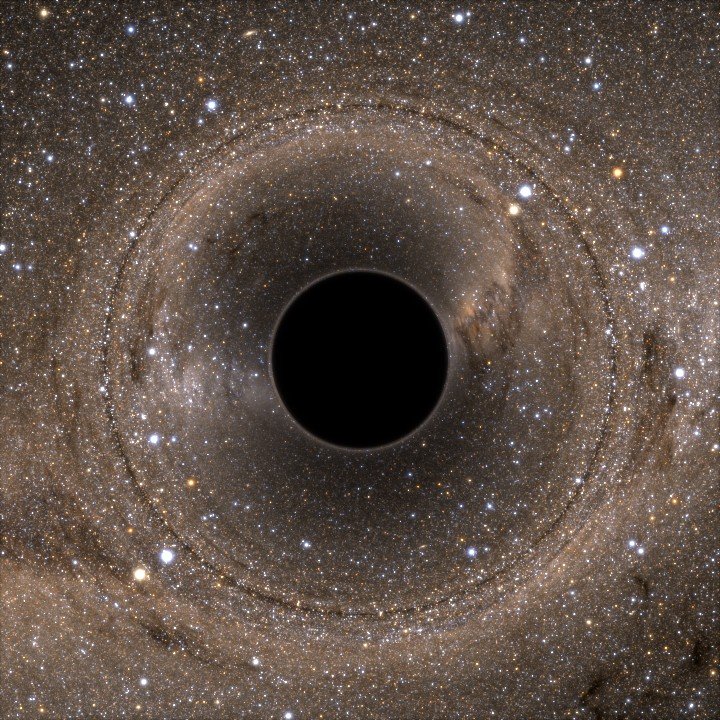

Picture a region in space so extreme that not even light itself can break free. Everything we know about physics gets twisted, warped, and stretched to its absolute limits. This is the strange world of black holes, and honestly, it’s wilder than you might think.
Black holes aren’t just cosmic vacuum cleaners devouring everything in sight. They’re laboratories where Einstein’s theories collide with quantum mechanics, where time itself bends into impossible shapes, and where the very fabric of reality tears at its seams. You might have heard they’re invisible, mysterious, or even terrifying. Here’s the thing: they’re all of those and so much more. Scientists have been unraveling their secrets for decades, and what they’ve discovered challenges everything we thought we knew about the universe.
So let’s dive into this cosmic rabbit hole. What you’re about to read will change the way you see space, time, and maybe even existence itself.
What Makes a Black Hole Black
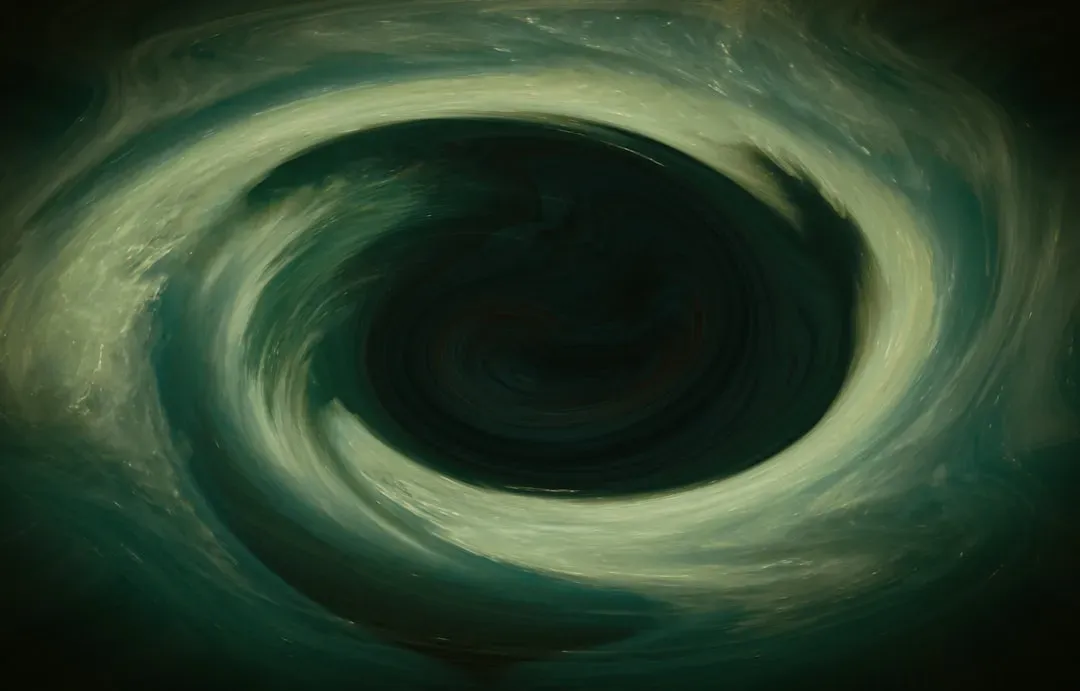
A black hole is an astronomical body so compact that its gravity prevents anything from escaping, even light, with Albert Einstein’s theory of general relativity predicting that a sufficiently compact mass will form such an object. Think of it as the universe’s ultimate point of no return. The event horizon is a boundary that marks the outer edge of black holes, the point at which nothing, not even light, can escape.
But here’s what most people get wrong: black holes don’t actually suck things in like a cosmic drain. Contrary to what you may have seen in movies, black holes don’t actually “suck” things in, and there are actually stars orbiting the supermassive black hole at the center of our galaxy that will keep orbiting without falling in unless something else disturbs them, requiring an object to fall right into the mouth of a black hole for it to be eaten. The real magic happens at that boundary, the event horizon, where the rules of space and time completely break down. Once you cross that line, there’s no coming back. Not because you’re being pulled harder, but because every possible path through spacetime leads inward.
The Birth of Cosmic Monsters
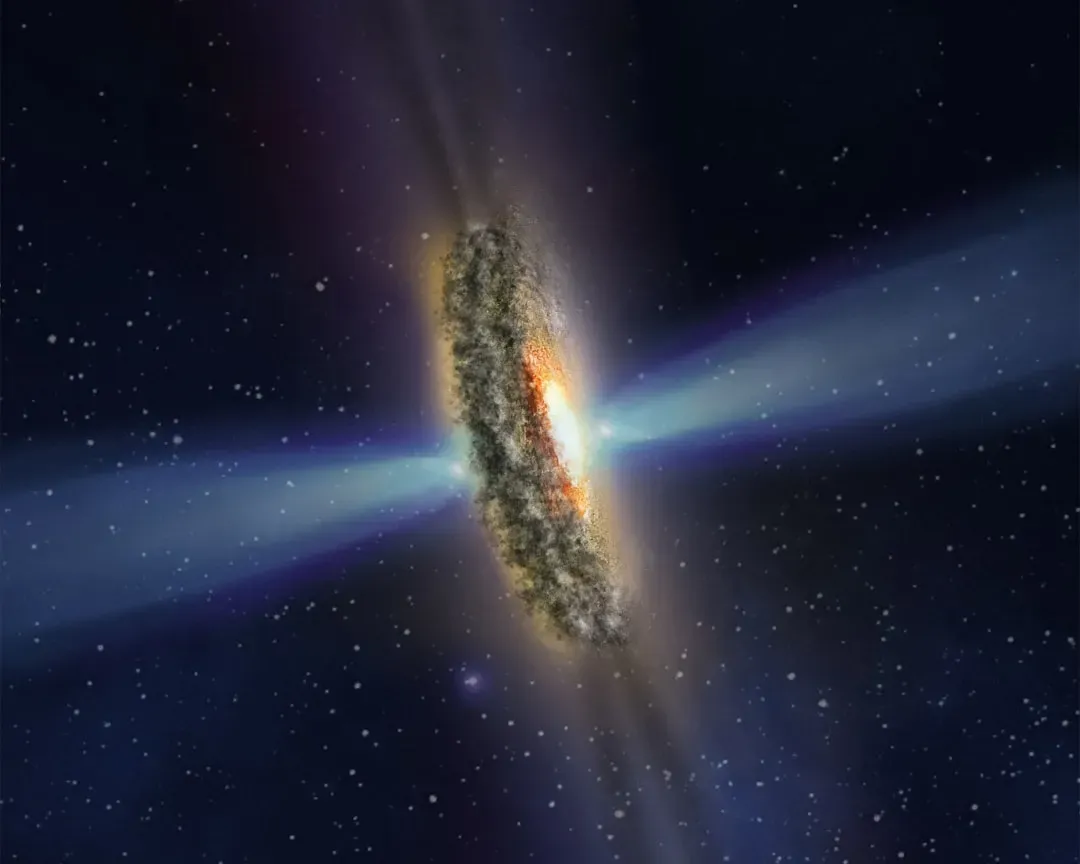
Black holes are expected to form via two distinct channels, with the first pathway being stellar corpses that form when massive stars die, specifically stars whose birth masses are above roughly 8 to 10 times mass of our sun. When these giant stars run out of fuel, they can no longer support themselves against their own crushing gravity.
What happens next is genuinely spectacular. The star’s core collapses in on itself in mere seconds. Black holes are incredibly dense objects formed when massive stars exhaust their fuel and collapse under their own gravity, and this intense compression causes a singularity to form at the center of the black hole, a point where all matter is compressed into an infinitely small point with infinite density. Imagine compressing something with more mass than our entire sun into a space smaller than a city. That’s the kind of density we’re talking about here.
The other way black holes can form is even more mysterious. The team proposes that the black hole formed there via the direct collapse of a gas cloud, a process that may explain some of the incredibly massive black holes Webb has found in the early universe. Scientists discovered this possibility in 2025, and it completely changes our understanding of how supermassive black holes could have appeared so early in cosmic history.
When Time Slows Down and Space Stretches Out
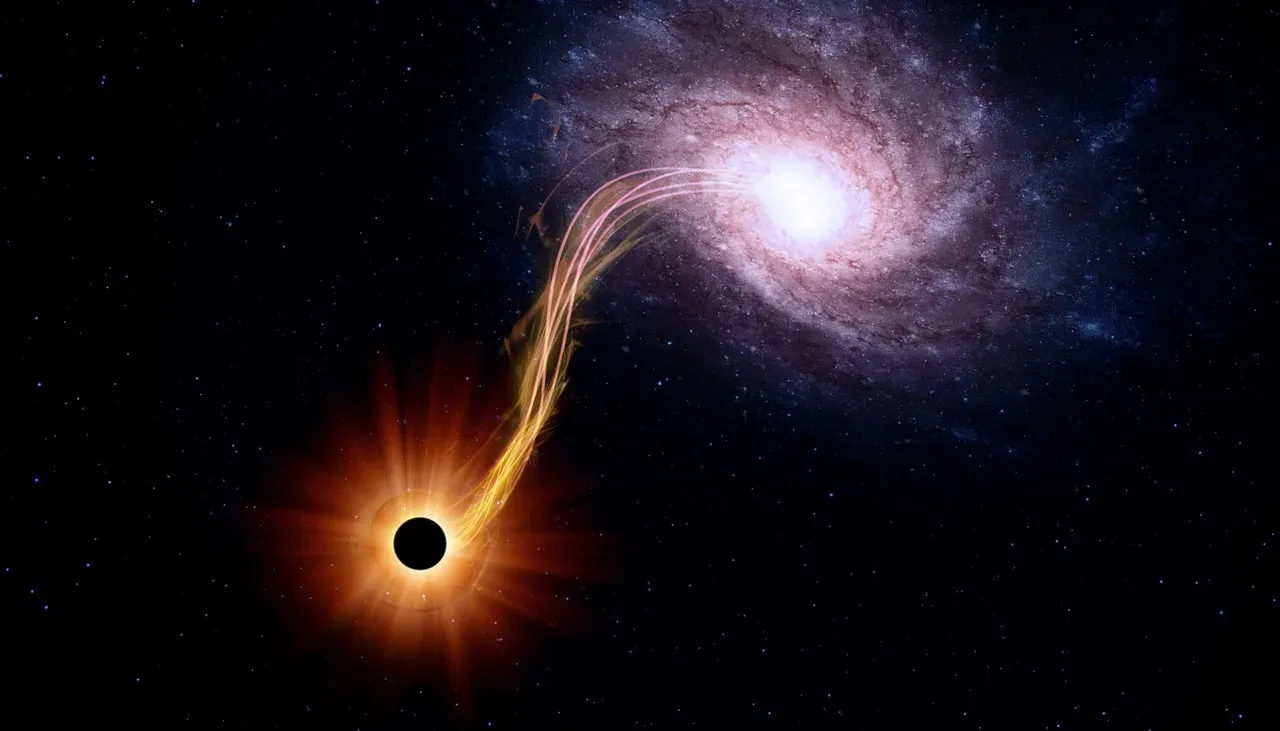
Let’s be real, this is where things get absolutely mind-bending. Near a black hole, time doesn’t tick at the same rate everywhere. In addition to gravity stretching and squashing objects, another strange phenomenon that a traveler would observe close to a black hole is something called time dilation, in which time passes slower closer to the black hole than further away.
Imagine watching a clock fall toward a black hole. To a distant observer, a clock near a black hole would appear to tick more slowly than one further from the black hole, and this effect, known as gravitational time dilation, would also cause an object falling into a black hole to appear to slow as it approached the event horizon, never quite reaching the horizon from the perspective of an outside observer. From your safe distance, you’d see the clock slow down more and more, its hands barely moving, the light from it getting redder and dimmer until it simply fades from view. Yet for someone falling with that clock? An observer falling into a black hole would not notice any of these effects as they cross the event horizon, with their own clocks appearing to them to tick normally, and they cross the event horizon after a finite time without noting any singular behaviour.
The stronger the gravitational field, the more pronounced the curvature, and the slower time passes relative to regions of weaker gravity, with time dilation effects increasing dramatically as an object approaches a black hole. This isn’t science fiction. It’s reality, confirmed by Einstein’s equations and verified through countless observations.
Spaghettification Isn’t Just a Funny Word
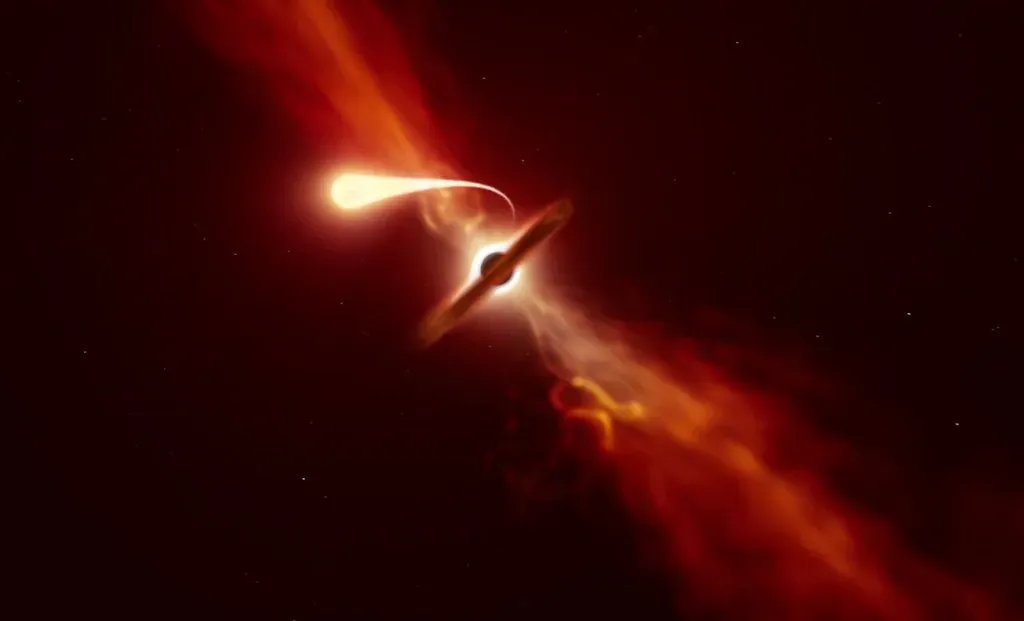
Here’s something that sounds ridiculous but is absolutely terrifying: if you fell into a smaller black hole, you’d be turned into cosmic spaghetti. Seriously. Observers falling into a Schwarzschild black hole cannot avoid being carried into the singularity once they cross the event horizon, and as they fall further into the black hole, they will be torn apart by the growing tidal forces in a process sometimes referred to as spaghettification or the “noodle effect”.
Smaller black holes exert intense gravitational forces, leading to a phenomenon known as “spaghettification,” where an object is stretched and torn apart as it approaches the event horizon, with anything passing the event horizon in relatively small black holes being stretched out and ripped apart by gravity. The gravity pulling on your feet would be so much stronger than the gravity on your head that you’d be stretched like taffy. It’s hard to say for sure, but scientists calculate the difference would be catastrophic.
Larger black holes offer a slightly different fate. In larger black holes, it would theoretically be possible to survive passing the event horizon, but such an explorer, and news of their fate, would be forever trapped inside the black hole. You might cross the event horizon intact, feeling nothing unusual at first. The universe would be your only witness to your final journey.
Ripples in Spacetime Tell the Story
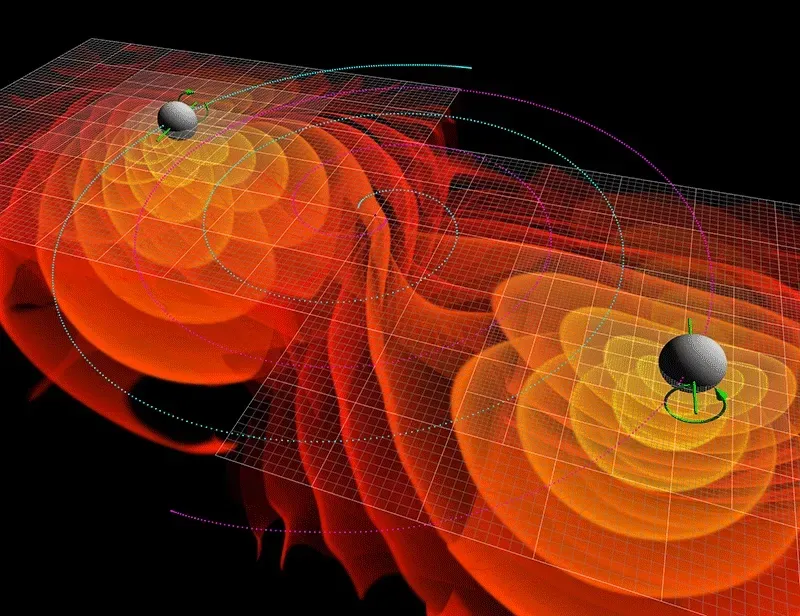
In January 2025, scientists detected something extraordinary. The clearest black hole merger signal yet, named GW250114, recorded by LIGO in January 2025, offers new insights into these mysterious cosmic giants, with advances in detector sensitivity allowing the team to observe this latest collision almost four times more clearly than the original discovery. When two black holes spiral into each other and merge, they don’t just collide silently.
When two black holes collide and merge, they release gravitational waves, which can be detected by the LIGO-Virgo-KAGRA detectors on Earth, allowing scientists to determine the mass and spin of the black holes. These waves are ripples in the very fabric of spacetime itself, spreading outward at the speed of light. Think of them like the ripples you see when you drop a stone into a pond, except instead of water, it’s the actual structure of space and time that’s rippling.
What’s remarkable is what these signals reveal. The LVK network’s detection labeled ‘GW231123’ suggests that two black holes collided an estimated 5 billion light-years from Earth, with the merger analysis suggesting the two original black holes clocked in at roughly 137 and 103 times our sun’s mass. This merger created a black hole so massive that it challenges current theories about how such monsters can even exist.
The Information Paradox That Haunted Hawking
Stephen Hawking discovered something that seemed impossible. In the 1970s, Stephen Hawking applied the semiclassical approach of quantum field theory in curved spacetime to such systems and found that an isolated black hole would emit a form of radiation now called Hawking radiation in his honor, also arguing that the detailed form of the radiation would be independent of the initial state of the black hole. Black holes aren’t entirely black after all – they leak.
But this creates a massive problem. Information flows into black holes as they consume matter, and that information can’t escape, but Hawking radiation doesn’t carry any information with it, so what happens to it when the black hole disappears? Imagine throwing a book into a black hole. All the information in that book – every word, every page – should be preserved somewhere according to quantum mechanics. Information can never be truly destroyed. Yet Hawking’s calculations suggested it just vanishes.
It is now generally believed that information is preserved in black-hole evaporation, and for many researchers, deriving the Page curve is synonymous with solving the black hole information puzzle, but views differ as to precisely how Hawking’s original semiclassical calculation should be corrected. Recent work in 2025 suggests the answer might lie in something called “quantum hair” – subtle signatures in the radiation around black holes that could preserve information after all. Scientists are still working out the details, but we’re closer than ever to solving this decades-old mystery.
Hawking’s Black Hole Area Theorem Finally Proven
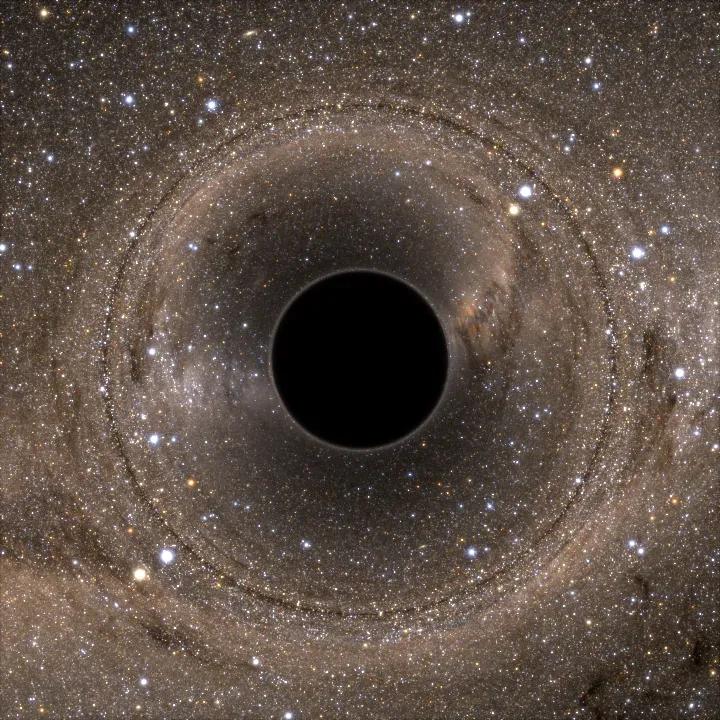
In 1971, Hawking made a bold prediction. In 1971, Stephen Hawking proposed that a black hole’s event horizon, its outer boundary where neither light nor matter can escape, cannot shrink, and in 2021, Isi and colleagues used LIGO data to examine gravitational waves emitted during a black hole merger and produced one of the first observational confirmations of Hawking’s idea. The 2025 detection provided even stronger evidence.
The newly analyzed signal strengthens the earlier findings with far greater accuracy, showing that the surface area of the final merged black hole is always at least as large as the combined areas of the two original black holes. Before the merger in the GW250114 event, the two black holes had a combined surface area of nearly 243,000 square kilometers. After they merged? Before the cosmic mammoths merged, the combined surface area of the two black holes measured nearly 243,000 square kilometres, but the merger almost doubled it, as the single black hole now had a surface area of roughly 400,000 square km, which is exactly what Hawking had theorised about the outer boundary of a black hole, which can never decrease in size.
This isn’t just an abstract theoretical result. It tells us something fundamental about the nature of reality itself. Event horizons can only grow, never shrink. It’s like a one-way door to oblivion, and once it exists, it’s there to stay until the black hole evaporates away completely through Hawking radiation over unimaginable timescales.
Forbidden Black Holes That Shouldn’t Exist
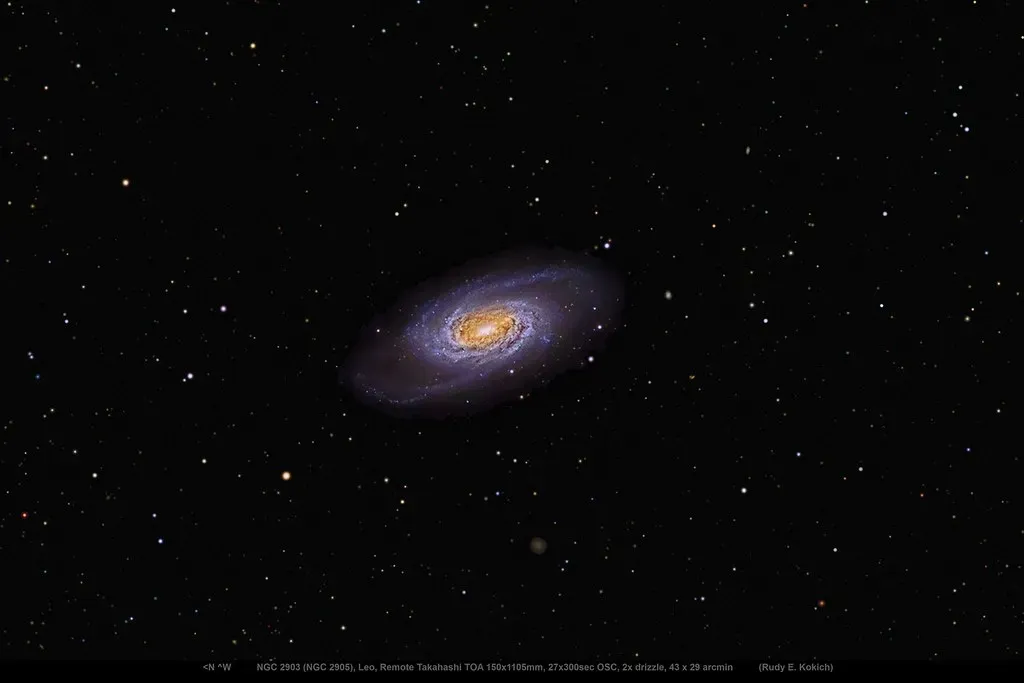
Scientists discovered something in 2023 that broke their models. In 2023, scientists detected the gravitational waves from a black hole collision that seemed impossible, and new research finally explains how this “forbidden” black hole came to be. The problem? These black holes existed in a mass range where physics says they shouldn’t be possible.
When massive stars reach the end of their lives, many collapse and explode as a supernova, leaving behind a black hole, but if the star falls within a specific mass range, a special type of supernova occurs called a pair-instability supernova, which is so violent that the star is annihilated, leaving nothing behind. This creates a “mass gap” where black holes simply shouldn’t exist – roughly between 70 to 140 times the sun’s mass.
Yet there they were, defying expectations. Astronomers with the Flatiron Institute’s Center for Computational Astrophysics and their colleagues have figured out just how these black holes may have formed and collided, with their comprehensive simulations uncovering the missing piece that previous studies had overlooked: magnetic fields. Rapidly rotating stars with strong magnetic fields can create black holes in this supposedly forbidden zone. The magnetic forces blast away material that would otherwise make the star explode completely, allowing a black hole to form where none should exist.
The Hidden World Beyond the Event Horizon
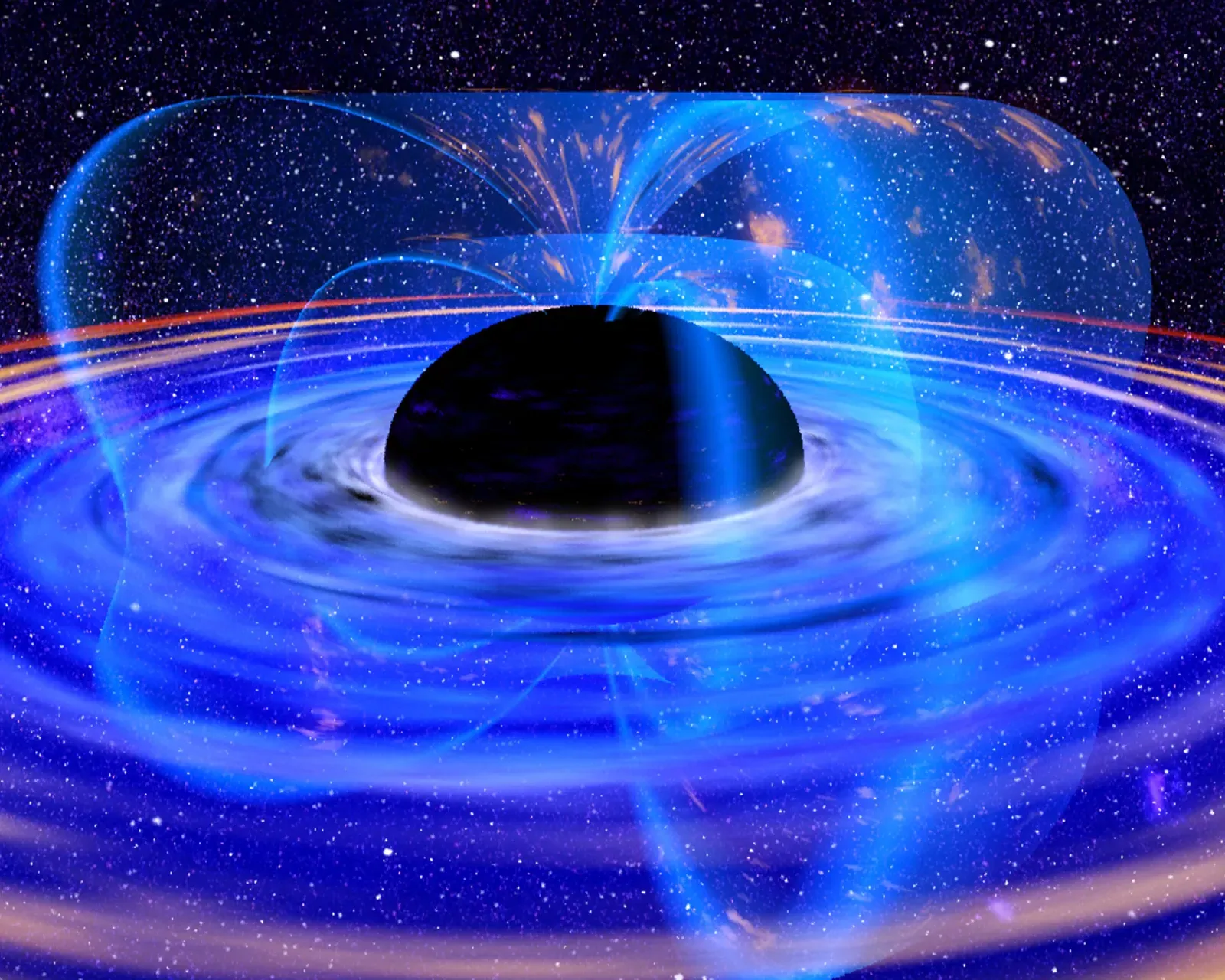
What’s actually inside a black hole? Honestly, nobody knows for certain. General relativity predicts that the very center of a black hole contains a point where matter is crushed to infinite density, the final destination for anything falling into the event horizon, with the singularity potentially being either a physical structure or a purely mathematical one, though right now astronomers don’t know which is true.
The event horizon is closely related to the concept of a singularity, the infinitely dense core of a black hole, where the known laws of physics cease to apply. This is where all our equations break down. General relativity predicts infinite density and infinite curvature of spacetime. Yet physicists know that infinities in nature usually signal that our theories are incomplete. We need a theory of quantum gravity – something that unites Einstein’s relativity with quantum mechanics – to truly understand what happens in there.
Some physicists believe that singularities do not exist, and that their existence, which would make spacetime unpredictable, signals a breakdown of general relativity and a need for a more complete understanding of quantum gravity, while others believe that such singularities could be resolved within the current framework of physics. The debate continues, with no clear resolution in sight. What we do know is that whatever exists at the center of a black hole represents the ultimate frontier of physics.
Black Holes at the Heart of Every Galaxy
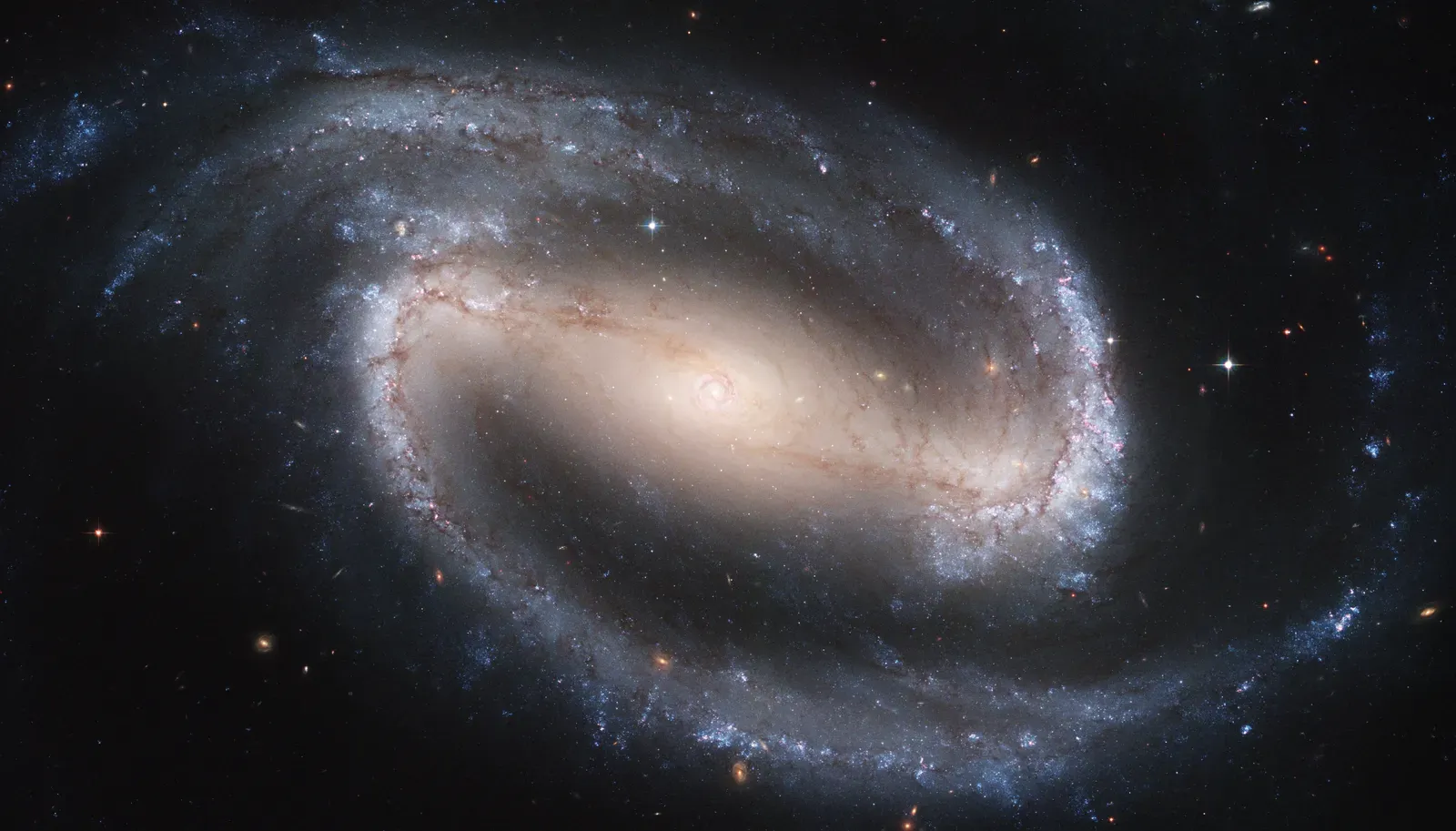
Supermassive black holes have masses more than 106 times that of the Sun, and these black holes are believed to exist at the centers of almost every large galaxy, including the Milky Way. Our own galaxy hosts a supermassive black hole called Sagittarius A*. The supermassive black hole at the center of our own Milky Way galaxy is called Sagittarius A*, and it’s about 15 million miles across and contains the equivalent of 4 million suns’ worth of mass.
Despite its enormous mass, it’s remarkably quiet. Don’t worry; it’s much too far away to pose any danger to Earth. In fact, you could think of it as a cosmic anchor, its gravity helping to hold our entire galaxy together as stars orbit around it in elegant, predictable paths. Some supermassive black holes, though, are far more dramatic. When they actively feed on surrounding material, they become some of the brightest objects in the entire universe, visible across billions of light-years as quasars.
UC Berkeley astronomers found a stealth black hole that is a companion to the massive black hole in the galaxy’s core, and one day, the two might merge and produce a ripple of gravitational waves. This discovery in 2025 revealed that galaxies can harbor multiple supermassive black holes, wandering through their outer regions, occasionally revealing themselves by shredding stars that venture too close.
What Comes Next in Black Hole Science
The tools we have today would have seemed like science fiction just a decade ago. Over the next decade, gravitational wave detectors like LIGO will continue to improve, giving us a sharper view of black holes and their mysteries. Future detectors like the Cosmic Explorer and Einstein Telescope promise to see black hole mergers from across the entire observable universe.
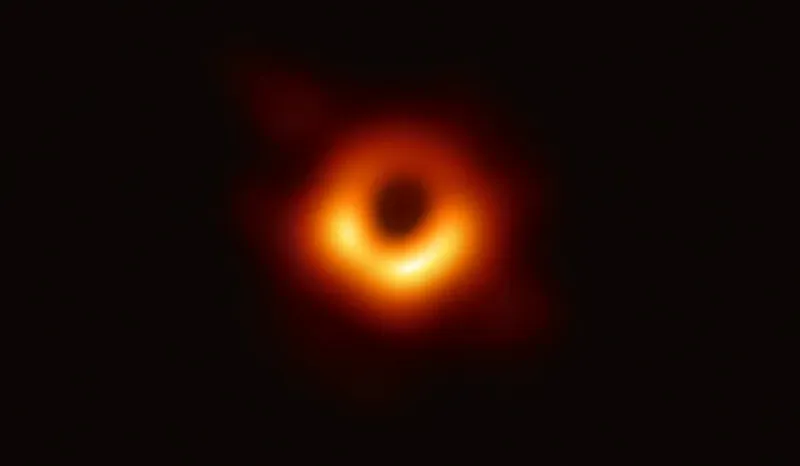
The Event Horizon Telescope captured the first-ever image of a black hole, specifically the supermassive black hole at the center of the galaxy M87, with the EHT being a virtual observatory consisting of telescopes spanning the planet, from Greenland to the South Pole. That iconic image from 2019 was just the beginning. Scientists are now working to make movies of black holes, watching how matter swirls and disappears in real time.
Simulations show that the formation of these types of black holes creates bursts of gamma rays, which might be observable, and looking for these gamma ray signatures would help confirm the proposed formation process and reveal how common these massive black holes might be in the universe. Every new observation brings fresh mysteries and deeper understanding. We’re living in a golden age of black hole astronomy.
Did you expect that something invisible could reveal so much about the universe? What would you have guessed about what happens when you get too close to one? The universe keeps surprising us, and black holes remain one of its most captivating mysteries.
Hi, I’m Andrew, and I come from India. Experienced content specialist with a passion for writing. My forte includes health and wellness, Travel, Animals, and Nature. A nature nomad, I am obsessed with mountains and love high-altitude trekking. I have been on several Himalayan treks in India including the Everest Base Camp in Nepal, a profound experience.