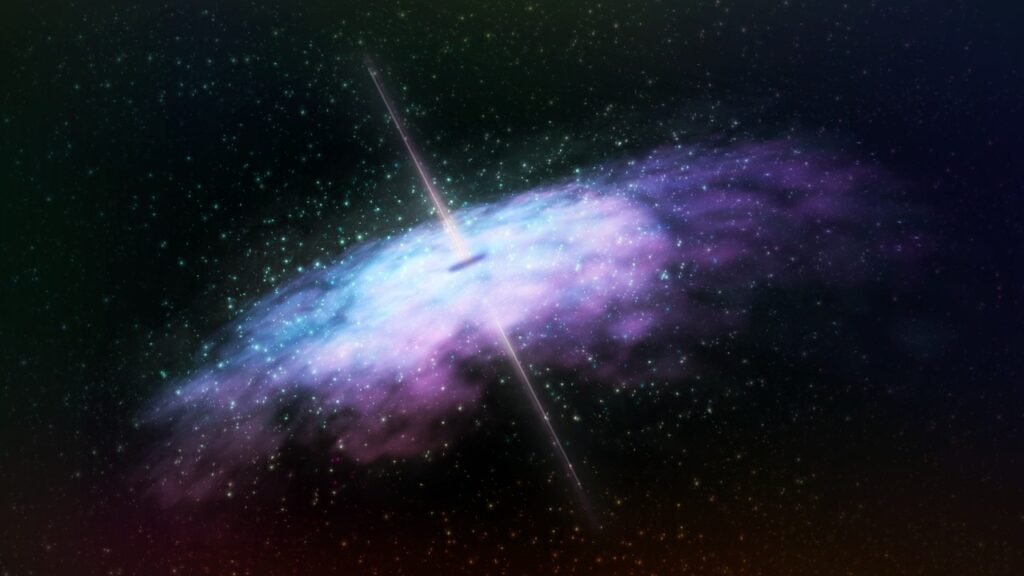


The Quiet Black Hole’s Fiery Past (Image Credits: Pixabay)
At the core of the Milky Way, a supermassive black hole known as Sagittarius A* has long puzzled astronomers with its subdued behavior, but fresh evidence points to a burst of intense activity that reshaped nearby cosmic structures mere centuries ago.
The Quiet Black Hole’s Fiery Past
Imagine a cosmic behemoth, four million times the mass of our sun, sitting silently at the galaxy’s heart – yet capable of explosive outbursts that echo through space. Sagittarius A*, or Sgr A* for short, holds this reputation as one of the dimmest supermassive black holes observed across the universe. Recent data, however, reveals it was not always so restrained. Within the last few hundred to 1,000 years, this entity unleashed a potent X-ray flare that ionized gas in a nearby molecular cloud, leaving detectable traces astronomers can now study.
These findings challenge long-held views of Sgr A* as a passive observer in the galactic drama. The flare’s energy, though brief on human timescales, marked a significant event in the black hole’s lifecycle. Researchers noted the imprint through subtle spectral signatures in the surrounding environment. This discovery emerged from meticulous observations targeting the galactic center’s dense regions. Such events remind scientists that even quiet black holes harbor untapped potential for violence.
Unraveling the Flare’s Signature
Astronomers turned their gaze to a massive molecular cloud near the galactic core, where the flare’s aftermath lingered like a ghostly echo. The cloud, bathed in the black hole’s radiation, absorbed and re-emitted X-rays in patterns that betrayed the outburst’s timing and strength. By analyzing these emissions, experts reconstructed the event’s profile, confirming its origin from Sgr A*.
The process involved mapping the cloud’s velocity and composition against known galactic dynamics. This flare likely stemmed from material spiraling into the black hole, heating up and releasing high-energy radiation. Unlike today’s sporadic flickers from Sgr A*, this was a sustained surge. The echoes provided a window into processes that occur deep within accretion disks. Such imprints persist because the gas acts as a natural archive of cosmic history.
XRISM’s Precision Unveils Hidden Details
Japan’s XRISM space telescope played a pivotal role in this breakthrough, capturing X-ray data with unprecedented resolution. Launched to probe high-energy phenomena, XRISM’s spectrometer distinguished individual photon energies to one part in 1,000 accuracy. Michigan State University researcher Stephen DiKerby and his team focused on two narrow emission lines from the cloud, which revealed its motion relative to the black hole.
These lines, sharp and distinct, allowed for precise modeling of the flare’s impact. The telescope’s capabilities outstripped previous instruments, enabling detection of faint signals drowned in the galactic center’s noise. DiKerby’s analysis compared the cloud’s observed shift with simulations, pinpointing the flare’s era. This tool not only confirmed the event but also highlighted XRISM’s value for future black hole studies. Observations like these build on decades of data from telescopes worldwide.
Key Observations and Their Broader Reach
To grasp the flare’s context, consider these core elements of the discovery:
- The molecular cloud lies just beyond Sgr A*’s immediate influence, acting as a distant witness to the eruption.
- X-ray echoes appear as ionized zones within the cloud, glowing faintly against the cosmic backdrop.
- The flare’s power suggests a temporary increase in accretion, possibly from disrupted stellar material.
- Timing aligns with human history, though invisible to ancient skywatchers on Earth.
- Spectral details match models of black hole feeding frenzies observed in more active galaxies.
These insights extend beyond Sgr A*, informing theories on how supermassive black holes evolve. In quieter phases, they influence star formation and galactic structure subtly. The flare underscores that dormancy can interrupt abruptly. Future missions may catch similar events in real time. For now, this echo connects our galaxy’s past to its present dynamics.
Key Takeaways
- Sagittarius A* produced a major X-ray flare 100 to 1,000 years ago, far brighter than its current state.
- XRISM telescope data from a nearby gas cloud provided the first clear evidence of this activity.
- These findings reveal the black hole’s potential for sudden energy releases, reshaping views of galactic cores.
As astronomers peel back layers of the Milky Way’s enigmatic center, revelations like this flare remind us of the universe’s hidden volatility – right in our cosmic backyard. What secrets might the next observation uncover? Share your thoughts in the comments below.