

Imagine waking up one day and discovering that everything you see, touch, and feel is not quite what it seems. Not fake, not an illusion in the cheesy sci‑fi sense, but a kind of cosmic projection, where the deepest layer of reality lives on a distant boundary of the universe. That’s the wild but serious idea behind the holographic universe theory, and it’s not just late‑night stoner talk – some of the best minds in physics have taken it seriously.
I remember the first time I heard about it, I felt a strange mix of vertigo and relief. On one hand, it’s unsettling to think we might be “encoded information” playing out in a higher‑dimensional script. On the other hand, it explains some of the most stubborn paradoxes in physics in one go, like snapping the last puzzle piece into place. Let’s walk through what this theory actually says, why serious scientists care about it, and what it might mean for how we see ourselves in the universe.
What Does a “Holographic Universe” Even Mean?
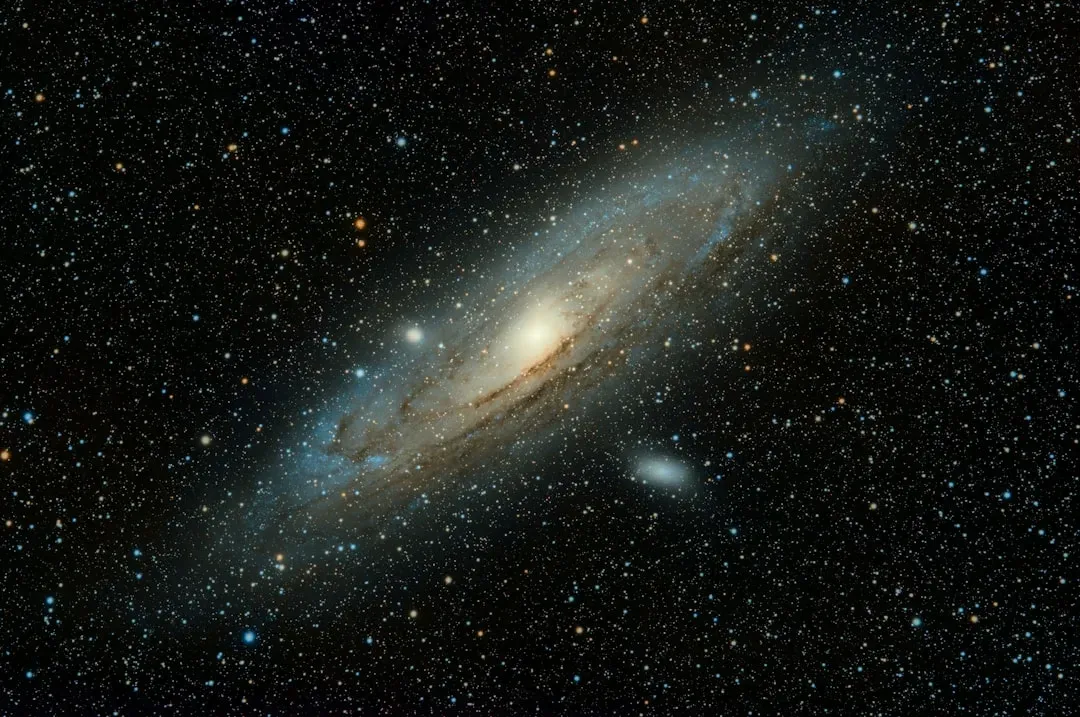
The easiest way to picture a holographic universe is to think about a regular hologram, like the ones on credit cards or fancy stickers. The image looks three‑dimensional, but all the information that creates that 3D image is stored on a flat, two‑dimensional surface. The holographic universe theory suggests something similar about reality: the three‑dimensional (plus time) world we move around in might emerge from information stored on a distant, lower‑dimensional boundary of the universe.
In this view, you and I are not “fake,” but the most fundamental description of us isn’t in the space we see around us. Instead, the raw data of reality would live on a kind of cosmic screen, and our familiar 3D world would be like a projection or a decoding of that deeper information. That sounds philosophical, but it’s actually a precise mathematical idea about how gravity, quantum fields, and geometry might all be different faces of the same underlying information. Rather than being a metaphor, “projection” here means an exact relationship between a higher‑dimensional world and a lower‑dimensional description.
How Black Holes Sparked the Hologram Idea
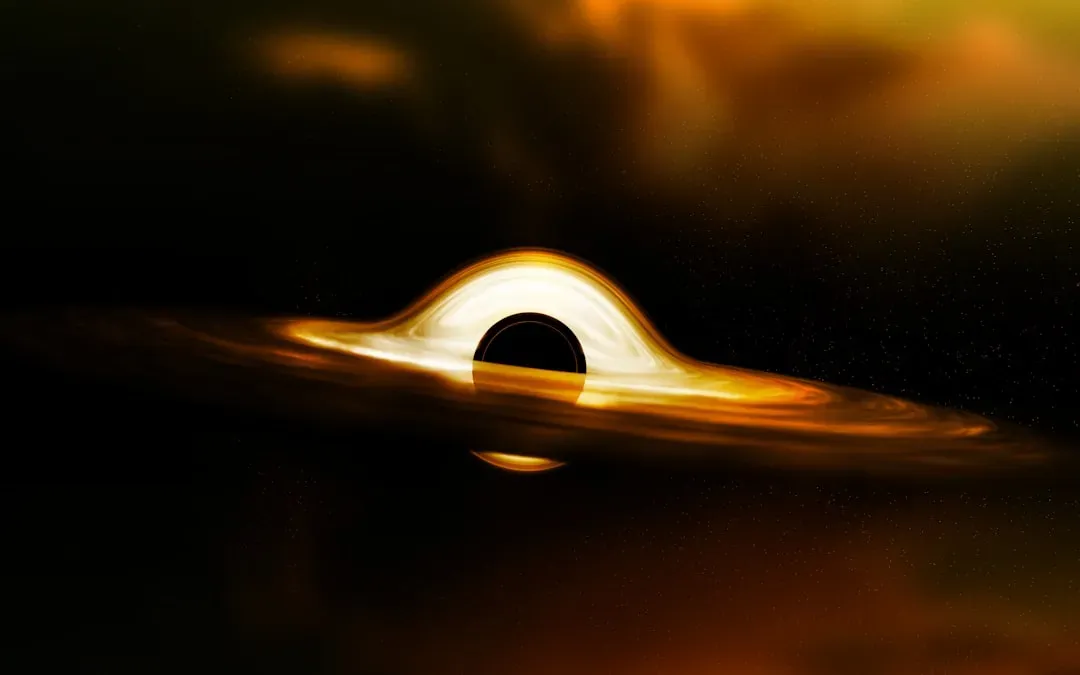
The holographic universe theory grew out of something surprisingly practical: trying to understand black holes. Physicists discovered that the amount of information, or entropy, inside a black hole doesn’t scale with its volume like you’d expect, but with the area of its event horizon. In simpler terms, a black hole seems to “store” information like a 2D surface, not a 3D object, which was utterly shocking when this idea first took hold.
This led to what’s called the holographic principle: the idea that the maximum amount of information in any region of space is proportional to the surface area of its boundary, not the volume inside. If that’s true for black holes, the argument goes, maybe it’s true for the entire universe. That’s the step where things jump from a weird feature of black holes to a sweeping possibility about reality itself: maybe everything we experience inside the cosmos is encoded on some faraway cosmic boundary, the way the interior of a black hole is encoded on its surface.
The AdS/CFT Breakthrough: A Universe in an Equation
The holographic principle went from speculation to something more concrete in the late twentieth century with what’s called the AdS/CFT correspondence. In simple language, this is a precise mathematical duality between two kinds of theories: one that lives in a gravitational universe with extra dimensions, and another that lives on a lower‑dimensional boundary with no gravity, just quantum fields. The shocker is that both descriptions turn out to be exactly equivalent; every process in one can be translated into the other.
Even though the original version of this duality involves a very specific kind of universe (with a geometry called anti‑de Sitter space, not our expanding, accelerating universe), the conceptual punch is huge. It shows that a universe with gravity can, in principle, be fully described by a theory with fewer dimensions and no gravity on its boundary. That’s about as close as physics has come to a working example of a holographic universe, and it’s why many physicists see holography not as a fringe idea, but as a serious candidate for how nature really works, at least in some regimes.
Why Physicists Take the Holographic Principle Seriously

This theory isn’t popular just because it sounds cool; it seems to solve problems that have haunted physics for decades. One of the biggest is the clash between quantum mechanics and general relativity, especially in extreme situations like near black holes. Holography offers a way to keep both sets of rules by shifting the point of view: gravity emerges from more fundamental quantum information living on a boundary, instead of having to be quantized in the usual way.
Another reason it’s taken seriously is that holographic models have actually produced useful calculations, especially for strongly interacting quantum systems that are otherwise impossible to handle. Physicists have used holographic tools to model exotic states of matter, quark‑gluon plasmas, and even aspects of condensed matter systems. It’s as if this wild‑sounding idea secretly doubles as a Swiss army knife for nasty, real‑world problems in physics, which is a strong hint that there’s something real under the hood.
Is Our Universe Really a Cosmic Projection?
Here’s where it gets tricky: we don’t yet know if the holographic principle applies to our actual universe, with its accelerating expansion and dark energy. The cleanest mathematical examples of holography work in universes that are not quite like ours, and extending those ideas to a realistic cosmology is still very much an open problem. So, claiming with confidence that “we live in a hologram” is jumping several steps ahead of the evidence.
However, there are serious efforts to build holographic models of universes more like our own, and to see if features like dark energy or cosmic inflation can be described from a boundary perspective. Some researchers think that the structure of cosmic microwave background fluctuations, the large‑scale web of galaxies, or even subtle patterns in gravitational waves could someday hint at a holographic origin. We’re not there yet, but the possibility that our entire cosmic history might have a dual description on a lower‑dimensional surface is not dismissed as fantasy in expert circles; it’s considered a hard, technical question still on the table.
Holograms vs. Simulation: Not the Same Thing
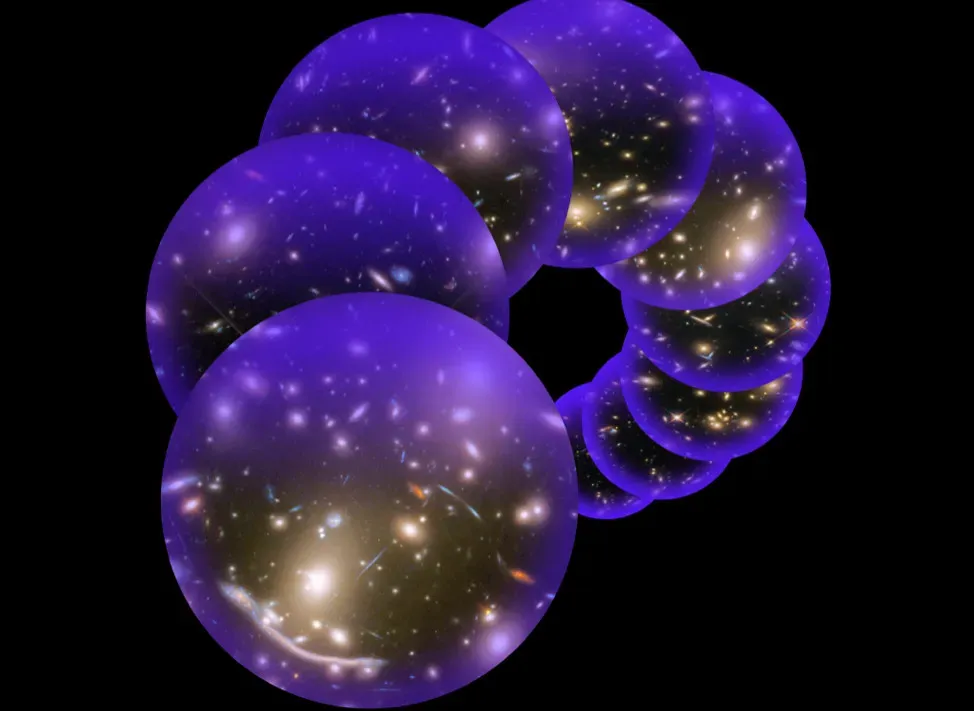
People often mash the holographic universe together with the idea that we live in a computer simulation, but they’re very different claims. The simulation hypothesis says some advanced civilization programmed our universe on a machine; the holographic principle says reality might be encoded on a boundary in a different number of dimensions, following the same physical laws, not running on someone’s laptop. One is a technological scenario; the other is a structural feature of nature.
If the universe is holographic, that doesn’t automatically mean there’s a “coder” or a “player” outside it. It just means that what we think of as the deepest level of reality – particles in space, fields, gravity – might itself be an emergent description of something more fundamental, like how temperature and pressure emerge from atoms bouncing around. That’s unsettling enough on its own, without dragging in cosmic gamers or sci‑fi storylines, and it forces us to rethink what we even mean by “real” in a much more subtle way.
What It Means for Consciousness, Free Will, and “You”

If reality is holographic, does that make you less real? From the inside, not really. Your experiences, your memories, your choices – they all arise from physical processes, whether those processes are most fundamentally described in three dimensions, two dimensions, or in some abstract space of information. A shadow still has a shape; the fact it comes from a projection doesn’t make the shape meaningless to the shadow itself, and in a similar way, our lived experience doesn’t vanish just because the underlying description might be different than we expected.
Personally, I find the idea strangely liberating rather than dehumanizing. If everything is ultimately information, then you are a very complex and unique pattern of that information, unfolding across time. Whether that pattern is written in the bulk of the universe or on a distant boundary doesn’t change the reality of your feelings, your relationships, or your responsibility for your choices. It just means that our old picture of “solid stuff in solid space” might be as incomplete as medieval maps of the world before we knew what a globe really looked like.
Where the Holographic Universe Theory Stands Today
Right now, the holographic universe theory sits in a fascinating middle zone: far from confirmed, but far too powerful and useful to ignore. It has reshaped how researchers think about black holes, quantum gravity, and the deep connections between information and spacetime. At the same time, there’s no decisive experimental proof that our actual cosmos is holographic, and turning the math into concrete, testable predictions remains a major challenge.
The honest answer is that the holographic universe is still a hypothesis, a bold and elegant one, that could either become a cornerstone of future physics or fade into a brilliant but incomplete idea. For now, it pushes us to ask better questions about what space, time, and matter really are, and reminds us that our everyday sense of reality might only be one layer of a much stranger structure. If the universe is a projection, the mystery isn’t whether it’s “fake,” but what deeper story is being projected in the first place.