
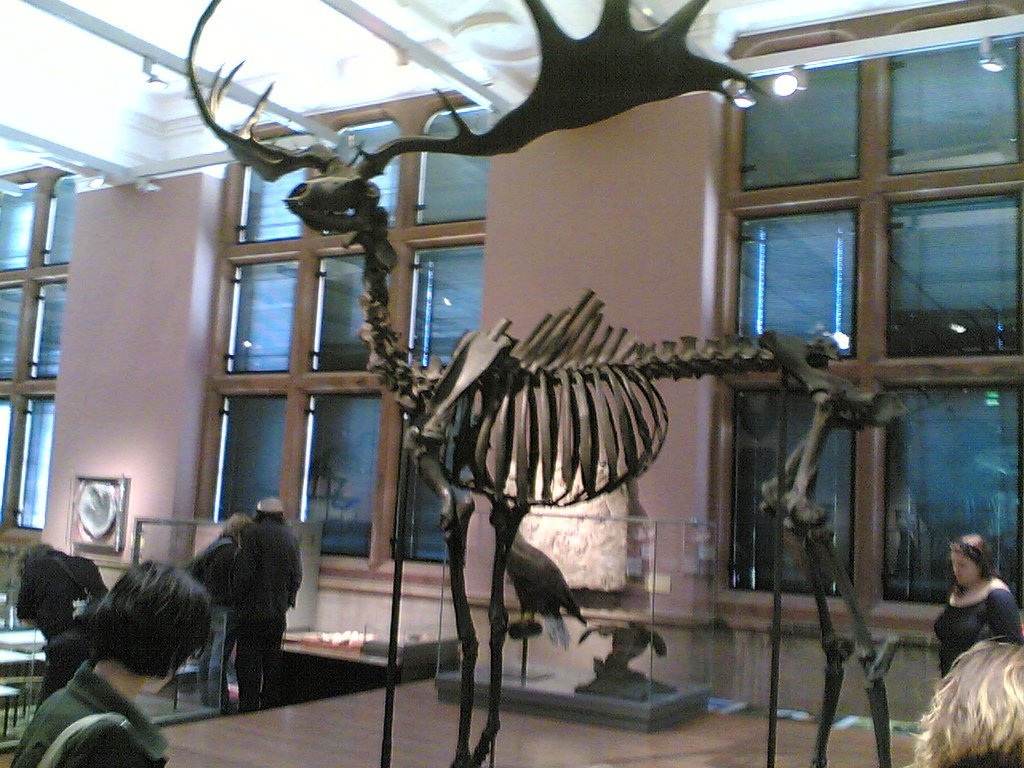

Imagine stepping out into the misty Irish lowlands over ten thousand years ago and seeing a creature so enormous and majestic that it seems almost unreal. Looming above the grasses stands the Giant Deer—also known as the Irish Elk—with antlers stretching a shocking seven feet across. It’s a scene that feels more like ancient myth than reality, yet not only did these animals exist, but their bones still lie hidden beneath Irish bogs and fields today. Let’s journey back in time and explore the fascinating story of the Giant Deer, from its staggering size to the mysteries of its extinction.
The World of the Giant Deer

The Ice Age was a time of colossal mammals: woolly mammoths, saber-toothed cats, and, of course, the Giant Deer. These massive creatures roamed across wide grasslands and forests that covered what is now Ireland and much of Eurasia. The landscape was harsh and cold, dotted with glacial lakes and thick patches of forest. Giant Deer thrived in this environment, grazing on the rich vegetation that grew after each long, bitter winter. Their presence shaped the local ecosystem, influencing plant growth and even the movement of other animals. Seeing a herd of these giants would have been an awe-inspiring, almost otherworldly experience.
Anatomy of a Titan

The Giant Deer was not just big—it was extraordinary. Standing nearly seven feet tall at the shoulder and weighing up to 1,500 pounds, it dwarfed the modern red deer. But the real showstoppers were its antlers, which spread wider than the height of an average human. These antlers, made of solid bone, could weigh up to 90 pounds each. Their size wasn’t just for show; they were likely used in dramatic displays and fierce battles between males during mating season. Imagine two giants clashing in a thunderous contest, their antlers locking like the arms of ancient warriors.
Why Were the Antlers So Massive?

The sheer size of the Giant Deer’s antlers has puzzled scientists for centuries. Some believe they evolved as a result of sexual selection, where bigger antlers meant greater success in attracting mates. Males with the most impressive headgear would have stood out in the crowd, signaling strength and good health. Others suggest the antlers acted as a deterrent to predators or as tools for sparring. However, such enormous antlers also came at a cost—they required vast amounts of minerals and energy to grow, making life tough for these ancient deer, especially in lean seasons.
Life in Ice Age Ireland

During the last Ice Age, Ireland was a wild and dynamic place. Rolling grasslands, icy rivers, and patches of ancient woodland provided a patchwork of habitats. Giant Deer roamed in herds, browsing on shrubs and tall grasses. They shared their world with other megafauna like wild horses and woolly rhinoceroses. The changing climate meant the landscape was always in flux, with forests advancing and retreating in response to glacial cycles. For the Giant Deer, adaptation was key—they needed to move and feed efficiently to survive the unpredictable seasons.
From Bones to Bogs: Fossil Discoveries

Much of what we know about the Giant Deer comes from bones pulled out of Irish bogs, riverbeds, and caves. These natural time capsules preserved skeletons so perfectly that some antlers still bear the scars of ancient battles. The first scientific descriptions date back to the 17th century, when local farmers stumbled upon gigantic skulls while digging peat. Museums across Ireland and Europe proudly display these remains, their size leaving visitors speechless. Each fossil tells a story, piecing together a lost world one bone at a time.
How Did They Get So Big?

The Giant Deer’s gargantuan size was a result of evolution favoring the strongest and most impressive animals. In the open landscapes of ancient Ireland, size was a huge advantage—literally. Larger males could dominate rivals, protect resources, and attract more mates. Over time, natural selection amplified these traits, giving us the almost unbelievable dimensions we see in the fossil record. But being a giant also meant needing a giant’s share of food and space, which would eventually become a challenge as the environment changed.
Giant Deer and Early Humans

It’s a thrilling thought: did humans and Giant Deer ever cross paths in ancient Ireland? Archaeological evidence suggests they did. Stone tools and cut marks on deer bones hint that early hunter-gatherers may have hunted these massive animals for meat, hides, and antlers. Imagine the thrill—and danger—of tracking a creature that could easily weigh as much as a small car. The Giant Deer would have been both a prize and a peril, shaping the culture and stories of the people who lived alongside them.
The Mystery of Their Extinction

Why did the Giant Deer disappear? This question has sparked debate for generations. Some scientists blame the changing climate at the end of the Ice Age, which transformed open grasslands into dense forests where such large antlers became a hindrance. Others point to overhunting by humans, or a deadly combination of both. As their preferred habitats shrank and food grew scarce, the giants struggled to survive. Their extinction was not sudden but a slow fading—one that still holds lessons for us today about the delicate balance of nature.
What Did They Eat?

The Giant Deer were herbivores, feasting mostly on grasses, leaves, and shrubs. Their wide mouths and strong jaws allowed them to chew tough vegetation. In the spring and summer, the meadows of Ireland would have been a banquet, but winters were likely much harder. During lean times, they might have stripped bark from trees or browsed on twigs. The demands of growing those enormous antlers meant they needed a steady supply of calcium and minerals, making them especially vulnerable when food was scarce.
A Case of Antler Overload?

Could the Giant Deer have evolved itself into a corner? Some researchers argue that their antlers became so large that they were more of a burden than a benefit. In denser forests, moving with such wide antlers would be like trying to run through a crowded subway car while holding a ladder sideways. This “antler overload” hypothesis suggests that natural selection may have pushed the species to an unsustainable extreme—one that couldn’t keep up with a changing world.
The Science of Fossil Reconstruction

Reconstructing the life of the Giant Deer is like putting together a thousand-piece jigsaw puzzle with half the pieces missing. Paleontologists use careful measurements and comparisons with modern deer to estimate how these giants looked, moved, and behaved. Computer models can simulate how antlers grew, how much they weighed, and how the animals might have used them. Each new fossil find adds another piece to the puzzle, revealing details about their muscles, movement, and even the diseases they suffered.
Genetic Clues from the Past

In recent years, scientists have begun to extract DNA from Giant Deer bones, offering tantalizing glimpses into their genetics. These analyses reveal how closely related they were to modern deer species, and how they may have adapted to the Ice Age environment. The genetic evidence helps confirm what bones alone can’t always show: the story of migration, adaptation, and eventual decline. It also raises questions about what made the Giant Deer so unique—and why they vanished while their smaller relatives survived.
The Irish Elk: A Name with a Twist

Despite being called the “Irish Elk,” these giants were neither true elk nor exclusive to Ireland. The name comes from old scientific confusion and the abundance of fossils found in Irish bogs. In reality, Megaloceros giganteus ranged from Ireland to Siberia, adapting to a variety of climates and habitats. The “elk” part stuck, even though the animal is more closely related to modern fallow deer. This mix-up is a reminder that science, like history, is always evolving.
Art and Myth: The Giant Deer in Culture

The Giant Deer has left a mark not just in the ground, but in the imagination. Ancient cave paintings from France to Russia show majestic stags with sprawling antlers, suggesting that early humans saw these animals as symbols of power and mystery. In Irish folklore, echoes of the Giant Deer linger in stories of enchanted stags and magical forests. Even today, their bones inspire awe and wonder—reminders of a time when giants roamed the earth.
Modern Relatives and Living Echoes

While the Giant Deer is long gone, its cousins still walk among us. The fallow deer, red deer, and moose all share some features with their ancient relative, though none match its sheer size. Watching a modern stag raise its antlers to the sky can feel like a faint echo of the past—an evolutionary memory passed down through the generations. These living deer remind us of what once was and what could be lost if we aren’t careful stewards of nature.
Lessons from Extinction

The fate of the Giant Deer holds important lessons for us today. It shows how vulnerable even the most powerful creatures can be when their environment changes too quickly. The combination of natural shifts and human pressure spelled the end for these giants—a pattern we see repeating with modern endangered species. Their story urges us to think about how we shape the world around us, and what we might lose if we don’t tread carefully.
The Ongoing Search for Answers

Despite centuries of research, the Giant Deer continues to surprise us. New fossil finds, genetic studies, and computer models keep adding layers to their story. Each discovery sparks fresh debates—about why they disappeared, how they lived, and what they can teach us about extinction and survival. The hunt for answers is far from over, and each new piece of evidence brings us closer to understanding these ancient giants.
Seeing the Giants Today

Though you’ll never see a living Giant Deer, their legacy is still visible across Ireland and beyond. Museums from Dublin to Moscow showcase their massive antlers and towering skulls, drawing crowds eager to glimpse a lost world. Some artists and scientists have even tried to reconstruct what these animals looked like in life, using sculpture and virtual reality. Standing in front of a Giant Deer display, you can almost feel the chill of the Ice Age wind and hear the distant thunder of hooves—a reminder that the past is never as far away as we think.
The Power and Fragility of Nature

The story of the Giant Deer is a testament to both the power and fragility of life. For thousands of years, these animals dominated their world, only to vanish when conditions changed. Their bones are relics of a time when nature could produce wonders beyond imagination—and a warning that such marvels can disappear in the blink of an eye. The awe they inspire is mixed with a sense of loss, urging us to cherish the incredible diversity of life that still surrounds us.
A Legacy Written in Bone

In the end, the Giant Deer’s most enduring legacy is written not in myths or paintings, but in the bones that lie beneath the Irish earth. Each antler, each skull, is a message from the past—a story of survival, splendor, and eventual loss. These ancient remains invite us to look back, to imagine a world more wild and strange than our own, and to remember that every creature, no matter how mighty, is part of a much larger story.


