
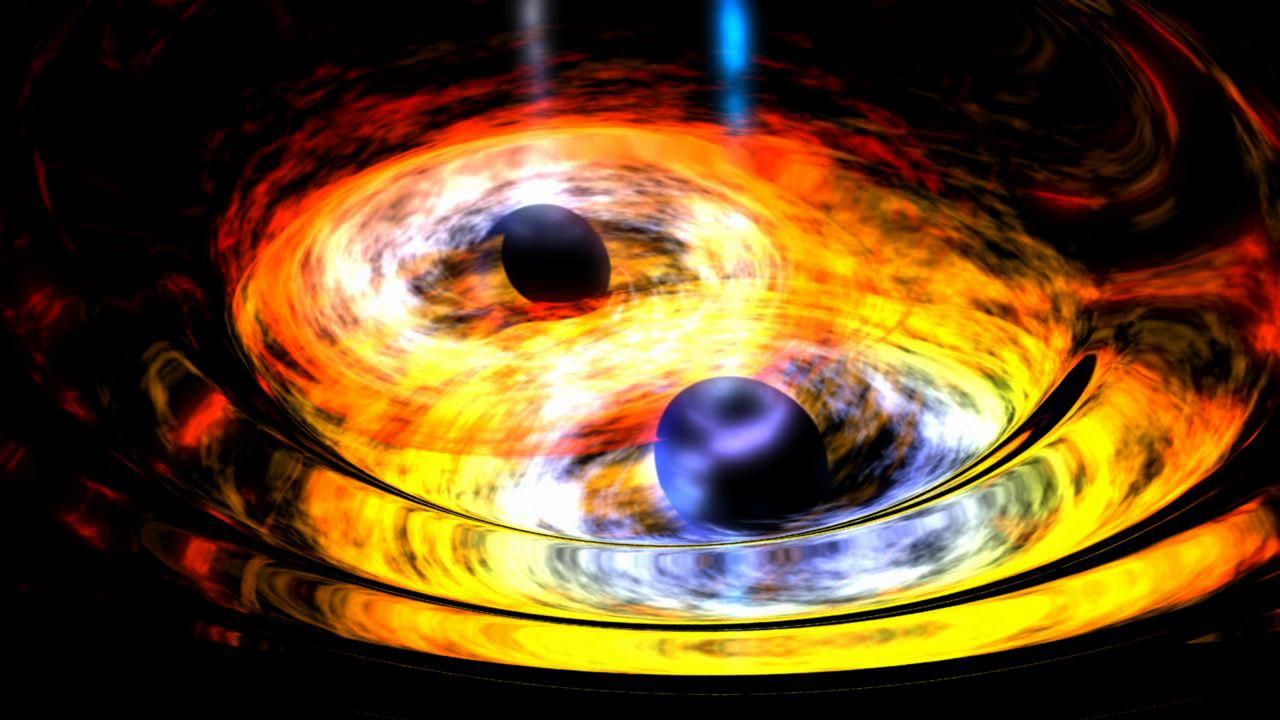
The Allure of the Event Horizon (Image Credits: Cdn.mos.cms.futurecdn.net)
Black holes continue to captivate astronomers and enthusiasts alike, drawing attention with their profound influence on our understanding of the universe.
The Allure of the Event Horizon
At the heart of black hole lore lies the event horizon, a boundary beyond which nothing – not even light – can escape. This invisible threshold defines the point of no return for anything drawn into a black hole’s grasp. Scientists have long puzzled over its properties, using theoretical models and observations to map its behavior.
Recent advancements in telescope technology have brought this concept into sharper focus. For instance, the Event Horizon Telescope collaboration released images in recent years that captured the shadows of supermassive black holes, offering visual clues to the event horizon’s scale. These efforts highlight how such boundaries challenge our grasp of space and time, pulling in matter with unrelenting force.
Exploring these ideas through interactive means, like word searches, makes the science more accessible. They encourage learners to identify and connect terms that form the foundation of black hole studies.
Essential Terms in Black Hole Vocabulary
Black holes encompass a rich lexicon of concepts that blend physics and astronomy. Familiarizing oneself with these words reveals the intricate mechanics at play in the cosmos.
One effective way to engage with this terminology is through puzzles that embed key phrases within a grid of letters. Such activities not only test recall but also deepen appreciation for the subject’s complexity.
- Singularity: The core of a black hole where density reaches infinity, compressing matter to an infinitesimal point.
- Accretion Disk: A swirling ring of gas and dust spiraling toward the event horizon, heating up and emitting radiation.
- Hawking Radiation: Theoretical particles emitted near the event horizon, suggesting black holes may slowly evaporate over time.
- Spaghettification: The stretching of objects due to intense tidal forces as they approach a black hole.
- Supermassive Black Hole: Gigantic versions at galaxy centers, millions or billions of times the sun’s mass.
- Gravitational Lensing: The bending of light around a black hole, creating distorted views of background stars.
These terms form the building blocks of discussions around black holes, from theoretical predictions to observational evidence.
Recent Insights Fueling Black Hole Fascination
Astronomers detected spacetime twisting around a spinning black hole in late 2025, confirming predictions from over a century ago. This observation, captured during a star’s destruction, showcased how rotation drags the fabric of reality itself.
Such discoveries underscore the dynamic nature of event horizons. Instruments like the James Webb Space Telescope have spotted rapidly growing supermassive black holes in the early universe, reshaping timelines for their formation. Meanwhile, analogue experiments in labs simulate event horizons using ultracold atoms, mimicking Hawking-like radiation in controlled settings.
These developments invite broader participation in astronomy. Puzzles incorporating 2025’s breakthroughs can bridge the gap between cutting-edge research and public curiosity, making abstract ideas tangible.
Why Puzzles Matter in Astronomy Education
Word searches serve as gateways to scientific literacy, particularly for complex topics like black holes. They transform dense information into playful challenges, reinforcing memory through repetition and discovery.
In an era of rapid astronomical progress, such tools democratize knowledge. Schools and online communities use them to spark interest, leading participants to explore deeper resources like telescope data releases.
By hunting for hidden words related to event horizons and singularities, individuals gain confidence in navigating astrophysical jargon. This approach has proven effective in engaging diverse audiences, from students to lifelong learners.
Key Takeaways
- Event horizons mark inescapable boundaries around black holes, central to modern astronomy.
- Interactive puzzles like word searches make learning black hole terms enjoyable and memorable.
- 2025 observations continue to reveal new layers of black hole behavior, advancing our cosmic knowledge.
Black holes remind us of the universe’s vast mysteries, where puzzles both literal and theoretical propel discovery forward. What black hole concept intrigues you most? Share your thoughts in the comments below.