
Somewhere beneath your feet, more than three thousand miles down, lies a world so extreme it defies imagination. Temperatures there rival the surface of the Sun. Pressures crush matter into forms that have no equivalent anywhere else on our planet. Yet this hidden realm is not dead or static. It is alive, shifting, spinning, and silently recording the entire history of our world.
Scientists are only just beginning to decode what that record says. From ancient magnetic signatures trapped in billion-year-old rocks to a core that appears to be spinning in reverse right now, Earth’s deepest interior is offering up revelations that are reshaping everything we thought we knew. Buckle up, because the story is far stranger than you’d expect. Let’s dive in.
A Planet Within a Planet: What the Earth’s Core Actually Is
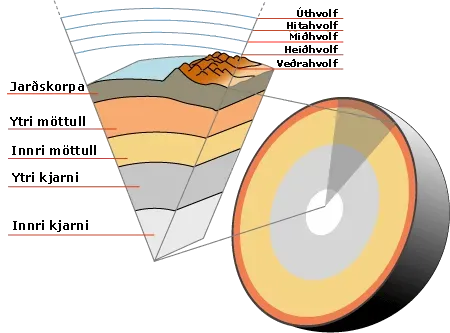
You probably learned in school that the Earth has layers, like a hard-boiled egg. But the real picture is much more dramatic than that simple analogy. The innermost layer is a hot, solid ball of metal with a radius of about 759 miles, surrounded by a liquid metal outer core. To put that in perspective, the whole core, split into inner and outer sections, has a diameter just shy of 7,000 kilometers. That makes Earth’s core marginally bigger than the entire planet Mars.
The Earth’s inner core is essentially a planet within a planet: a hot sphere with a mass of one hundred quintillion tons of iron and nickel that lies about 5,150 kilometers beneath our feet. Honest\y, when you try to picture that sitting silently below every city, every ocean, and every mountain range, it becomes almost impossible to wrap your head around. The inner core is believed to be composed of an iron-nickel alloy with some other elements, and the temperature at its surface is estimated to be approximately 5,700 Kelvin – roughly the temperature at the surface of the Sun.
Reading the Past Without Going There: How Scientists Study the Core
Here’s the thing: nobody has ever seen the Earth’s core. Nobody has drilled down to it or sent a probe to sample it. Direct observation of Earth’s core is impossible, and scientists typically study it by analyzing changes in the size and shape of seismic waves as they pass through the core. Think of it like trying to understand the inside of a sealed metal ball by listening to how sound bounces around inside it. That is essentially what seismologists do, just on a planetary scale.
Modern global seismology serves as an inverted telescope with which scientists can probe the Earth’s deepest shell. Each major earthquake sends ripples of energy threading through the entire planet, and those waves change character depending on what they pass through. The team’s analysis of seismic data collected from thousands of earthquakes unveiled the structure and behavior of Earth’s inner core. They discovered that the inner core’s inhomogeneity strengthens as one goes deeper toward the center of the Earth.
The Innermost Inner Core: A World Hidden Within a World
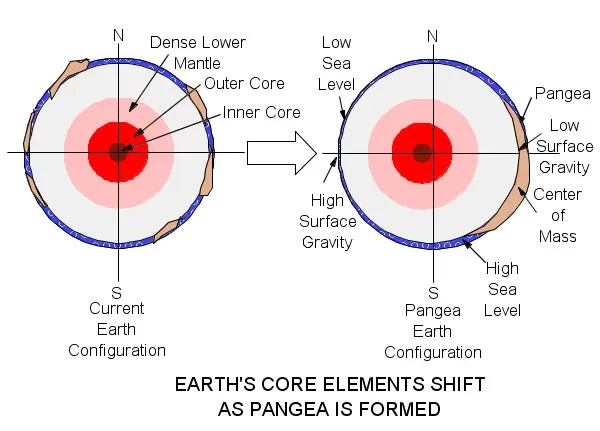
If you thought a solid iron ball the size of the Moon was surprising enough, scientists have now confirmed there is yet another layer buried inside that one. Not long ago it was thought Earth’s structure comprised four distinct layers: the crust, the mantle, the outer core and the inner core. Thanks to research by scientists at the Australian National University, we now know there is a fifth layer referred to as the innermost inner core. It is a discovery that took twenty years of searching to confirm.
By stacking seismic data and adding collections of seismic signals together into a single trace, researchers were able to amplify signals from several major seismic events. For the first time, they identified three-, four-, and five-fold seismic reverberations, which allowed a more detailed probe of the inner core than previously achieved. The different travel times of pairs of waves confirmed the presence of the innermost inner core, no wider than 650 kilometers across, made of dense iron. This structure could be the result of a fundamental change in the growth of the inner core at some point in Earth’s past.
The Core’s Wild Secret: It Is Spinning in Reverse Right Now
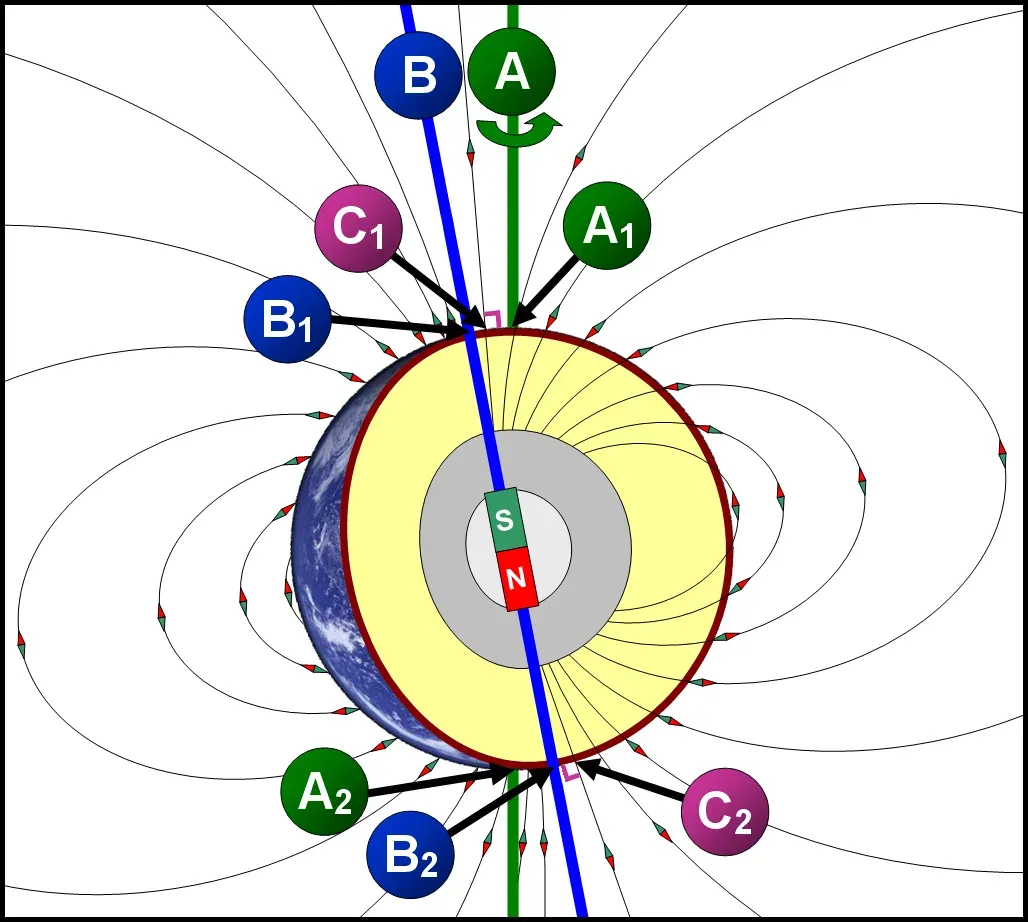
Of all the recent discoveries about Earth’s interior, this one might be the most jaw-dropping. Buried more than 3,000 miles beneath our feet, Earth’s solid inner core was once thought to be unchanging, locked in place at the heart of the planet. New research has revealed something much more dynamic. According to a study published in Nature Geoscience, Earth’s inner core has not only slowed down, it now appears to be rotating in reverse compared to the planet’s surface.
By tracking seismic waves from earthquakes that have passed through Earth’s inner core along similar paths since 1964, scientists found that the spin followed a roughly 70-year cycle. By the 1970s, the inner core was spinning a little faster than the planet. It slowed around 2008, and from 2008 to 2023 began moving slightly in reverse, relative to the mantle. This suggests that the inner core undergoes a cyclical pattern, oscillating approximately every 70 years, meaning the core last reversed its motion in the 1970s and could do so again in the future.
The Core and Earth’s Magnetic Field: The Shield That Makes Life Possible
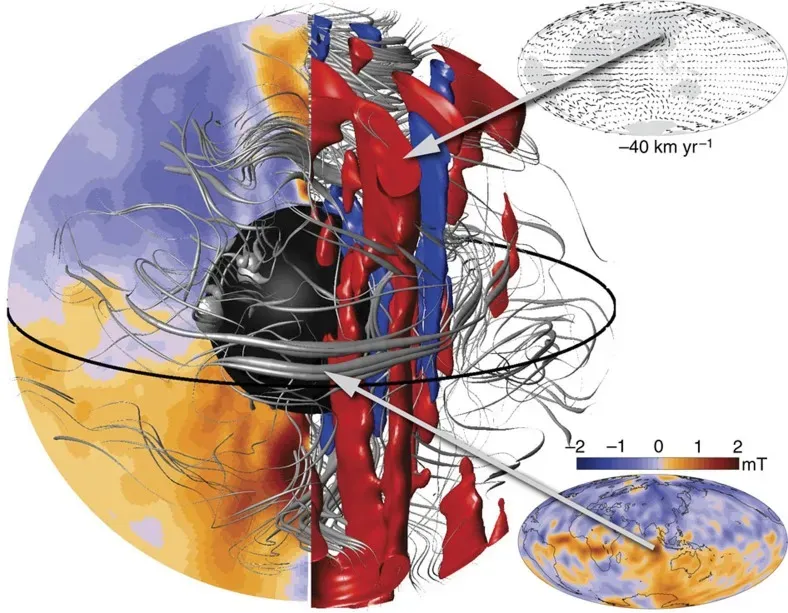
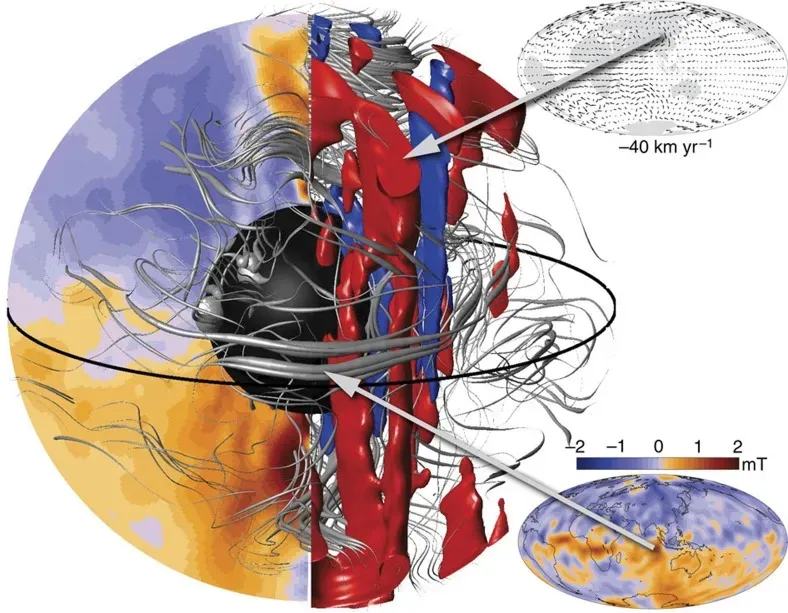
Think of the inner core as a time capsule: a fossilised record that takes us back into the deep past and tells us more about the planet’s evolution. Not only can the inner core enlighten us about events that happened on Earth hundreds of millions to billions of years ago, it is also an engine room integral to sustaining the planet’s magnetic field, which is what makes all life possible. Without the core, we would have no magnetic field. Without the magnetic field, Earth would look a lot like Mars.
Our magnetosphere shields us from erosion of our atmosphere by the solar wind, erosion and particle radiation from coronal mass ejections, and cosmic rays from deep space. Mars and Venus serve as sobering models for the harmful effects of solar wind on a planet without protection. Mars shows signs of having had water billions of years ago, but it is now a near-empty desert with a low-density atmosphere. Evidence from NASA spacecraft suggests that because Mars lacks a full protective magnetosphere, solar wind has eroded the planet’s atmosphere over time.
When the Core Was Born: The Magnetic Field’s Near-Death Experience
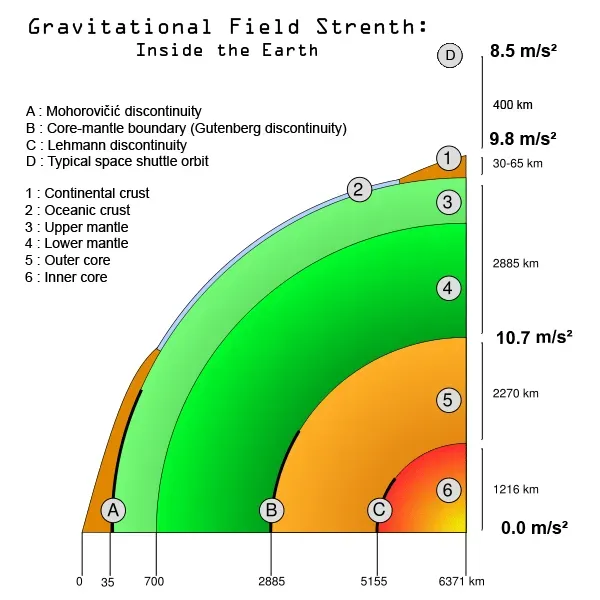
I think one of the most stunning stories in all of geology is the tale of how Earth’s inner core was born and how it may have saved life on this planet just in time. About 565 million years ago, Earth’s magnetic field dropped to just around ten percent of today’s strength. Then, almost miraculously, over the course of just a few tens of millions of years, it regained its strength – just in time for the sudden profusion of complex multicellular life known as the Cambrian explosion.
Increasingly, scientists believe it was the birth of Earth’s inner core – a sphere of solid iron that sits within the molten outer core, where churning metal generates the planet’s magnetic field. Once the inner core was born, possibly four billion years after the planet itself, its treelike growth accreting a few millimeters per year at its surface would have turbocharged motions in the outer core, reviving the faltering magnetic field and renewing the protective shield for life. It is hard to overstate how close things came to going very differently. The timing was, in a very real sense, miraculous.
What the Core Still Has Left to Tell Us
Even after all the breakthroughs of recent years, researchers are the first to admit that the core still holds more secrets than answers. In August 2024, researchers at the Australian National University discovered a large, doughnut-shaped region of the core parallel to Earth’s equator. Seismic waves travel through the region approximately two percent slower than in the rest of the core. The pair estimates that this area is just a few hundred kilometers thick. Nobody fully understands what is happening there.
Understanding inner core structure and dynamics, including energy exchange across the liquid core boundaries, helps Earth and planetary scientists to better understand planetary formation, the workings of Earth’s magnetic field, and the age of the inner core – the time capsule to understanding Earth’s past, present, and future. Developing new ways to study Earth’s innermost region can even help us learn more about other planets in our solar system. Every small seismic signal, every repeating earthquake, every laboratory simulation of impossible pressures is another page turned in a story that began four and a half billion years ago and is still being written right now.
Conclusion
The Earth’s core is not a cold, dead relic sitting frozen at the center of our world. It spins, it pulses, it shifts direction, and it quietly shapes the conditions that allow every living thing on this planet to exist. From its role in generating the magnetic shield that keeps our atmosphere intact to the ancient magnetic records it encodes in rock, the core is an extraordinary archive of planetary history that scientists are only beginning to unlock.
What makes this story so endlessly compelling is how much of it still lies just out of reach. For all the seismic data and diamond-anvil experiments and supercomputer simulations, the core remains genuinely mysterious. Every answer seems to open three new questions. That is not a failure of science – it is science working exactly as it should.
The planet beneath your feet is far more alive, more dynamic, and more surprising than most of us ever stop to consider. If the idea that something as ancient and enormous as the Earth’s core is still changing, still moving, still revealing new secrets right now does not fill you with a sense of wonder, honestly, I’m not sure what will. What do you think about it? Share your thoughts in the comments below.