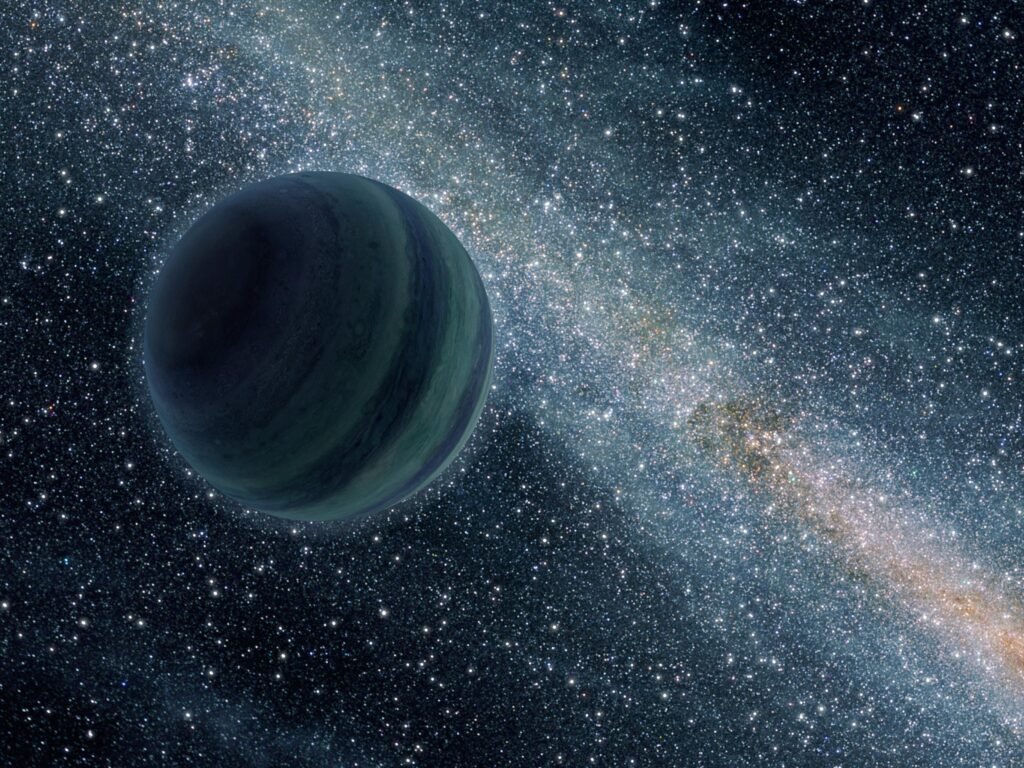

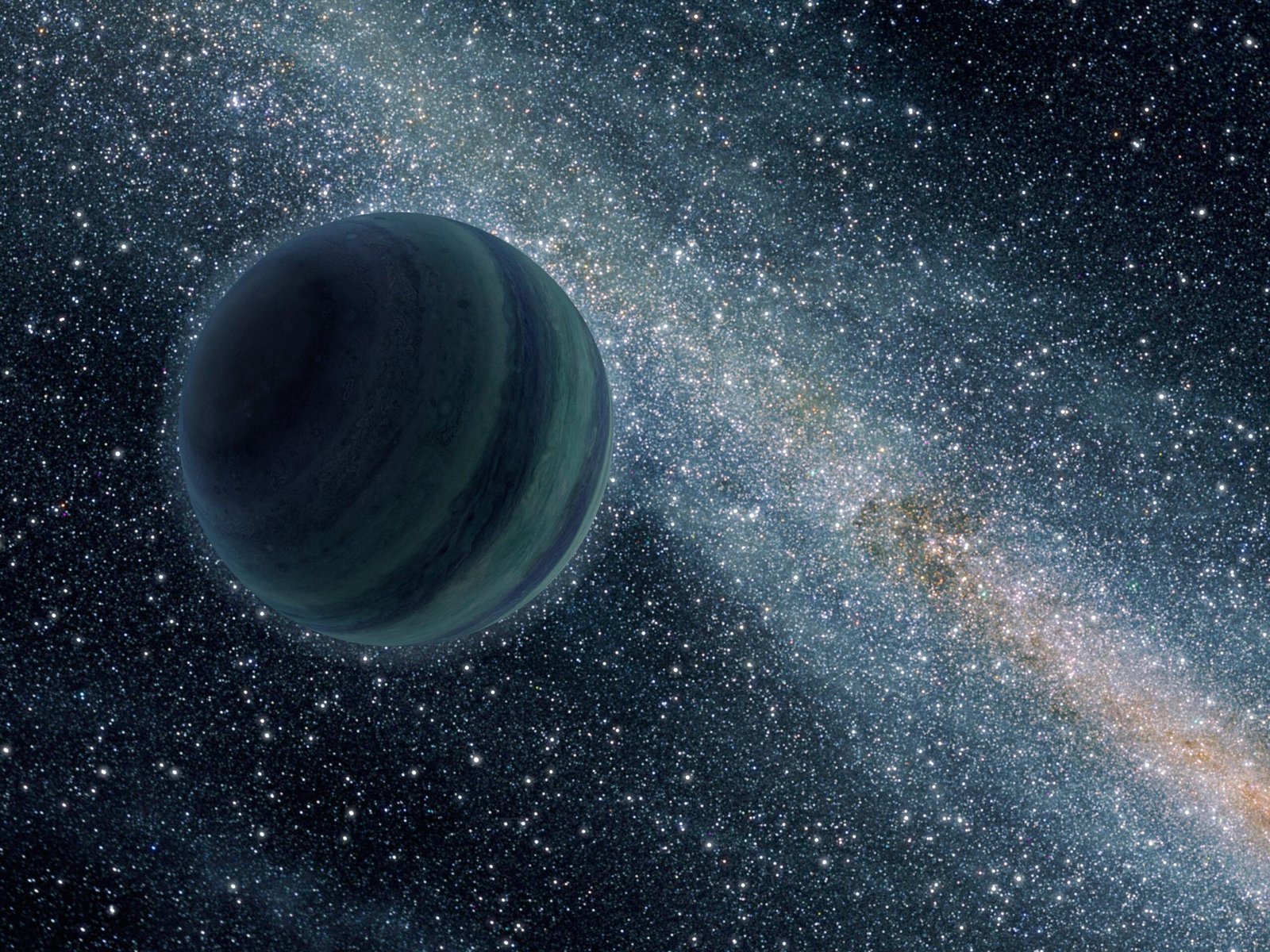
Rogue Planets: Nomads of the Cosmos (Image Credits: Upload.wikimedia.org)
Munich, Germany – Scientists at Ludwig Maximilian University announced findings that moons orbiting rogue planets might maintain habitable conditions far longer than previously thought. These planets, cast out from their stellar systems, wander the galaxy’s cold expanse without a sun’s warmth. Yet, a new study suggests their large moons could host liquid oceans and the chemistry for life, powered by internal heat and insulating atmospheres.
Rogue Planets: Nomads of the Cosmos
Rogue planets drift through interstellar space after ejection from their birth systems. Gravitational tugs during close stellar encounters or collisions with other planets often fling them free. Despite such violent upheavals, these worlds frequently retain their moons.
Post-ejection, the moons’ orbits shift dramatically. What once circled smoothly becomes highly elliptical, swinging from distant periastron to close perigee around the planet. This setup proved central to the research published February 24, 2026, in Monthly Notices of the Royal Astronomical Society.EarthSky
Hydrogen Atmospheres: The Key to Enduring Warmth
Primordial hydrogen atmospheres envelop these moons, acting as powerful greenhouses. Unlike carbon dioxide layers that condense and fail in frigid space, hydrogen remains stable indefinitely. This blanket traps internal heat, preventing rapid cooling.
The study modeled atmospheres on Earth-sized moons around Jupiter-like gas giants. Researchers found hydrogen sustains surface temperatures suitable for liquid water, even absent stellar radiation. Lead author David Dahlbüdding noted, “Our collaboration with the team of Professor Dieter Braun helped us recognize that the cradle of life does not necessarily require a sun.”
Tidal Forces Ignite Subsurface Life
Highly elliptical paths amplify tidal interactions. As moons approach their planet, gravitational squeezes deform rocky interiors, generating intense heat. This process mirrors volcanism on Jupiter’s moon Io and geysers on Saturn’s Enceladus.
Heating drives water cycles: evaporation from warm depths, condensation on cooler surfaces. Such wet-dry shifts concentrate organics, fostering complex molecules vital for biology. The team calculated these dynamics could persist for billions of years, outlasting many star-bound habitats.
Parallels to Earth’s Origins
Conditions evoke primordial Earth, where asteroid strikes released hydrogen-rich gases. Dahlbüdding highlighted this link: “We discovered a clear connection between these distant moons and the early Earth, where high concentrations of hydrogen through asteroid impacts could have created the conditions for life.”
Today, subsurface oceans on Enceladus hint at similar potential. Rogue moons extend this paradigm, suggesting life arises from planetary dynamics rather than sunlight alone.
Billions of Hidden Laboratories
Astronomers estimate billions of rogue planets populate the Milky Way, rivaling star-hosted ones. Each could host multiple moons primed for habitability. This vast reservoir expands astrobiology’s search space dramatically.
Key requirements for such worlds include:
- Large size, akin to Earth, to hold atmospheres.
- Gas giant primaries for strong tides.
- Primordial hydrogen envelopes.
- Elliptical orbits post-ejection.
- Internal volatiles for oceans.
| Atmosphere Type | Stability in Interstellar Cold | Greenhouse Potential |
|---|---|---|
| Hydrogen | Indefinite | Strong heat retention |
| Carbon Dioxide | Condenses quickly | Insufficient in void |
These factors position rogue moons as enduring cradles amid cosmic isolation.
Key Takeaways
- Hydrogen atmospheres and tidal heating enable starless habitability.
- Moons could mirror early Earth’s chemistry for billions of years.
- Billions of rogue planets imply countless potential life sites.
The discovery reframes habitability, proving life needs not orbit stars. As telescopes like the James Webb probe deeper, rogue systems emerge as prime targets. What secrets do these dark wanderers hold? Share your thoughts in the comments.