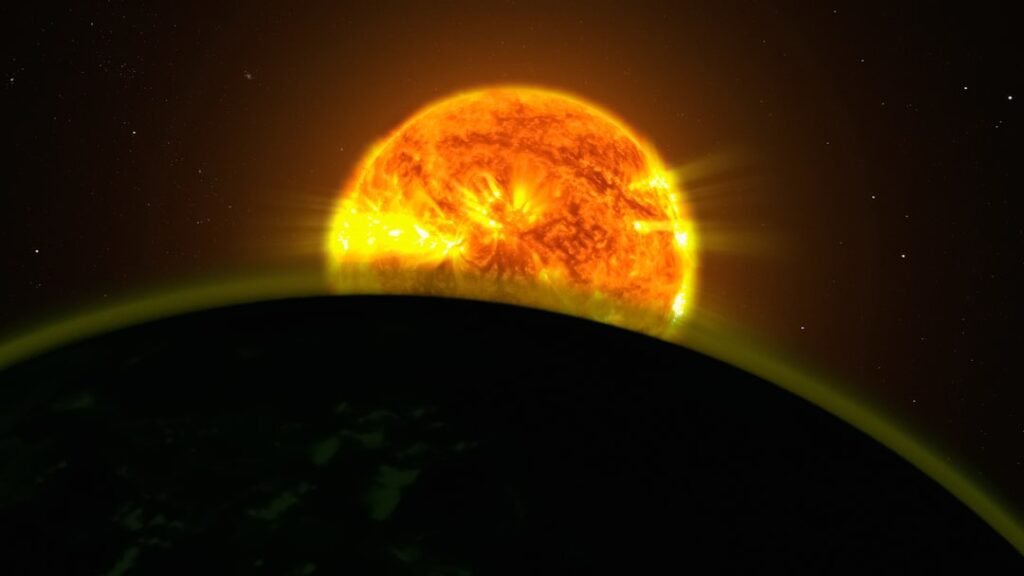


A Discovery That Stretches Imagination (Image Credits: Unsplash)
Astronomers have uncovered a peculiar exoplanet that challenges existing models of planetary formation, thanks to observations from NASA’s James Webb Space Telescope.
A Discovery That Stretches Imagination
The James Webb Space Telescope recently captured data on PSR J2322-2650b, a Jupiter-sized exoplanet locked in a tight orbit around a millisecond pulsar, a type of rapidly rotating neutron star. This finding emerged from detailed spectroscopic analysis, which revealed features never before documented in exoplanet atmospheres. The planet’s proximity to its host – merely about one million miles away – results in an orbital period of just 7.8 hours, subjecting it to extreme gravitational forces.
Researchers noted the planet’s unusual mass and structure during initial scans in late 2025. The pulsar’s intense radiation and stellar winds further complicate the system’s dynamics, eroding material from the planet’s surface over time. This environment represents one of the harshest known for planetary survival, yet PSR J2322-2650b endures, offering a glimpse into the resilience of worlds in pulsar systems.
Gravitational Distortion in Action
Gravitational tides from the pulsar have elongated PSR J2322-2650b into a distinctive lemon-like form, far from the spherical shapes typical of most planets. This deformation arises because the planet orbits so closely that the pulsar’s pull overwhelms its own structural integrity. Simulations suggest such tidal locking could lead to internal heating, potentially driving geological or atmospheric activity unseen elsewhere.
The neutron star, with a mass 1.4 times that of the Sun packed into a sphere roughly 11 kilometers across, amplifies these effects. Observations indicate the planet maintains a gaseous envelope despite the stresses, hinting at robust composition. This configuration marks PSR J2322-2650b as part of a rare “black widow” binary system, where the pulsar gradually strips away its companion’s outer layers.
An Atmosphere of Soot and Potential Diamonds
Spectroscopic data from the Webb telescope points to a helium- and carbon-dominated atmosphere, a stark departure from the hydrogen-rich envelopes common in gas giants. Carbon appears in forms suggesting soot-like particles and possibly condensing clouds that could form diamonds under high pressure. This carbon-rich profile implies the planet formed or evolved under conditions favoring heavy elements over lighter gases.
Scientists detected signatures of methane and carbon dioxide in trace amounts, but the dominance of carbon challenges theories of planetary accretion in such extreme locales. The atmosphere’s opacity, likely due to soot, obscures deeper layers and complicates further study. These findings build on prior Webb observations of exoplanets like WASP-39b, but PSR J2322-2650b stands out for its pulsar host and bizarre chemistry.
Key Features of This Enigmatic System
The system’s peculiarities extend beyond the planet itself, encompassing the pulsar’s behavior and the binary dynamics.
- Mass: Comparable to Jupiter, yet tidally deformed.
- Orbit: 7.8-hour period, at one million miles from the pulsar.
- Host Star: Millisecond pulsar, a spinning neutron star emitting radio pulses.
- Atmosphere: Rich in carbon and helium, with soot clouds and diamond potential.
- System Type: Black widow binary, prone to material ablation.
- Distance: Located thousands of light-years from Earth, in the Milky Way.
This list underscores how PSR J2322-2650b integrates multiple astrophysical extremes, from compact object physics to exotic planetary atmospheres.
Challenging Planetary Formation Models
The discovery prompts reevaluation of how planets form around neutron stars, environments once thought inhospitable to stable worlds. Traditional models predict hydrogen dominance in gas giants, but PSR J2322-2650b’s carbon-heavy makeup suggests alternative pathways, perhaps involving supernova remnants or recycled stellar material. Future observations could clarify whether such planets represent relics from the pulsar’s progenitor star.
Comparisons with other exoplanets observed by Webb, such as those in habitable zones with methane traces, highlight the diversity across cosmic scales. For more details on the observations, see the report from NASA Science.
Key Takeaways
- PSR J2322-2650b is the first confirmed exoplanet with a carbon-dominated atmosphere around a pulsar.
- Its lemon shape demonstrates extreme tidal forces in close orbits.
- The findings expand our understanding of planetary survival in high-radiation environments.
This extraordinary exoplanet reminds us that the universe harbors forms of life – or at least planetary existence – beyond our wildest expectations, pushing the boundaries of astronomical knowledge. What do you think about this cosmic oddity? Share your thoughts in the comments.