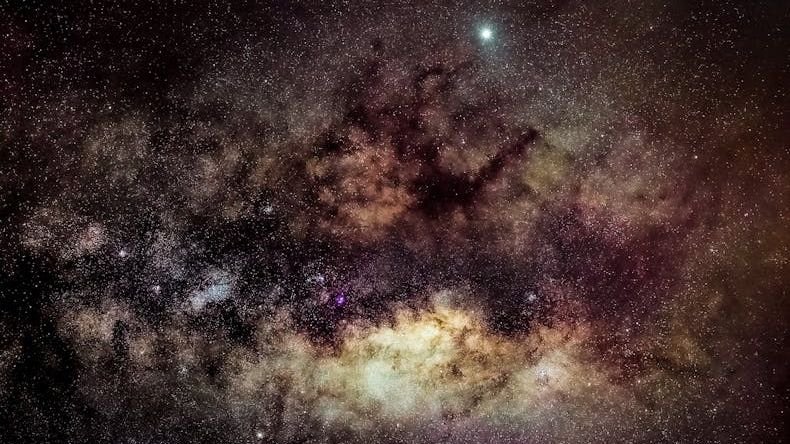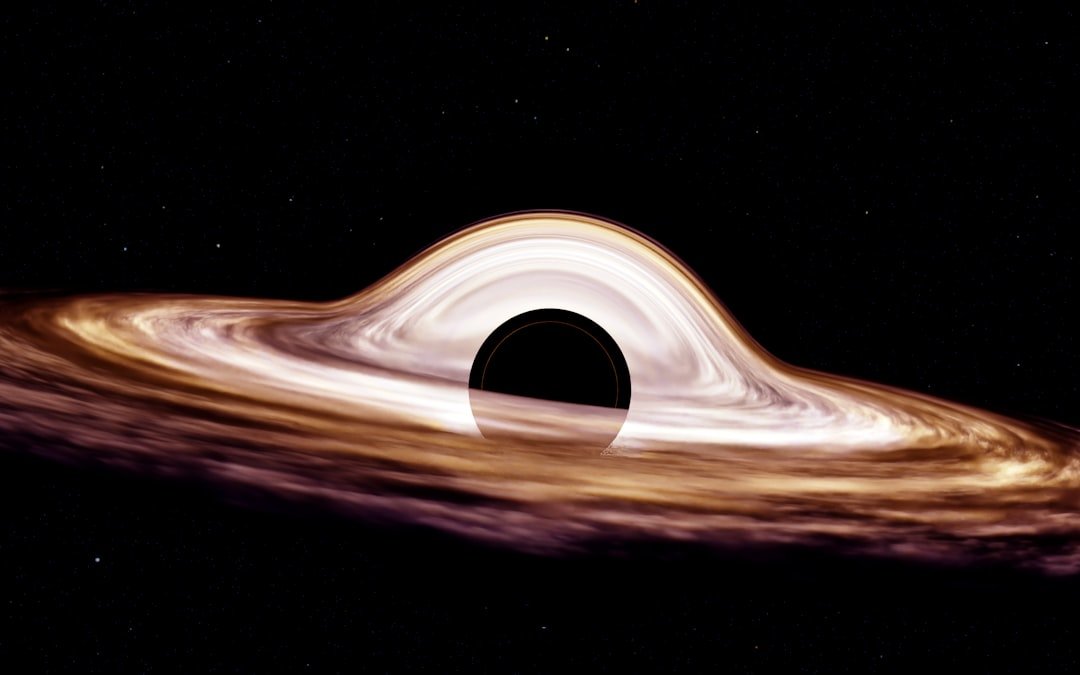
Astounding Speed Challenges Expectations (Image Credits: Unsplash)
Astronomers recently captured a rare cosmic event where a distant galaxy lost nearly all its brilliance in a remarkably short time. Located 10 billion light-years away, galaxy J0218-0036 saw its brightness drop to just one-twentieth of its previous level between 2002 and 2018.[1][2] This dramatic fade stemmed from its central supermassive black hole running critically low on fuel, marking one of the fastest such changes ever observed.
Astounding Speed Challenges Expectations
The galaxy’s core, known as an active galactic nucleus (AGN), typically varies in brightness by only about 30 percent.[1] Yet J0218-0036 plunged to five percent of its original glow over roughly 20 years – an observed period that equates to about seven years in the galaxy’s rest frame due to cosmic time dilation at redshift 1.8.[2] After accounting for the host galaxy’s steady light, the AGN itself faded by a factor of 50.
Researchers first noticed the discrepancy when comparing images from the Sloan Digital Sky Survey around 2002 with those from the Hyper Suprime-Cam on the Subaru Telescope in 2018.[3] The earlier image showed a brighter object, while the later one revealed a much fainter source amid deeper sky surveys. This rapid variability stunned the team, as standard models predicted changes over tens of thousands of years.
The Mechanics of Cosmic Hunger
Supermassive black holes, millions to billions of times the sun’s mass, power AGN by pulling in surrounding gas that forms a hot accretion disk.[1] Friction in this disk generates intense radiation, making the nucleus outshine entire galaxies. In J0218-0036, the black hole – estimated at hundreds of millions of solar masses – experienced a sudden drop in its gas supply.
The accretion rate plummeted to one-fiftieth of its prior level over those seven rest-frame years.[3] Tomoki Morokuma, principal staff scientist at Chiba Institute of Technology’s Astronomy Research Center and lead researcher, remarked, “It is fascinating that an active galactic nucleus can change its brightness so dramatically over such a short period of time, and that this fading appears to be caused by a large change in the accretion rate onto the supermassive black hole.”[2] Dust obscuration was ruled out, as the dimming spanned optical to infrared wavelengths.
Key Observations That Pieced It Together
The international team drew on multiple observatories to confirm the event. They analyzed archival data alongside new spectra to track the decline precisely.
- Sloan Digital Sky Survey (SDSS): Captured the galaxy’s brighter state around 2002.
- Hyper Suprime-Cam (HSC) on Subaru Telescope: Revealed the faded version in 2018, with higher sensitivity exposing surrounding faint objects.
- Gran Telescopio Canarias (GTC) and W. M. Keck Observatory: Provided optical and near-infrared spectra.
- Additional sources: Radio, X-ray, and infrared archives for multiwavelength coverage.
These efforts, detailed in a November 2025 paper in Publications of the Astronomical Society of Japan, matched observations against theoretical models of AGN behavior.[1] Toshihiro Kawaguchi of the University of Toyama noted, “This object shows rapid variability that cannot be explained by standard models. It provides an important test case for developing new theoretical models.”[1]
Rewriting the Rules of Black Hole Activity
This discovery upends assumptions about how supermassive black holes cycle through active and quiescent phases. Previous views held that fuel depletion occurred gradually, but J0218-0036 demonstrates shutdowns can happen swiftly – on decade-long human timescales.
Such events may influence galaxy evolution by halting the energy output that regulates star formation. The team anticipates wide-field surveys like HSC will uncover more examples, shedding light on black hole “on-off” switches. Morokuma emphasized the potential: “Using wide-field survey data, such as those from Hyper Suprime-Cam, we hope to discover more objects like this and learn how the activity of supermassive black holes shuts down and restarts.”[3]
Key Takeaways
- The galaxy dimmed 95% over 20 observed years, with the AGN fading even faster.
- Accretion rate dropped to 1/50th, confirming fuel starvation over seven rest-frame years.
- This rapid change challenges slow-evolution models and calls for new theories on AGN variability.
As telescopes grow more powerful, events like J0218-0036 remind us that the universe holds surprises on timescales we can witness. This fading galaxy underscores how quickly cosmic engines can stall, reshaping our understanding of the cosmos. What do you think caused the sudden gas cutoff? Tell us in the comments.